
Generative Engine Optimization (GEO) is reshaping how brands get discovered online in 2026. Customers now rely on AI-powered engines like ChatGPT, Google Gemini, Perplexity, and more to surface recommendations, compare businesses, and make decisions, often without viewing traditional search results.
For enterprise and multi-location brands, visibility in these generative engines depends on far more than keywords or backlinks. AI systems evaluate real-time signals from across the web, including customer reviews, sentiment, listing accuracy, brand authority, etc.
This guide highlights five GEO tools used in 2026 and explains how enterprise-grade platforms adapt to generative search at scale.
What is Generative Engine Optimization (GEO)?
Generative Engine Optimization (GEO) is the practice of structuring and refining content so AI-powered search engines, such as Google’s AI Overviews, ChatGPT, and Perplexity can clearly understand, trust, and cite it in their synthesized, answer-based results. While rooted in SEO, GEO shifts the focus from keyword rankings and backlinks to topical authority, factual accuracy, semantic clarity, and brand credibility that enable AI models to extract and summarize information directly.
What to look for in a GEO software
GEO software differ significantly from traditional SEO platforms. Instead of focusing only on rankings and traffic, they help brands influence how AI engines interpret and recommend businesses.
Strong GEO platforms support:
- Visibility tracking across generative AI engines
- Accurate, structured business data across directories and maps
- Review volume, sentiment, and response quality at scale
- Entity authority and citation consistency
- Enterprise workflows, permissions, and automation
Most tools address one or two of these areas. Very few support all of them in a unified system. For enterprise and multi-location brands, this creates gaps because generative engines evaluate businesses holistically, not in isolation. GEO platforms must connect visibility, data accuracy, reputation, and authority to influence how AI engines interpret and recommend brands.
The following section examines the top generative engine optimization tools in 2026 and how each approaches this challenge.
Top generative engine optimization tools for AI search in 2026
Enterprise brands need GEO tools that support AI-driven discovery while maintaining consistency across locations, platforms, and teams. The tools below address GEO in different ways, with varying levels of depth and enterprise readiness.
1. Birdeye Search AI
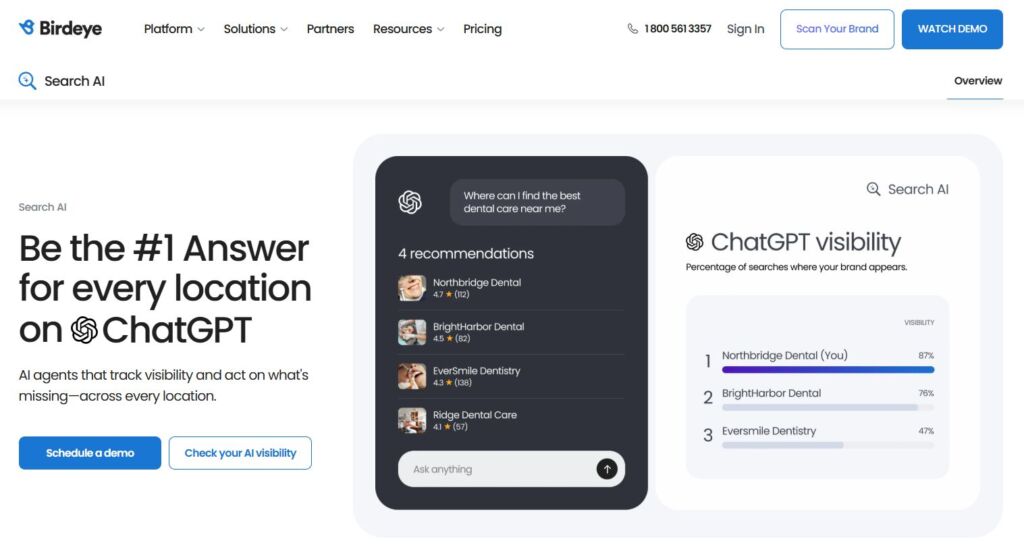
Birdeye Search AI tracks and improves how brands and locations appear across AI-powered discovery engines like ChatGPT, Google Gemini, and Perplexity, supported by more than 3,000 integrations across CRM, EHR/EMR, POS, PMS, and other enterprise systems.
Birdeye is an enterprise-grade, agentic marketing platform built for multi-location global brands that need centralized control over reputation, discovery, and customer engagement at scale. It brings together reviews, listings, AI-driven discovery, messaging, social engagement, and insights in a single system designed for distributed teams.
Powered by an agentic AI framework, Birdeye uses configurable AI agents to manage discovery and reputation workflows while enforcing brand standards and governance.
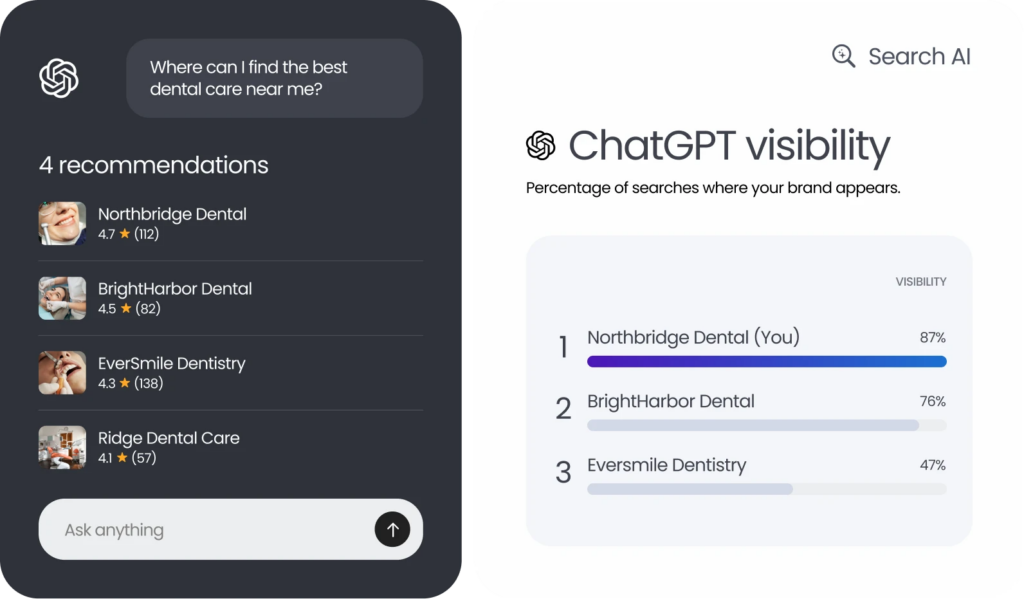
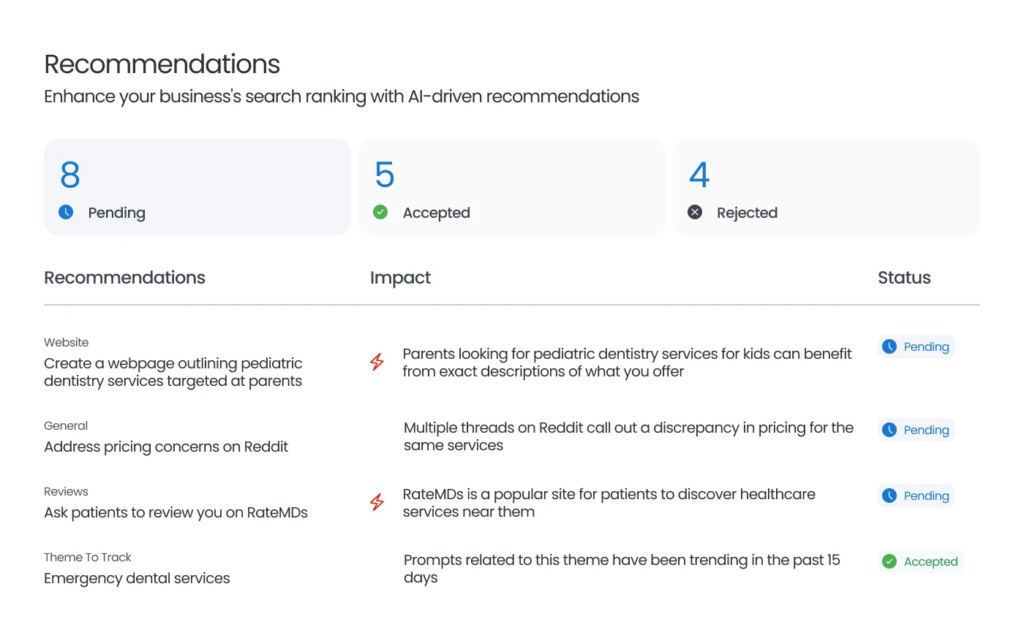
Core Search AI capabilities include:
- Prompt analysis: Understand the exact AI search queries users are asking by brand, service, and location.
- Visibility tracking: Benchmark where your brand shows up in generative answers against competitors on ChatGPT, Gemini, Perplexity, and more.
- Citation analysis: Identify which sources AI engines use most for your category and measure your citation share of voice.
- Accuracy audits: Detect whether business details fed to AI engines match trusted sources and flag gaps for correction.
- Sentiment and thematic insights: Monitor sentiment and message themes in the AI answers that mention your brand and competitors.
- Recommendations engine: Suggest prioritized actions based on visibility gaps, citation sources, sentiment, and data accuracy to improve inclusion in generative AI answers.
Birdeye’s agentic framework deploys specialized AI agents, such as Listings AI Agents, Reviews AI Agents, Insights AI, and Search Optimization Agents, to continuously strengthen the signals that generative engines rely on, from structured business data to fresh reviews and engagement insights.
Ratings/reviews
G2 rating: 4.7/5 with 3,700+ reviews
2. Otterly.ai

Otterly.AI approaches GEO as a generative search visibility tool. It helps teams monitor when and how content appears in AI-generated summaries, conversational results, and answer-based search experiences. While it provides insight into AI exposure and query behavior, it functions mainly as an observation and monitoring layer rather than a full GEO execution platform.
Key capabilities:
- Monitoring content visibility in AI-generated search results
- Tracking AI answer and summary presence across platforms
- Query and prompt-based insight into generative search performance
- Detecting shifts in AI result behavior and visibility
- Early-stage analysis of generative search exposure
Ratings/reviews
G2 rating: 4.9/5 with 39 reviews
3. Semrush

Semrush addresses GEO primarily through content and competitive intelligence. As generative search reshapes how users discover information, Semrush has expanded support for AI Overviews and conversational keyword research.
Key capabilities:
- AI Overview visibility tracking
- Topic clustering for conversational queries
- Competitive domain and keyword analysis
- Content optimization for semantic relevance
Semrush focuses on content performance rather than brand-level discovery signals. It does not track how AI engines cite brands, evaluate sentiment, or reconcile business data across locations. For enterprise teams, Semrush supports GEO research but not AI-driven discovery execution.
Ratings/reviews
G2 rating: 4.5/5 with 3,132 reviews
4. Peec AI
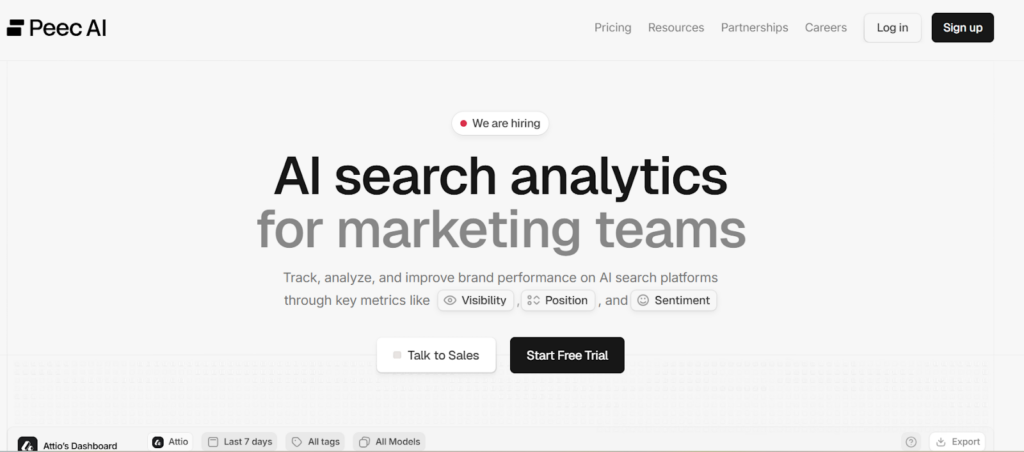
Peec AI approaches GEO by focusing on AI-powered content creation and optimization, helping teams generate content that is more likely to be surfaced in generative search results. It emphasizes improving topical relevance and content clarity to align with how AI engines interpret and summarize information. While Peec AI supports content production for GEO, it does not provide full visibility into AI citations or AI answer placement, making it more of a content execution tool than a comprehensive GEO platform.
Key capabilities:
- AI-generated content creation for web pages and blogs
- Topic clustering and content structure suggestions
- Semantic optimization to align content with AI query intent
- Content refinement for clarity, relevance, and depth
- Workflow support for scaling content production
Ratings/reviews
G2 rating: 5/5 with 2 reviews
5. Surfer SEO

Surfer SEO contributes to GEO by focusing on how AI models interpret written content. It helps marketers structure pages using semantic analysis and NLP to improve relevance for conversational queries.
Key capabilities:
- AI-driven content scoring
- Semantic keyword suggestions
- SERP-based content benchmarks
- Optimization for conversational search
Surfer SEO operates at the page level, not the brand or entity level. It does not track AI visibility, citations, reviews, or listings consistency. As a result, it supports content optimization within a GEO strategy but cannot manage enterprise discovery at scale.
Ratings/reviews
G2 rating: 4.8/5 with 537 reviews
These tools highlight the different ways GEO is being approached—from content analysis to visibility tracking. For enterprise brands, the key distinction is not which platforms observe generative search behavior, but which ones can actively influence how AI engines surface, cite, and recommend brands across locations at scale.
Conclusion
As generative engines take over how customers discover and compare brands, GEO tools are no longer just about analysis; they determine who gets recommended and why. While many platforms support pieces of the GEO puzzle, Birdeye Search AI stands out as the most complete solution in 2026, giving enterprise and multi-location brands the visibility, control, and execution needed to influence AI-driven discovery at scale rather than simply observe it.