
What Arizona finance teams should know
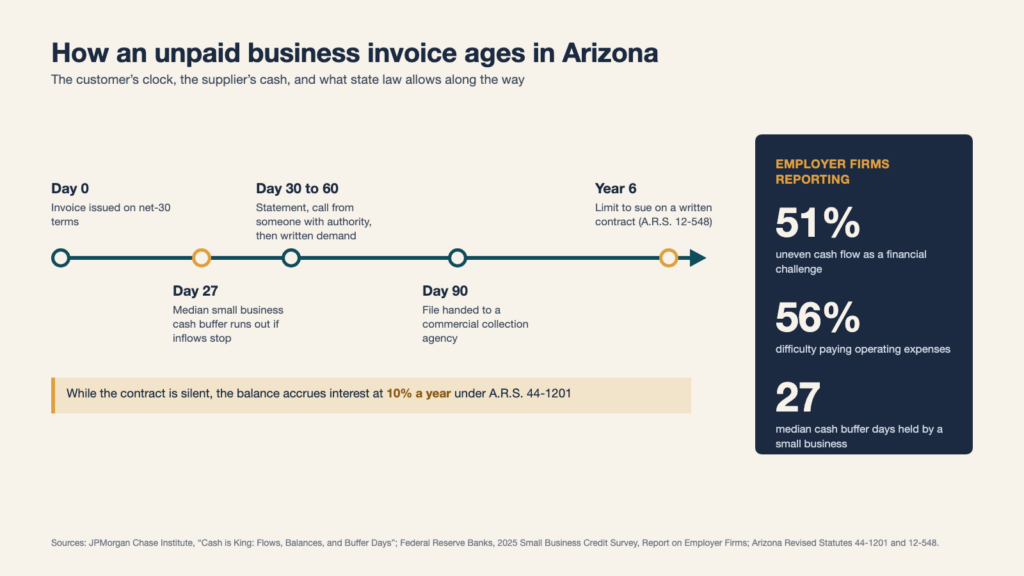
- The typical small business holds about 27 days of operating cash, so a customer who pays at day 90 is borrowing three cash cycles from its supplier.
- Business debt sits outside the federal consumer collection law, which gives a commercial creditor more room to act.
- Arizona sets a default interest rate of 10 percent a year when a contract is silent, and it gives creditors six years to sue on a written contract.
- Companies that recover the most money treat day 90 as a hard handoff point rather than as the cue for a fourth reminder email.
An invoice that reaches 90 days past due has usually stopped being a bookkeeping problem and become a financing decision. The customer is using its supplier’s working capital at no cost, while the supplier keeps paying its own vendors on schedule. Every week that passes lowers the odds that the balance is ever paid in full.
For companies in Arizona, the arithmetic is worse than it looks, because the median small business holds less than a month of operating cash. State law also spells out exactly what a creditor is entitled to collect, and knowing those numbers changes how a finance team runs its receivables. The same arithmetic decides when an account stops being worth chasing in-house and is more profitable when handled by a commercial collection agency.
Why a late invoice costs more than the balance owed
The JPMorgan Chase Institute studied the daily cash flows of 597,000 small businesses and found that the median firm holds 27 cash buffer days. That figure means a typical company could cover roughly four weeks of outflows if money stopped coming in tomorrow. A quarter of the businesses in that study held fewer than 13 days. Against that backdrop, a $40,000 invoice that slides from net 30 to day 90 has taken away two months of cash the supplier had every reason to count on.
The pressure hasn’t eased. In the Federal Reserve’s 2025 Small Business Credit Survey, 56 percent of employer firms said paying operating expenses was a financial challenge, and 51 percent pointed to uneven cash flow. Three-quarters cited rising costs of goods, services and wages. A company that is already stretching to make payroll cannot absorb a large customer paying three months late without drawing on a credit line or delaying its own payables.
That is where the real cost hides. Interest on the credit line, the controller’s hours spent chasing the account, and the management attention pulled away from selling all land on the supplier’s side of the ledger. None of it appears on the aging report, which is why a receivable that’s finally paid at day 120 still costs the company money it will never invoice for.
Business debt plays by different rules than consumer debt
Many Arizona executives assume that collecting from another company works the same way as collecting from a consumer, and that assumption leaves money on the table. The Fair Debt Collection Practices Act is the federal law most people picture when they think of collections. According to the Consumer Financial Protection Bureau, it covers debts that are primarily for personal, family or household purposes and does not cover business debts. A business-to-business balance is governed instead by the contract, by state law and by ordinary commercial practice.
Arizona’s rules are more generous to creditors than most owners realize. Under A.R.S. 44-1201, an unpaid obligation carries interest at 10 percent a year unless the parties agreed to a different rate in writing. A supplier whose contract never mentioned interest is therefore still entitled to charge it. Under A.R.S. 12-548, an action for debt on a written contract executed in the state can be brought within six years of the cause of action accruing, which gives a creditor far more runway than the customer’s silence suggests.
The state also regulates who may collect on a company’s behalf. Arizona requires anyone operating a collection agency to apply to the state for a license under Title 32 of the Revised Statutes, complete with a financial statement and a bond. A finance team should ask for those licensing details before handing over a single file.
How well-run companies escalate an overdue account
The companies that collect the highest share of what they bill share one habit, and it has little to do with aggression. They decide the escalation calendar before the first invoice goes out and then follow it without exception. A statement goes out at day 30, a phone call from someone with authority happens at day 45, and a written demand that cites the contract terms and the interest now accruing goes out at day 60. By day 75, the customer has received a final notice naming the date on which the account will leave the company’s hands.
At day 90 the file moves to a specialist. Many Arizona finance teams hand accounts at that stage to a commercial collection agency like Summit A*R, who has worked business-to-business receivables nationwide since 1996 and built their approach around preserving the customer relationship. Your internal team returns to running the business while a licensed expert pursues the balance. This also changes the customer’s calculus, because a demand from an agency signals that the supplier has stopped treating the debt as a relationship issue and started treating it as a legal one.
What the escalation calendar prevents is drift. An account that receives a fourth polite reminder at day 110 is teaching the customer that the supplier’s deadlines are negotiable, and a customer who has learned that lesson once may start applying it to every future invoice.
What to settle before the next invoice goes out
Most of the leverage in a collection is created months before anything is overdue. A credit application for every new commercial account, including a personal guarantee when the customer is a closely held company, gives the creditor a second source of recovery if the business entity fails. A written interest rate and a late fee in the terms of sale mean the supplier is never limited to Arizona’s statutory default. A defined dispute window in the contract stops a customer from raising a quality complaint for the first time at day 88.
Invoicing on delivery rather than at month-end shortens the clock, and requiring a purchase order number on every invoice removes the most common excuse for a payment being held in a customer’s accounts payable queue. None of these steps is expensive, and together they decide whether a finance team spends its autumn collecting revenue it already earned or booking new business, and a collection an Arizona company never has to start costs it nothing at all.
Frequently asked questions
Can an Arizona business charge interest on an overdue invoice?
An Arizona business can charge interest on an overdue invoice even when its terms of sale never mentioned it. Under A.R.S. 44-1201, an unpaid obligation carries interest at 10 percent a year unless the contract sets a different rate in writing.
How long does a company have to sue over an unpaid invoice in Arizona?
An action for debt on a written contract executed in Arizona can be brought within six years under A.R.S. 12-548. Shorter periods apply to some other claims, so a creditor holding an older account should confirm the timeline with counsel.
Does the Fair Debt Collection Practices Act limit how one business collects from another?
The federal act does not apply to business debts, because it covers debts for personal, family and household purposes. Arizona still licenses collection agencies, and the underlying contract still governs what the creditor can recover.