When the container ship Ever Given ran aground in the Suez Canal in March 2021, it took six days to refloat. For those six days, one of the world’s busiest trade arteries was closed, vessels queued at both ends, and companies with no visible connection to Egyptian waterways discovered they had one. Analysts are still arguing about what it cost. What nobody argues about is the lesson: a single point of failure took out a route that most supply chains had quietly assumed would always be open.
Since then, “resilience” has become one of the most overused words in corporate strategy decks. Few industries, though, have had to build it into their operations as literally as defense logistics.
Military and defense supply chains don’t have the option of absorbing a delay and apologizing to customers later. A missed shipment can mean a grounded aircraft, a stalled vessel, or a mission that doesn’t happen on time. That pressure has forced defense logistics operators to solve resilience problems commercial supply chains are only now confronting at scale – and there’s a lot in that playbook worth borrowing.
Why Defense Logistics Offers a Different Model of Resilience
Commercial supply chains have spent recent years reacting to disruption: a pandemic, a war, a canal blockage, a chip shortage. Defense logistics is built around the assumption that disruption is the default condition, not the exception. Operations often run in unstable regions or locations with limited infrastructure – and failure isn’t measured in quarterly earnings, it’s measured in operational readiness.
That difference in stakes produces a difference in method. Where commercial supply chains have historically optimized for cost and speed, defense logistics optimizes for certainty first. Redundancy, contingency planning, and coordination all follow from that single reordering – and each one translates.
Redundancy Isn’t Waste – It’s Strategy
In most commercial supply chains, redundancy reads as inefficiency. Extra suppliers, extra inventory, and alternate routes all show up on a spreadsheet as cost. In defense logistics, the same redundancy is treated as core strategy rather than overhead: backup suppliers and pre-positioned stock are built into day-to-day operations from the start, not held in reserve for a crisis.
SCA Group, headed by S.C.A. – Shipping Consultants Associated Ltd., is one of the operators working this way, running a portfolio that spans military husbanding, fuel supply, catering and food supply, life support services, and aviation support across a global office network – the kind of spread that exists precisely so that no single node carries the whole operation.
The same logic governs how planning works. Defense logistics planning doesn’t begin with a forecast and treat deviations as exceptions. It begins with a range of scenarios and pre-negotiated fallback options. Commercial operators now stress-testing routes before they need them, or dual-sourcing critical components, are applying a version of the same discipline. The goal isn’t predicting the next disruption. It’s building a system that doesn’t need to predict it in order to keep working.
The lesson isn’t “carry more inventory.” It’s that redundancy should be priced in as insurance rather than written off as waste.
Coordination Across Many Moving Parts
The clearest lesson commercial supply chains can take from defense logistics is how much coordination, not just capacity, determines whether an operation holds up under pressure.
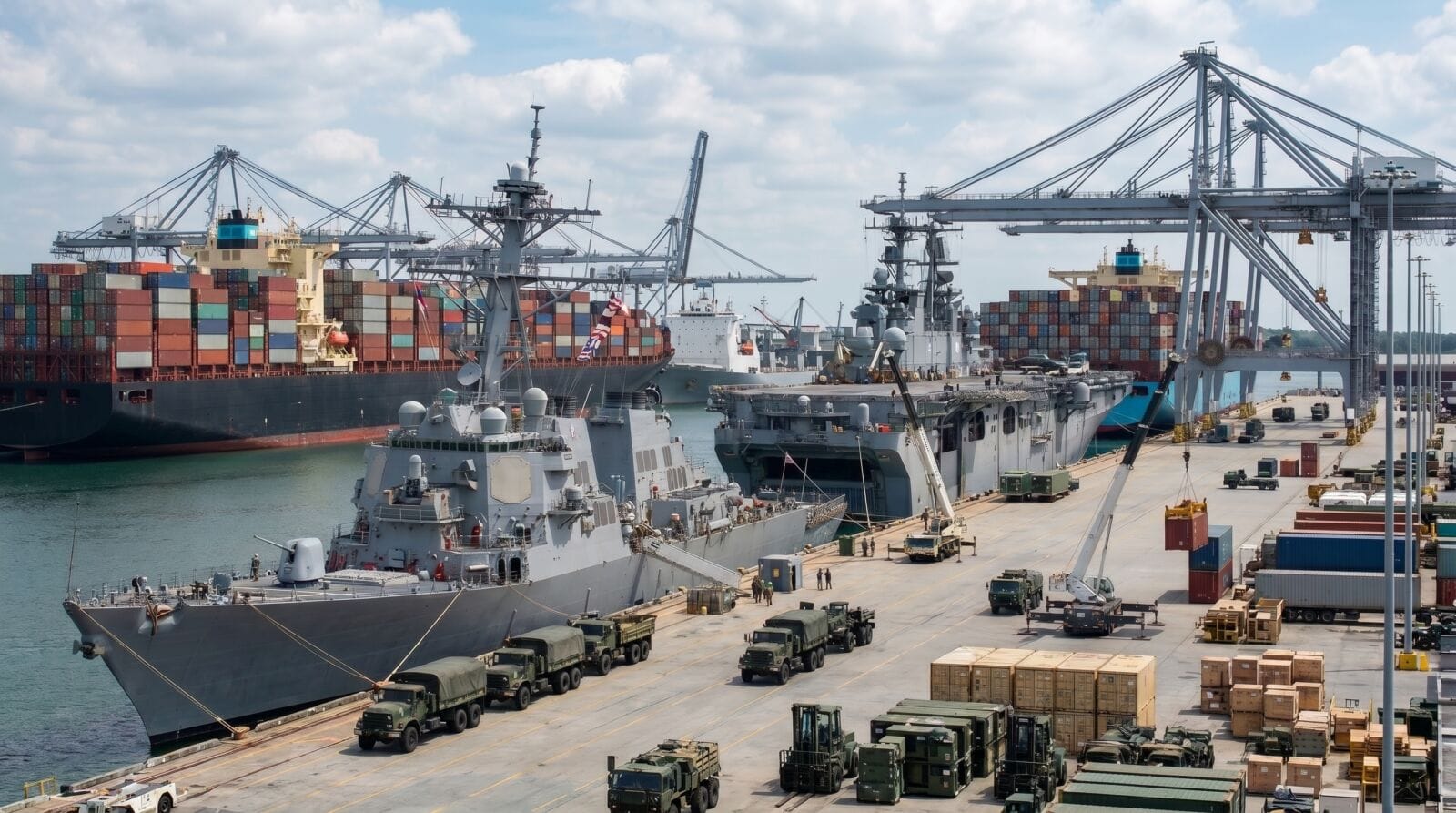
Consider a naval port call. Coordinated support for naval vessels during port calls can require fuel, provisions, transport, and local authority clearances to converge against a schedule with no slack in it. Any one of those arriving late makes the rest academic. The capacity is rarely the constraint. The sequencing is.
“In defense logistics, resilience isn’t something you activate when disruption hits,” said Michael J. Harrison, one of two Directors of Shipping Consultants Associated Ltd. “It has to be built into operational decisions long before disruption occurs.”
Commercial supply chains rarely face quite that level of time compression. But the underlying problem – coordinating suppliers, transport, and compliance requirements as a single system rather than a series of separate handoffs – is identical. Most companies only discover which handoff was load-bearing after it fails.
What Commercial Supply Chains Can Borrow
None of this requires a defense budget or a military contract to apply. Three takeaways translate directly:
- Price redundancy as insurance, not idle cost. Backup suppliers and buffer inventory on critical inputs are a hedge, not a line item to trim.
- Build contingency into regular operations. Planning that only exists for emergencies tends not to work during one.
- Manage coordination as one system. Vendor relationships that are only compared to each other after something breaks aren’t a supply chain – they’re a collection of contracts.
This integrated approach is central to SCA Group’s operating model. Under the leadership of Michael J. Harrison and Jacopo Landi, the company coordinates multiple logistics requirements rather than treating each service as an isolated function. In practice, that means bringing together the suppliers, local partners, transport, compliance, and operational support needed to keep an assignment moving when conditions change.
Resilience in defense logistics was never optional. It was the cost of doing the work at all. Commercial supply chains are now being priced on the same basis – by insurers, by procurement teams, and increasingly by customers who noticed which companies could still deliver in 2021, and which couldn’t. The operators who already treat disruption as a design assumption rather than an interruption have a working answer. The rest are still building one.