Every summer, Arizona tire shops run into the same wall. Pavement temperatures climb past anything the rest of the country deals with, sidewalls that were fine in March start letting go on the I-10, and the phone does not stop. Shop owners across the Valley describe the same pattern year after year. A slow spring, then eight to ten weeks where the bays are full from opening to close and the limiting factor is not customers or inventory, it is how fast the team can get wheels on and off machines.
That seasonal crunch is why equipment decisions in this market look different than they do in Portland or Pittsburgh. A shop in a mild climate buys for steady volume. A shop in Phoenix, Tucson or Yuma buys for the peak, because the peak is where the year is made or lost.
Why desert conditions push tire failure forward
Heat is the obvious factor, but it works in more than one way. Rubber compounds age faster at high temperature, so a tire in Arizona reaches the end of its useful life on the calendar well before it reaches it on the tread depth gauge. A set that would have another two years left in a cooler state can be dry cracking here at five years with plenty of tread showing.
Underinflation makes it worse. A tire running low flexes more in the sidewall, and flexing generates heat on top of the ambient load. On a 115 degree afternoon with asphalt considerably hotter than that, the margin between normal operating temperature and failure is thin. This is the mechanism behind the blowouts that close freeway lanes every July.
Then there is the monsoon season, which washes debris across roads that were clean an hour earlier, and construction traffic, which puts screws and staples everywhere. Add the sheer distances people drive in this state and the result is a repair and replacement volume that is genuinely higher per vehicle than the national picture.
The wheels coming through the door are not what they used to be
Ten or fifteen years ago, the typical passenger wheel was a 16 or 17 inch alloy with a reasonably tall sidewall and no electronics inside it. Today a shop sees 20 inch wheels on family crossovers, 22 inch wheels on trucks that never leave pavement, low profile sidewalls that fight back during mounting, run flat construction with stiff reinforced sidewalls, and a tire pressure sensor on nearly everything built after 2008.
That combination is unforgiving. Low profile and run flat tires need controlled bead pressure rather than force. Painted, polished and powder coated finishes scratch if a clamp or a mounting head touches them wrong, and the customer sees it in the parking lot. Sensors sit right where the old habit of levering a bead over the rim wants to put pressure. Every one of those is a damage claim waiting to happen, and in a market where reviews drive walk in traffic, a scratched 22 inch wheel is more expensive than it looks.
This is the real reason equipment matters more now than it did. The machine is no longer just a labor saver. It is what stands between a busy shop and a steady stream of small, avoidable payouts.
What separates one machine from another
Shop owners comparing one tire machine against another usually start with price and end up somewhere more useful once they work through what the differences actually do on the floor.
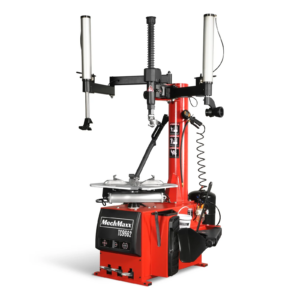
- Swing arm versus tilt back tower. Tilt back designs move the mounting head away from the wheel between operations, which speeds up the cycle and reduces contact with the rim face
- Rim clamp range. Check the stated minimum and maximum, because a machine rated to 22 inches externally may handle far less internally, and the specification that matters depends on how the wheel is held
- Bead breaker design and adjustability, since this is where most sidewall and rim damage originates
- Helper arms and bead press systems. On low profile and run flat work these turn a two person wrestling match into a one person job
- Leverless or touchless mounting heads, which remove the metal on metal contact that causes scratching
- Plastic or composite protection on clamps, heads and rollers, and how easily those wear parts are replaced
The helper arm question deserves its own note. Shops that skip it to save on the purchase usually find that the staff avoids the difficult wheels or takes shortcuts on them, and shortcuts are exactly what damages rims. Equipment that makes the correct method the easy method is equipment that changes behavior.
Throughput arithmetic during the busy months
The case for better equipment is easiest to see in seconds. Suppose a shop does 30 tires on an average summer day across two bays, and the right tire changing machine saves 90 seconds per tire compared to what is currently on the floor. That is 45 minutes a day recovered, which over a ten week peak is roughly 37 hours of bay time. Put a labor rate against that and add the jobs that fit into the recovered slots, and the payback period on the equipment gets short.
The same arithmetic runs in the other direction with damage. One replacement wheel on a late model truck can cost more than a year of maintenance on a good machine. Two of them in a season and the comparison is no longer close.
There is a staffing angle here too, and it is a real constraint in this market. Experienced technicians are hard to hire in Phoenix and Tucson, and harder to keep. A machine that lets a less experienced technician do a clean job on a difficult wheel widens the pool of people a shop can hire, which matters more than any single hour of saved time.
DEEPER DIVE: Here are Arizona’s Most Admired Companies of 2026
Practical checks before the purchase
- Power supply. Confirm whether the unit needs single phase or three phase, and what the shop panel actually provides before delivery day
- Compressed air. Check the required pressure and flow, because an undersized compressor will make a capable machine perform badly
- Floor space and swing clearance, including the room a technician needs to work around the machine with a truck wheel
- Anchoring requirements, since many machines need to be bolted to the slab
- Wear part availability and pricing for mounting heads, clamp covers and bead roller assemblies
- Service response time in Arizona specifically, because a machine down in July is not the same as a machine down in February
- Training included with the purchase, which pays for itself the first time a run flat comes through
Handling the sensor problem properly
Tire pressure sensors are the quiet source of comeback work. They sit at the valve, they are fragile, and a technician working quickly will eventually catch one. The fix is partly procedural and partly equipment based. Marking sensor position before demounting, setting the mounting head clearance correctly and using a machine that does not require force at the bead all reduce the failure rate. So does stocking service kits, because a customer who leaves with a warning light on will be back and it will not be a paid visit.
Shops that get this right make the sensor check part of the written inspection and tell the customer about a weak sensor battery before it fails. That turns a liability into a sale.
The business picture
Arizona added population faster than almost any state in the last decade, and most of that growth arrived with vehicles attached. Commute distances here are long, the road surface is hard on rubber, and the climate shortens tire life independent of mileage. The demand is not a cycle that is going to fade.
For shop owners, the question is not whether the work will be there in July. It is whether the shop is set up to take all of it. Equipment that adds throughput during the eight weeks that matter, and prevents the damage claims that eat into the margin on that work, is one of the few capital decisions in this business with a return you can actually measure.