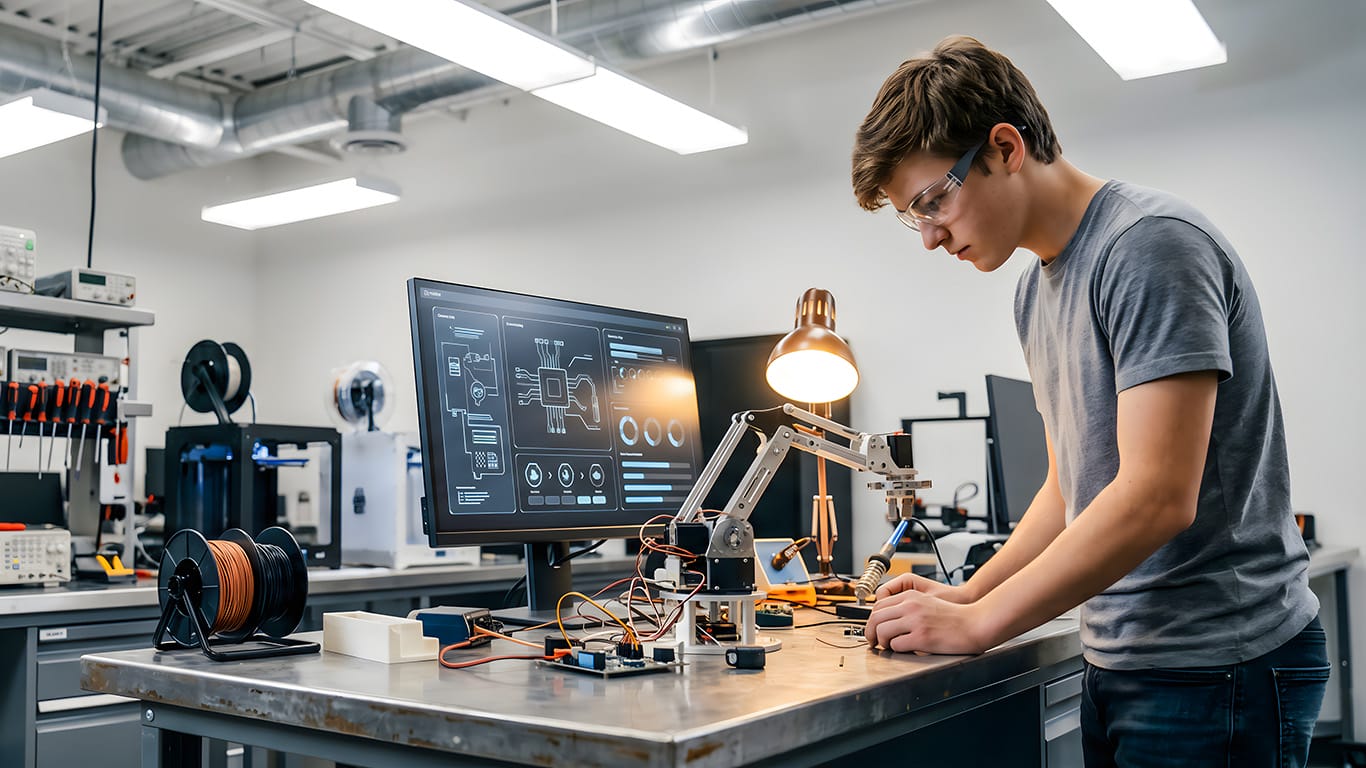
The image of a startup often begins with a laptop, a pitch deck and a small team. For many product-based businesses in Arizona, however, the more important starting point is a workshop. It is where an idea becomes a prototype and an entrepreneur discovers whether a product can actually be made.
That is why makerspaces are becoming increasingly relevant to Arizona’s entrepreneurial economy. Community workshops in Phoenix, Mesa, Tempe and other parts of the state give residents access to equipment, training and peer knowledge that would otherwise be difficult for an individual founder to afford. Their tools may include 3D printers, laser cutters, woodworking equipment, electronics benches, sewing machines and metalworking facilities.
The larger value of a makerspace is that it reduces the distance between having an idea and learning whether it deserves to become a business.
Lowering the Cost of Experimentation
Launching a physical product business usually requires spending money before earning any. A founder may need prototypes, fixtures, samples and packaging before approaching a customer or manufacturer. Outsourcing every early version can quickly consume a limited startup budget, especially when a design changes several times.
A makerspace changes that equation by allowing members to share access to equipment. Instead of purchasing a machine for one experiment, an entrepreneur can learn the process, make a prototype and revise it in the same environment. Early 3D printing projects can also teach practical lessons about scale, tolerances, material behavior and assembly before a founder attempts a commercial product.
Memberships, materials, training and failed prototypes still cost money. Yet the cost of being wrong is often lower when a business can test a concept in small increments rather than commit immediately to tooling or a large production order.
Turning Skills Into Business Opportunities
Makerspaces are not only equipment rental facilities. The strongest spaces create learning communities where people with different skills work near one another. A product designer may meet an electronics specialist. A woodworker may learn digital fabrication. A small-business owner may receive feedback from someone who has already solved a similar production problem.
This exchange matters because many first-time founders do not initially know which manufacturing questions to ask. They may have a promising design but no understanding of wall thickness, fastening methods, production time or material costs. Classes and informal conversations can expose these issues before they become expensive.
Accessible tools also allow people to enter entrepreneurship gradually. Someone exploring 3D printers for beginners may begin with organizers or replacement parts, then progress to custom fixtures or small-run consumer goods. The business may emerge from a skill developed after work rather than a formal startup plan.
Why Arizona Is a Natural Fit
Arizona has several characteristics that make the makerspace model especially useful. The state has a growing base of technology, advanced manufacturing, aerospace and semiconductor activity, but it also has a large community of independent businesses and tradespeople. Makerspaces can sit between those worlds, introducing modern fabrication methods in an environment that remains practical and hands-on.
The state’s universities, community colleges and entrepreneurial organizations also contribute to this network. Phoenix Forge in downtown Phoenix, for example, operates as a community makerspace connected to educational and civic partners. The region includes other spaces and startup resources that help residents move from learning to commercialization.
Arizona’s geography adds another reason to build local capability. When specialized suppliers or fabrication services are not nearby, being able to make a prototype locally can shorten development cycles. A founder can test a part in the morning, modify the design and produce another version without shipping files and samples back and forth.
From Prototype to First Customer
The most important transition for a maker is not from sketch to prototype. It is from prototype to a product another person will pay for.
Makerspaces can support that transition by giving founders room to produce limited quantities. A business might make 10 units for a local market, 50 for an online launch or a customized batch for one commercial customer. These small runs reveal whether assembly takes too long, packaging protects the product and customers understand how to use it.
Desktop manufacturing tools are especially valuable at this stage. Companies such as Creality have helped make 3D printing more accessible to small teams, but owning a printer is only part of the process. A viable product still requires sound design, repeatable settings, quality checks and a realistic calculation of labor and material costs.
The makerspace environment makes those lessons visible. A founder who initially prices only the filament may soon recognize the cost of failed prints, post-processing, maintenance and customer support. Discovering those expenses during a 20-unit test run is safer than discovering them after accepting an order for 2,000 units.
Building a Bridge to Arizona Manufacturing
Makerspaces should not be viewed as replacements for professional manufacturers. Their more useful role is as a bridge.
A startup can use shared equipment to prove that its design works, document the production process and establish early demand. When volume increases, the company can approach an Arizona machine shop, contract manufacturer or molding specialist with a clearer specification and a tested product. This reduces uncertainty for both the founder and the production partner.
In some cases, the business may retain a hybrid model. Prototypes and customized components can remain in-house, while standardized parts move to conventional production. A small team comparing Creality 3D printers, for example, should consider not only purchase price but also build volume, material compatibility, maintenance requirements and whether the equipment fits the expected production workflow.
This progression—from shared tools to owned equipment to outside manufacturing—allows a company to add capacity when demand justifies it instead of buying everything at the beginning.
Community Can Be as Valuable as Equipment
Entrepreneurship can be isolating, particularly for founders building physical products. Makerspaces place them around people who are accustomed to testing, repairing and improving things. That culture encourages experimentation without pretending every experiment will succeed.
The community can also create business relationships. Members may become suppliers, collaborators, customers or sources of referrals. Workshops give founders opportunities to explain their products and observe how people respond. For a young company, this direct feedback can be more useful than private assumptions.
However, community workshops are not automatic startup accelerators. Access can be limited by opening hours, training requirements or equipment availability. Shared machines may not provide the consistency required for regulated products, and not every maker has experience with pricing, intellectual property or sales. Successful commercialization may still require support from business advisers, attorneys, investors and manufacturing specialists.
A Practical Path From Making to Market
Arizona makerspaces are becoming launchpads for new businesses because they offer something many founders need before funding or scale: an affordable place to learn by making.
They allow entrepreneurs to test an idea, build technical confidence and produce enough units to learn from real customers. Just as importantly, they connect people who might otherwise work alone and create a pathway toward Arizona’s wider manufacturing and startup ecosystem.
Not every workshop project will become a company, nor should it. But when people can experiment without making a major capital commitment, more ideas have the chance to prove their value. For Arizona, that means makerspaces are more than rooms filled with tools. They are places where practical skills, local collaboration and small-scale manufacturing can turn a promising concept into the foundation of a new business.