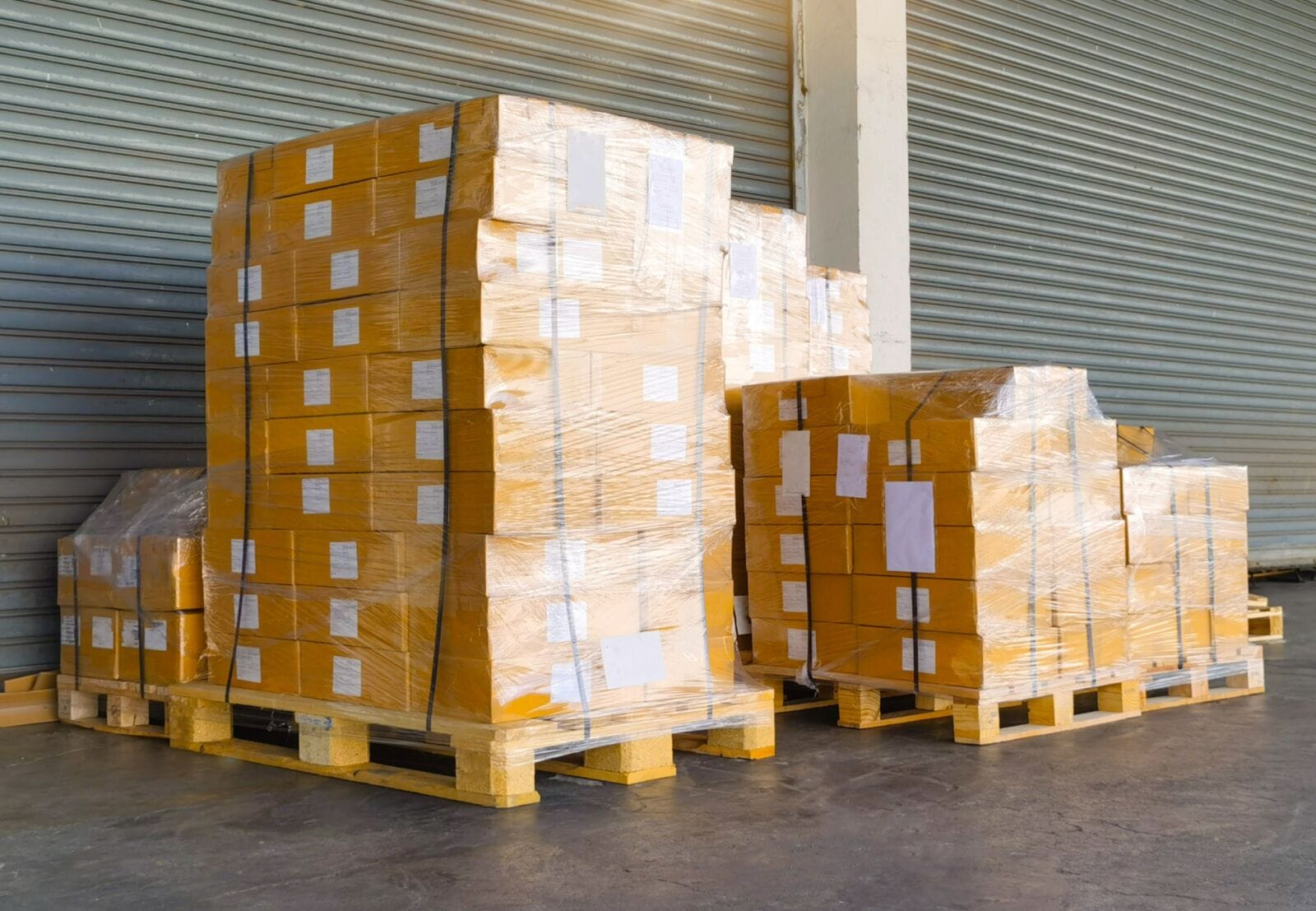
Hand-wrapping a few pallets isn’t too much of an issue. Grab a roll of film, circle the load a few times, and move on.
Things change as volume rises, though. Manual wrapping uses paid time on every load, and the result depends on the person holding the roll. Pallet stretch wrappers solve these everyday problems. A suitable machine can make wrapping faster and more repeatable while giving managers a clearer picture of labor and film use.
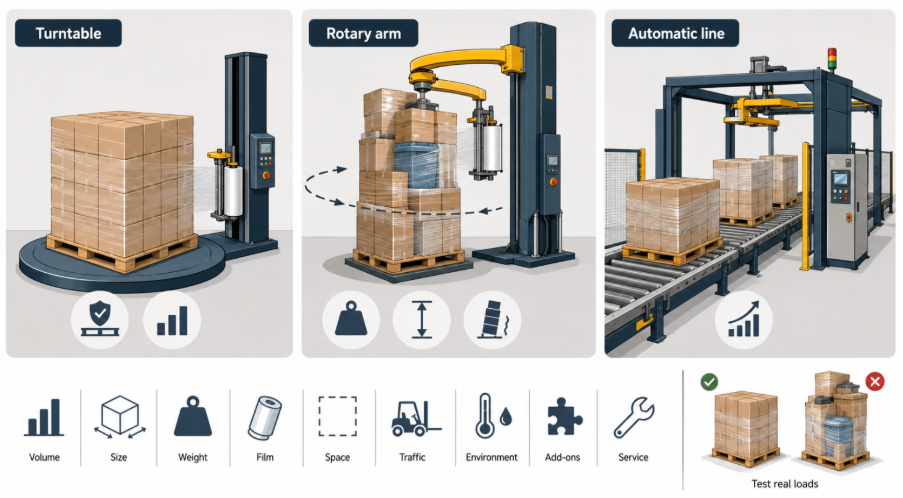
Manual wrapping costs more than the roll of film
Film is the obvious cost, but someone also has to retrieve it, secure the tail, walk around the pallet, bend to wrap the bottom, and reach to cover the top. That routine may take only a few minutes, but multiply it by dozens of pallets per shift, and it becomes a steady claim on labor.
The physical side matters too. Manual wrapping involves repeated pulling, twisting, walking and posture changes. Those movements add exposure to the kinds of strain employers work to reduce. Across private industry, overexertion, repetitive motion and bodily conditions caused 946,290 cases involving days away from work, job restriction or transfer during 2023 and 2024.
With an automatic wrapper, operators still need clear travel paths and proper guarding. However, much of the circling, crouching and film pulling goes out the window, which is useful at a busy station where the task repeats all day.
Repeatable wrapping makes loads easier to trust
A finished pallet can look secure even though it isn’t. The film may not actually be applying enough containment force in the right places to hold the load through forklift handling, braking, vibration and turns.
Manual results vary, and workers may compensate by adding more film, yet extra layers do not automatically fix weak tension or loose areas.
A machine can run a saved pattern with set top counts, bottom counts, speed and film tension. The same type of load receives the same basic treatment from one shift to the next. Operators can adjust the program for fragile cartons, sharp corners, tall pallets or irregular loads, but the starting point is controlled.
That consistency also helps when loads fail. Managers can compare the settings and pallet configuration instead of wondering whether one employee happened to pull harder than another.
Throughput improves without forcing people to rush
The value of a faster wrapping cycle goes beyond pallets per hour, as it can also improve movement around the shipping area.
With a semi-automatic machine, the operator attaches the film when required and starts the cycle. Fully automatic systems can handle even more of the sequence depending on the setup.
The extra capacity helps during late-day shipping peaks or production runs involving new products. Finished goods are less likely to be kept waiting at the finishing station while forklift drivers look for an available employee.
The result will vary by facility, but small savings on each pallet can still become meaningful when they repeat every workday.
Film control can produce ongoing savings
Manual wrapping often leads to inconsistent stretching or extra revolutions for reassurance. Both can increase consumption without producing a better load.
Many machine wrappers use powered pre-stretch, which elongates film before it reaches the pallet. This allows more usable film to come from the roll while maintaining controlled tension. The machine also follows the programmed number of wraps instead of adding another pass because the operator is unsure.
Simple payback calculation
A credible return-on-investment estimate needs real operating numbers. Start with these inputs:
- Pallets wrapped per day
- Average minutes spent on each pallet
- Loaded hourly labor cost
- Current stretch film use and price
- Expected maintenance and consumable costs
- Cost of damaged goods or rework
- Machine price, installation, training, and guarding
Estimate labor savings by multiplying pallets by minutes saved per load and operating days, while film savings should come from a controlled test. Damage reduction is harder to predict, so treat it conservatively unless the facility has reliable claim and rework records.
Include work the employee can complete while the wrapper runs. In some operations, the real gain comes from keeping a forklift moving, preparing labels or staging the next pallet rather than cutting headcount.
Small process improvements can keep paying
Stretch wrapping is easy to overlook because it happens after the product has been made. Yet a weak final step can waste both labor and finished goods that have accumulated value throughout production.
An automated wrapper earns its place when it brings control to that step. The case should be built from the facility’s pallet count, labor time, film use, and damage history. When those numbers support the purchase, the return comes from doing an ordinary job faster and more consistently, pallet after pallet.