Creative displays usually aim to do more than show an image. In a busy space, a flat poster can fade right into the background. A display that adds movement, depth, or shifting imagery does the opposite. It makes people stop and take a closer look.
Lenticular printing offers designers a way to create that kind of experience without digital screens or electronic components. It works by placing a specialized lens over an interlaced image. As the viewer moves or shifts their angle, the artwork changes. Those changes can include image flips, a sense of motion, zoom, and real 3D depth.
So why has custom lenticular art caught on for creative displays?
It blends traditional printed graphics with visual movement and depth. It also adapts easily to different designs, sizes, and uses, which makes it work across all sorts of settings.
Here are the reasons lenticular art continues to draw attention as a creative display format.
1. Creates Eye-Catching 3D Visual Effects
One of the main reasons designers reach for custom lenticular art is the way it simulates depth on a surface that is actually flat. A lenticular lens is made up of many tiny ridges, called lenticules, and these steer different slices of an interlaced image toward the viewer. That creates a parallax effect, so elements can look closer, farther away, or more dimensional as the viewer moves around.
For designers, that adds a visual layer that flat printing cannot offer. A designer can place objects across different depth levels, and overlapping pieces help sell the three-dimensional look even more. The payoff is a display that shifts depending on where the viewer stands, instead of looking the same from every angle.
2. Adds Movement to Static Displays
Lenticular printing can suggest movement without turning a printed display into a digital screen. Consider the flip effect. It swaps between two images as the viewer changes position. Motion effects string several frames together to mimic a short animated sequence, and zoom effects can make an object seem to drift closer or pull away.
That makes the format a strong fit when a design involves progression or transformation. A sequence might show the stages of an action, two related images, or a slow visual change. The viewer sets the effect off themselves, just by walking past or shifting where they stand.
3. Offers Greater Creative Flexibility
Creative flexibility is another benefit of this format. Designers can work with a wide range of images, layers, depth, colors, shapes, and visual effects to suit their needs and preferences.
For 3D designs, designers can group artwork into several layers and then decide which elements sit on the focal layer. Lenticular layouts can use up to 15 layers of depth, depending on the design, which lets designers build visual connections among the foreground, middle ground, and background elements.
As a result, the same printing technique can produce vastly different visuals, ranging from artistic installations to exhibition graphics, retail displays, and even wall designs.
4. Encourages Viewers to Explore Different Angles
Traditional printed artwork tends to show the same image no matter where the viewer stands. Lenticular displays play by different rules. Move to a new spot, and you might see a second image, watch the apparent depth change, or catch a sense of movement.
That pulls people into a more active way of looking. Someone walking past may notice an image changing and then shift their position to figure out the effect. For fixed displays, designers can run the lenses vertically so the effect responds naturally as viewers move side to side. Handheld pieces can use a different lens orientation that responds to tilt.
5. Works Well for Large-Format Creative Displays
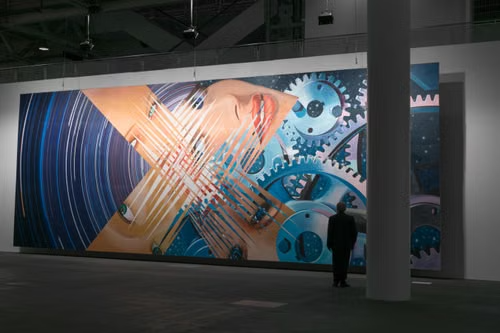
Lenticular printing isn’t limited to small cards, stickers, or handheld pieces. Designers can produce large-format lenticular work for posters, point-of-purchase displays, signage, wall art, and other fixed installations. For some lens types, large-format configurations can reach up to 48 × 96 inches.
That scale gives designers more room to play with depth and movement. On a bigger surface, you can pull elements apart more clearly across different visual planes, and motion sequences get easier to catch from a distance.
Large-format work also makes lenticular a smart choice when the display itself needs to become part of the surrounding space.
6. Combines Physical Art with Interactive Viewing
Lenticular art sits in an interesting space between traditional printing and digital media. It remains a physical, printed piece, yet the image can respond to the viewer’s movement. There are no screens, no electronic controls, and no animation software running behind the scenes. The effect comes straight from the printed artwork and the lens laid over it.
The interaction stays simple. Walk past the piece or tilt it, and the image can change as you move. That lets viewers take in the artwork from different angles while retaining the look and feel of a physical print.
It can also deepen visual storytelling. Several frames can suggest movement, while a flip effect can reveal two separate images from different angles. A 3D composition can place elements at different depths, helping viewers see how those parts fit together within the scene.
Closing Remarks
Custom lenticular art has become popular because it changes how people experience a printed image. Instead of showing a single, fixed frame, it can create a sense of depth, movement, or transformation as the viewer changes position.
It also gives designers plenty of creative freedom, since the artwork can be customized and produced in different sizes. With careful attention to the design, lens direction, image sequence, and viewing environment, lenticular printing can turn an ordinary display into something that catches people’s attention and invites them to take a closer look.