
Compare card-processing offers by the fees your business would pay on the same sales volume, transaction count and payment mix.
A quoted percentage leaves questions open: the per-transaction charge, which sales attract extra fees, and whether account charges are included. A small spreadsheet answers them before you sign.
Define the effective rate first
For this comparison, the effective processing rate is total included processing fees divided by gross card-sales volume, multiplied by 100.
The U.S. Chamber of Commerce’s CO— guide, “How to Calculate Credit Card Processing Fees,” describes this fees-to-sales formula and advises including monthly processor fees. Use the same period and fee scope for every offer.
Keep refund and chargeback principal out of the fee line, and record whether your volume figure is gross or net of refunds. Switching the denominator mid-comparison changes the result without any change in pricing.
A lower percentage can produce a higher bill
Consider two hypothetical offers, not quotations from real providers:
- Plan A: 2.4% of each sale, plus $0.30 per transaction.
- Plan B: 2.7% of each sale, plus $0.10 per transaction.
Assume 1,000 equal payments a month and no other fees, refunds or disputes.
| Average transaction | Monthly sales | Plan A fees | Plan A rate | Plan B fees | Plan B rate |
| $10 | $10,000 | $540 | 5.40% | $370 | 3.70% |
| $50 | $50,000 | $1,500 | 3.00% | $1,450 | 2.90% |
| $100 | $100,000 | $2,700 | 2.70% | $2,800 | 2.80% |
Method: fees = monthly sales × percentage + 1,000 × fixed fee. Hypothetical figures.
At a $50 average transaction, Plan A’s lower percentage still costs $50 more a month; at $100, Plan A is cheaper. The fixed fee explains the swing: $0.30 adds 3% to a $10 sale but 0.3% to a $100 sale. The crossover here is about $66.67 per transaction.
Add the payment mix as separate inputs
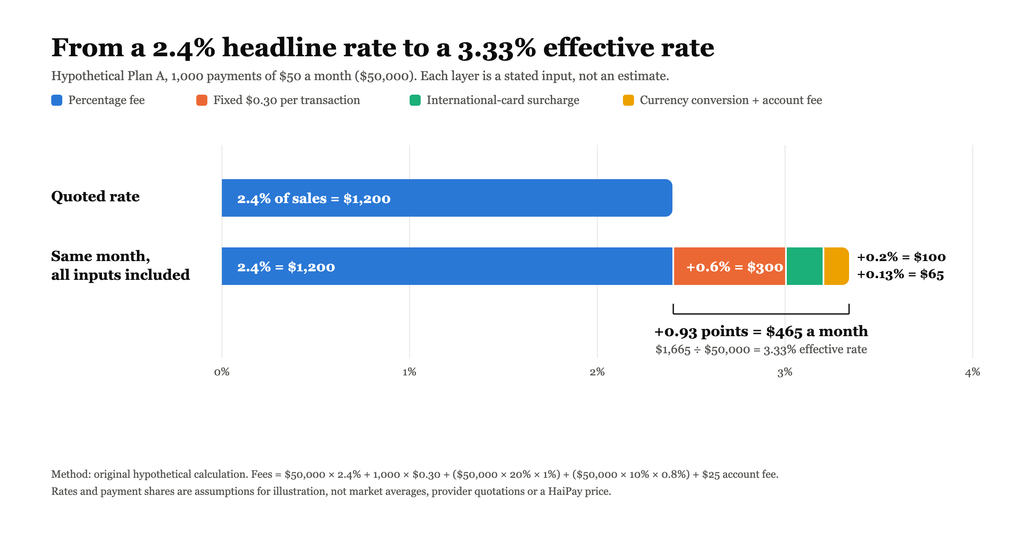
Extend Plan A’s $50 scenario with three more assumptions: an international-card surcharge of 1% on 20% of volume, a currency-conversion fee of 0.8% on 10% of volume, and a $25 monthly account fee. The two volume shares are independent.
| Cost component | Calculation | Monthly fee |
| Base percentage fee | $50,000 × 2.4% | $1,200 |
| Fixed transaction fees | 1,000 × $0.30 | $300 |
| International-card surcharge | $50,000 × 20% × 1% | $100 |
| Currency conversion | $50,000 × 10% × 0.8% | $40 |
| Monthly account fee | Fixed assumption | $25 |
| Total modeled fees | Sum of the five components | $1,665 |
| Effective rate | $1,665 ÷ $50,000 × 100 | 3.33% |
Method: original hypothetical calculation; rates and shares are assumptions, not averages.
The model moves from a 2.4% headline to a 3.33% effective rate, and every point of the difference traces to a listed input rather than vague “hidden fees.”
To run your own scenario, enter the figures from your written quote into HaiPay’s credit card processing fee calculator. Treat the output as an estimate, not a binding price.
Keep a list of costs outside the model
Ask each provider which charges its quote includes and which need additional inputs:
- Are network or assessment fees (the card networks’ own charges) already included?
- Are there payout charges, monthly minimums or taxes on fees?
- Does the exchange rate carry a spread beyond the stated conversion fee?
- Which fees apply to refunds and disputes, and which are returned?
Do not enter a charge twice because it appears under two labels, and track reserves or holds (funds the processor retains temporarily) separately from fees.
Send shortlisted providers one shared input sheet: volume, transaction count, ticket size, card mix and converted volume. Ask each to explain its estimate line by line and to show unknown inputs as unknown rather than replacing them with zero. Once live, repeat the calculation with matched-period statements before blaming any gap on a rate change.
Author: Crystal Zhong is Public Relations at HaiPay. Both plans and all figures in this article are hypothetical, not provider quotations or savings claims.