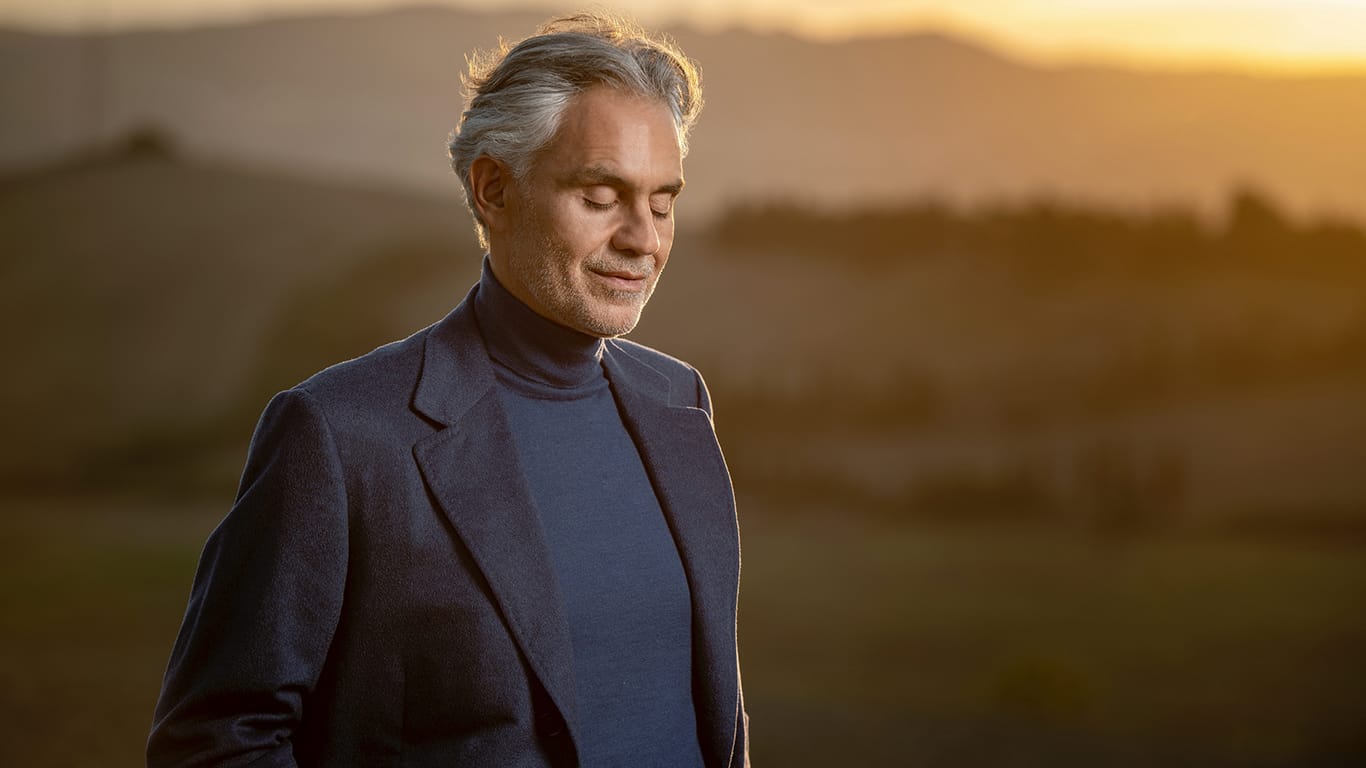
Maestro Andrea Bocelli has, easily, one of the most recognizable voices in music.
His career has been remarkable. He has sold more than 90 million records worldwide and over 20 billion streams.
In addition to his sold-out arena shows, Bocelli has appeared at the Olympic Games, the World Cup, and Global Citizen. He has earned a Golden Globe, seven Classical BRITs and seven World Music Awards, plus a star on the Hollywood Walk of Fame.
He will bring his talents to Phoenix’s Mortgage Matchup Center on Friday, Sept. 18. The tour celebrates the 30th anniversary of “Romanza.”
Released in 1997, “Romanza” introduced the world to Bocelli. About 20 million copies of “Romanza” were sold worldwide, becoming one of the best-selling contemporary classical albums.
On Friday, Sept. 25, “Romanza (30th Anniversary) will be available in standard and deluxe editions. The deluxe package includes gold-colored vinyl, a signed lithograph by Bocelli, and a coffee table book featuring newly commissioned liner notes by journalist Craig McLean, tracing Bocelli’s career.
Bocelli spoke with AZ Big Media. Here we go!
MORE NEWS: Arizona earns 19 Michelin Guide selections in inaugural Southwest Guide
What do you appreciate most about performing for fans in Arizona?
Andrea Bocelli: In Arizona, I have always found audiences to be warm and, above all, attentive. For a performer, being truly listened to is the most precious gift, because a concert finds its meaning in the encounter between those who offer the music and those who receive it. I am always struck by how naturally audiences embrace such varied repertoire, from operatic arias in Italian to songs in English. When people listen sincerely, language ceases to be a barrier, and even thousands of miles from home, one feels a genuine sense of closeness.
Since Romanza, you’ve performed for presidents, popes, royalty, and at global events. How do you see your artistic evolution across these three decades?
AB: Over 30 years, many things have changed, from the voice and the way I use it to the awareness with which I approach each piece. Yet I do not believe the reason I sing has changed. I have always sought in music the kind of beauty that can elevate the spirit and bring people closer together. Experience has given me new tools, but it has also taught me to approach music with greater humility. With time, I have come to understand that the artist does not stand at the center of the work, but in service to it.
“Romanza” changed the course of your life and became one of the best-selling classical albums of all time. Looking back three decades later, what emotions surface as you revisit this album?
AB: The first emotion is gratitude. “Romanza” arrived at a decisive moment in my life, when I had many hopes but no certainty about what the future would bring. Listening to it today brings back the enthusiasm of those years, but also their fragility and innocence. I feel an almost paternal tenderness toward the person I was. While we are living through a moment, we cannot know whether it will become part of history. We can only try to meet it sincerely and offer the very best of ourselves.
When preparing the 30th anniversary edition, did returning to these recordings reveal anything new to you, either musically or personally?
AB: Recordings do not age in the same way people do. They preserve a breath, an intention and even a moment of hesitation. Listening again, I naturally encountered passages that I would approach differently today, but I also rediscovered a freshness that cannot be constructed or recreated. It belongs to that particular moment in life. Returning to these recordings reminded me that technique may become more refined with time, while the truth of an interpretation comes from somewhere deeper. Perhaps that is what struck me most.
This edition includes a previously unreleased extended version of “Con Te Partirò.” What made this version special enough to share now?
AB: Even a song that is known around the world may still hold something that has not yet had the opportunity to reveal itself. The value of this version lies precisely in the chance to hear a familiar song in a form never previously released. I do not consider it merely a curiosity, but a different perspective on a melody that has entered so many lives. Sharing it today means entrusting it once again to the audience, in the hope that they may discover something unexpected within it.
The deluxe edition features never-before published photographs from the original sessions. What do those images capture about that moment in your life?
AB: Those images preserve a time when the future was still unwritten. In those gestures and moments of concentration, there is no awareness of what would follow. I was not thinking about how I might one day be portrayed, but only about the work before me. The value of those photographs lies not simply in the fact that they have never been published, but in their unguarded quality. They capture a season of life with a sincerity that continues to move me after so many years.
The new coffee table book includes liner notes by journalist Craig McLean. What aspects of your journey did you feel were important to illuminate through this collaboration?
AB: I wanted the notes to reveal what usually remains behind the visible achievements. An artistic journey is not made only of dates, recordings and successes. It is also shaped by study, encounters, doubts, decisions and moments when the road ahead is not yet clear. Craig was able to look beyond a simple chronology and capture something of the spirit in which I tried to live these 30 years. I am especially grateful for the depth and attention with which he approached this story.
One of the three unreleased albums, Le Mie Poesie, features poems you wrote and recited. What inspired you to share this deeply personal side of your artistry?
AB: Poetry has always been a very personal space for me, one to which I return when my singing voice falls silent and I feel the need to entrust a thought to the written word. Within those verses are my search for beauty, my contradictions, my affections and the questions to which I have not yet found an answer.
I chose to record the poems myself, because I believe there is something especially compelling in hearing a poem in the voice of the person who wrote it. As a boy, I often imagined how extraordinary it would have been to hear Pascoli, Leopardi or Carducci recite their own verses. Italian is also a language that is music in itself. I hope their sound and musicality can reach even those who do not understand every word.
“Torre del Lago” and “Dall’Archivio” bring forward operatic and archival recordings that have never been released. How did you choose which pieces belonged in this collection?
AB: “Torre del Lago” began as a personal gallery of beauty. Each piece is a small painting, with a distinct face and a light of its own. I did not seek artificial uniformity. The selection follows a principle of intentional variety, bringing together different kinds of music through intimate affinities, through memory and through what each piece chooses to express. Many of these works were recorded at Torre del Lago Puccini with the Orchestra of the Puccini Festival, in the very place where Giacomo Puccini, the composer of “La Bohème” and “Turandot,” once lived. Among Luigi Denza’s songs is “Occhi Turchini,” a melody I have known since childhood through Beniamino Gigli’s recordings. “Leggenda di Guerra” is especially dear to me because I first heard it as a child in the voice of my grandfather, Ilo, who had fought in the Dolomites during the First World War. Only later did I discover a version by my beloved teacher Franco Corelli.
Dall’Archivio has a different character. It brings together pieces recorded over the course of my career that remained outside my official albums. Some were projects still in their infancy, while others were simple demos, often created in an almost artisanal way and perhaps all the more sincere for that reason. Each track has its own breath, its own atmosphere and its own emotional temperature.
Some of these pieces were composed or co-written by me, including “Ascoltami,” “Inno per la Pace” and “Borgo Natio,” which sets to music a poem dedicated to the Tuscan countryside where I grew up. There are also two small jewels in the Neapolitan language, “Nu Vase” and “Pe‘na Canzone,” as well as “Lentamente,” written by friends from Pisa as a heartfelt tribute to the memory of my father, Sandro. Bringing these works together means finally allowing them to meet the public.
The exclusive unveiling takes place at Teatro del Silenzio in your hometown. What does presenting this collection in that setting mean to you?
AB: Teatro del Silenzio is not simply a stage. It is part of the landscape in which I grew up, and it holds my roots, my affections and many of the memories that shaped the person I am. Presenting a collection there that spans thirty years of my life is not so much a celebration of the distance traveled as it is a return to the beginning. Among the audience are people who knew me long before fame arrived. For this reason, every time I sing there, I feel that I am coming home.
Poetry appears throughout your work, now more explicitly in “Le Mie Poesie”. What role does poetry play in your creative life?
AB: Poetry is a way of questioning existence. It does not necessarily provide answers, but it helps us recognize what truly matters. I have always believed that beauty and goodness travel together, and that poetry is born, in some way, from their union. It is impossible to define. We may find it in the smile and kiss of someone we love, in a man’s courage, in a mother’s tenderness or in anything that leaves us breathless and without words. Those who devote their lives to the pursuit of goodness live poetically.
The verses in “Le Mie Poesie” emerged from very different moments and emotions. “Una Voce” took shape from the rustling of leaves and the voice of the wind, in which I imagined my father speaking to me through creation. I”l Dì” is a moral bequest steeped in faith and addressed to my children. It asks them to look for me not in what may one day remain of me, but in the values, I tried to pass on to them and in the good I tried to sow.
You recently performed “DNA,” the official FIFA World Cup 2026 anthem. How did that experience connect with this moment of reflection and celebration?
AB: Football has been part of my life for as long as I can remember, and it has always held a special place in my heart. Sport and music speak different languages, yet they share the same extraordinary ability to bring people together beyond every border. As I look back over 30 years of my career, reaching a new and vast audience through this song, united by a common passion, has been both a gift and a responsibility.
Celebrating an anniversary should not mean looking only to the past. It also means recognizing that the journey continues and welcoming with gratitude whatever life still has in store for us.
On tour, songs like “Time to Say Goodbye” and “Vivo per Lei” have become cultural touchstones. How does performing them today feel compared to the first years after their release?
AB: Those songs have traveled far beyond my own voice. Audiences have embraced them, connected them to their memories and, in a sense, made them part of their own lives. I perform them today with a different awareness. I know that I am not simply singing a melody, but entering, with respect, into the personal stories of many people. That brings a sense of responsibility, but it is also one of the greatest gifts a performer can receive.
Do you have a message to fans as you mark “Romanza’s” 30th anniversary, what message would you like to share with the listeners who have accompanied you on this journey?
AB: The first thing I wish to say is thank you. I have always tried to maintain an open and sincere relationship with those who have been kind enough to follow my musical journey, one grounded in intellectual honesty and transparency. I have simply shared what I love, seeking beauty wherever I felt its presence.
It is the listeners, through their presence and affection, who have made this long journey possible. If the music I have interpreted has accompanied even one meaningful moment in their lives, then my work has fulfilled its truest purpose. My hope is that they will continue to listen with the same curiosity and the same open heart with which they welcomed me 30 years ago.