Planning a Colorado white-water getaway from sunny Arizona? Your main decision, Bighorn Sheep Canyon or Royal Gorge rafting, comes down to today’s Parkdale gauge reading and the age of your youngest paddler. Quick answer: most outfitters welcome 6- to 7-year-olds on Bighorn, while the Royal Gorge generally starts at 12-16 and closes once the gauge tops ≈3,200 cfs. Over the next few minutes we’ll decode those numbers, debunk the “one-age-fits-all” myth, and map the easiest route from your driveway to Cañon City. (Policies checked September 2026.)
Your one-minute snapshot
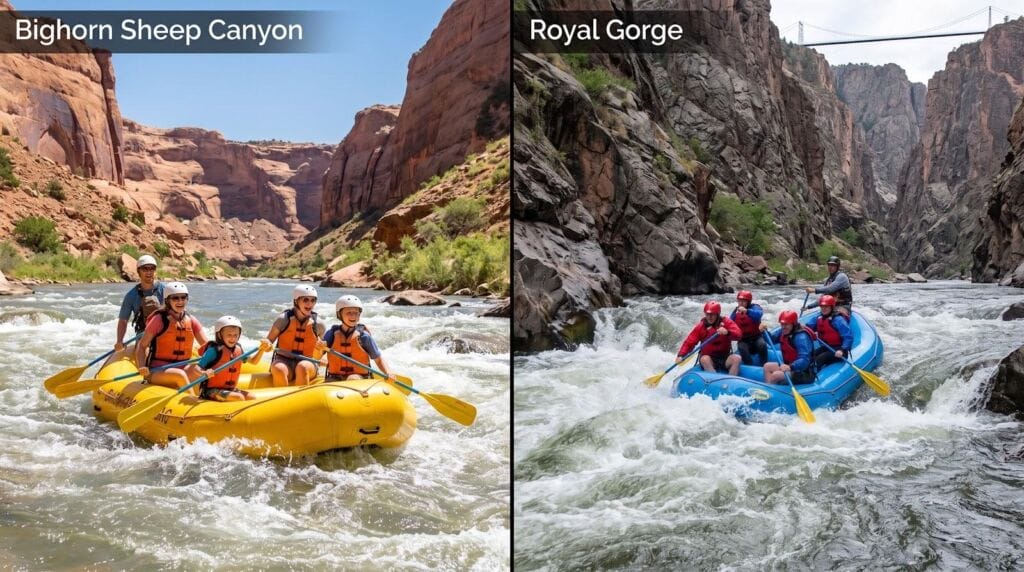
We promised clarity, so here are the essentials before we dive into river science and season planning. (Operator policies reviewed September 2026.)
| Bighorn Sheep Canyon | Royal Gorge | |
| Typical class | II-III splash zones | III-IV, with moments that flirt with Class V power |
| Usual minimum age | 6-7 years* | 12-16 years* |
| What bumps the age? | Spring flows can raise it a year or two | Above-moderate flow often pushes it to 15-16 |
| Low-water feel | Smaller waves, more rocks, still family-friendly | Narrow slots, pin hazards, still advanced |
| Best for | Mixed-age families, cautious first-timers, and wildlife watchers | Fit, confident swimmers who want adrenaline and sheer granite walls |
Echo Canyon River Expeditions hosts an interactive Arkansas River map that walks you rapid by rapid through each section, with the baseline age cutoff listed for every stretch: the Family Float at 4+, Bighorn at 6+, and the Gorge at 13+ at normal flows, rising when runoff forces stricter limits.
Pair it with the live USGS Parkdale chart in a second tab and you can translate the raw cfs reading into what each section will feel like on your date.
For extra homework, Echo Canyon’s “Decoding Water Flow Charts” guide explains why families gravitate toward the 1,200-1,800 cfs midsummer window and how anything above about 2,000 cfs edges into serious-swimmer territory.
Together, the map and the guide let you run the same gauge-check playbook the pros use before you ever hit the booking form.
Need a deeper side-by-side? For a nitty-gritty checklist that spells out Class I-III splash zones versus Class IV+ gauntlets and minimum ages of 6+ against 13+, Echo Canyon’s guide excels at comparing whitewater rafting the royal gorge and bighorn sheep canyon. Skim it, then come right back for the full, independent rundown.
Quick gut-check: choose Bighorn if your youngest paddler is under twelve or someone craves more sunshine than spray. Pick the Royal Gorge only when every seat belongs to a strong-swimming teen or adult ready for a narrow granite corridor with little time to catch a breath.
Reading the Parkdale gauge without oversimplifying
Why Parkdale is the shared reference point
Every Arkansas River segment has at least one gauge, yet outfitters and state officials rally around USGS 07094500 at Parkdale. The sensor sits where family-friendly Bighorn Sheep Canyon ends and the Royal Gorge begins, so one screen captures the pulse of both trips.
Because the river pinches here, its cubic-feet-per-second (cfs) reading tells guides whether Class III waves will stay playful or jump toward Class IV power, and how shallow late-summer lines may feel. In short, Parkdale is the traffic light we all agree to obey.
The feed refreshes about every 15 minutes year-round. Open it on your phone and you’ll see the live flow, a seven-day trend, and a dotted historical median. Context matters: an 800-cfs reading feels different if the river has been sliding from 1,200 all week; a dawn spike from 1,800 to 2,200 often previews bigger hydraulics by lunch.
Bookmark it before you book: the USGS Arkansas River at Parkdale gauge 07094500. (Data verified September 2026.)
Next, we’ll show why “high means older kids” is only half the story, and how very low water creates its own set of challenges.
What high water changes
When spring runoff surges, the Arkansas turns into a conveyor belt of fast, pushy current. Waves grow taller, holes deepen, and the calm pools between rapids nearly vanish. Guides suddenly have seconds, not minutes, to corral swimmers before the next hydraulic rolls in.
That speed forces outfitters to tighten the gate. A child who breezed through Bighorn at ≈900 cfs may be sidelined once the gauge climbs past ≈1,800 cfs. On the Royal Gorge, published minimums often leap from 12 years to 15-16 years during peak runoff to match longer swims, colder water, and heavier rescue scenarios, according to local operator reports.
You’ll notice the difference too. Paddle strokes that once steered the raft like a family minivan now feel more like braking a freight train. Miss a line and the river, not the guide, decides where you finish the story. The payoff is pure adrenaline, but only if everyone in the boat is strong enough, calm enough, and old enough to keep pace.
In short, high water doesn’t just add splash factor; it rewrites the safety script, bumps the age line, and demands sharper reflexes all around. (Operator policies verified September 2026.)
Why low water isn’t automatically “kid water”
At first glance, late-season flows seem forgiving: the raft drifts slower, waves look smaller, and the water feels warmer under an August sun. Parents sometimes assume that means younger children are good to go. Not so fast.
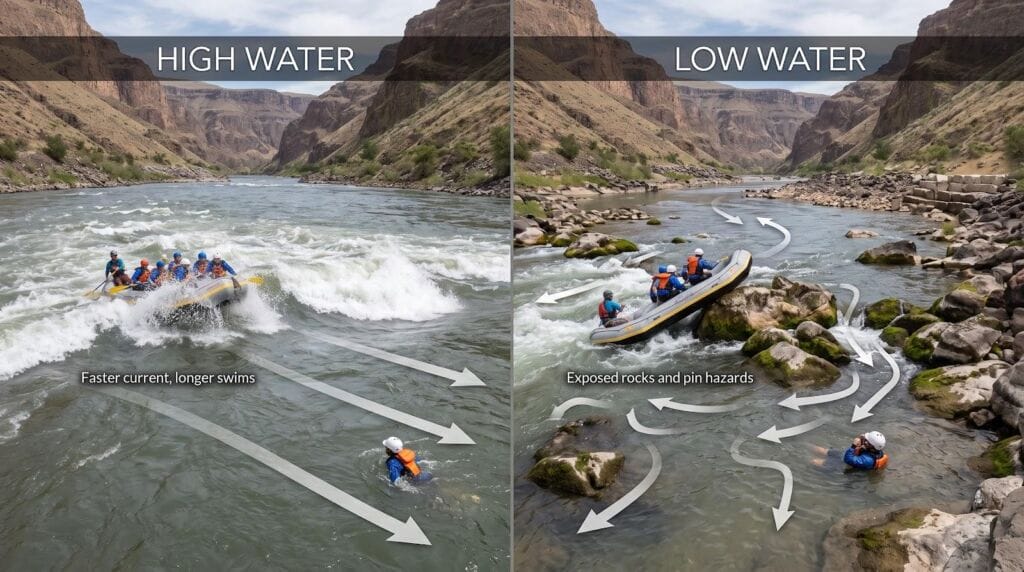
When the Parkdale gauge drops below roughly 650 cfs, more riverbed shows its teeth. Hidden rocks rise to seat level, forcing guides to thread narrow slots with pinpoint strokes. Miss by a foot and the boat can hang up, spin sideways, or pin against rail-bed reinforcement. A June 2025 American Whitewater trip report describes exactly that in the Narrows: a boat wedged in a three-point pin against the metal that armors the rail bed on river left, and an hour of throw ropes and pulleys that still could not free it.
Low water also shortens reaction time. Swims may be briefer than during peak runoff, but they end with harder impacts on shallow ledges. Scrapes and bruises replace big-wave dunkings, yet the consequences still demand paddlers who can flip to a feet-downstream position and kick clear of obstacles.
Inside the Royal Gorge the challenge often intensifies. The channel funnels between granite walls and rail-bed riprap, so every guide move must be picture-perfect. Rapids like Sunshine and Sledgehammer keep their Class IV bite, just with less water to cushion mistakes. Experienced outfits therefore treat the Gorge as an advanced run even when the waves barely crown the bow.
Bottom line: quieter water changes the type of risk, not the amount of risk. Stick with the published age floor unless your chosen outfitter lowers it after scouting the day’s lines and confirming every paddler’s skills. (Conditions verified September 2026.)
Late April-May: cold water, wild mood swings
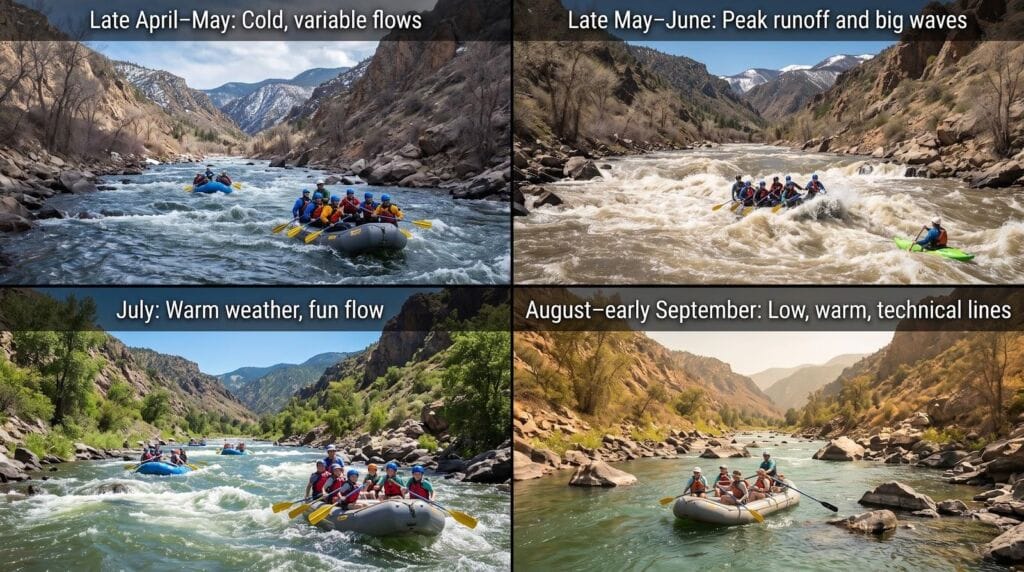
Spring on the Arkansas is a box of chocolates: snowmelt starts, stalls, then surges without warning. One week you may float past the Parkdale gauge at ≈800 cfs, the next you’re staring at ≈1,900 cfs and flurries. According to the NRCS, a record-warm March melted the Arkansas Basin’s snowpack weeks early; by June 1, 2026 the basin stood at just 18 percent of median, a collapse that rewrote the spring flow calendar. Water still feels fridge-cold, so wetsuits or splash tops stay on the gear pile whether you’re in Bighorn or the Gorge.
Early birds do score emptier rivers and shoulder-season prices, but the trade-off is unpredictability. Guides watch overnight temperatures and mountain snow depth the way market analysts scan tickers; a 15-degree dip near Leadville can freeze meltwater in its tracks and chop tomorrow’s flow in half.
Age policies swing just as hard. Outfitters remain conservative until runoff settles. If your calendar insists on late April with young kids, pencil in Bighorn and keep a mellow family float as plan B. Royal Gorge trips usually begin in May, though operators check the gauge twice a day and won’t hesitate to bump the minimum age when water spikes.
Bring layers, flexibility, and a sense of humor. Spring rewards the adaptable. (Seasonal patterns verified September 2026.)
Late May-June: peak flows, peak thrills
Runoff hits its stride once mountain snow finally releases winter’s savings account. In a typical year the Parkdale gauge often surges well above 2,000 cfs and can exceed 3,200 cfs during peak runoff, prompting commercial closures in the Royal Gorge. Every rapid grows a fresh set of muscles: Bighorn’s splash feels like a roller-coaster, while the Royal Gorge graduates from sporty to downright serious.
Outfitters respond in two big ways. First, they raise minimum ages, sometimes overnight. A guest who cleared the Royal Gorge at ≈13 years can wake up to a 16-and-up rule if flows spike after dark, a change Royal Gorge operators list explicitly for late-May high water. Second, they add muscle on the water: senior guides, safety kayakers, and beefier rescue gear stand by at every launch.
For families, this window is choose-your-own-adventure. Confident teens may call it the highlight of summer break; younger kids or hesitant paddlers often prefer to cheer from the bridge and book Bighorn once levels settle. Either way, check the gauge morning and evening and keep your phone handy for last-minute texts from the guide shop.
High water delivers the season’s most electric rides, so be sure everyone in the boat is strong enough, cool enough, and old enough to enjoy every surge. (Patterns verified September 2026.)
July: sweet spot for warm weather and manageable flow
By midsummer the river often finds its groove. Daytime highs break into the eighties, water temperatures edge up, and the Parkdale graph typically sits between ≈800 and 1,500 cfs, a range many outfitters call “fun flow.” The Voluntary Flow Management Program even targets about 700 cfs at Wellsville from July 1 to August 15 in normal years to support recreation.
That stability lets guides print a weekly plan instead of sending “call us” texts. A 6-year-old in Bighorn usually stays on the manifest, while 12-14-year-olds get solid odds of making the Royal Gorge cut, provided they can swim with conviction.
Availability, not river risk, becomes the bigger headache: Colorado’s vacation clock peaks around Independence Day and prime seats sell out weeks ahead. Book early, show up hydrated, and leave a buffer day in case afternoon thunderstorms or an unexpectedly low-snow year like 2026.
July proves that thrilling and family-friendly can coexist; you just have to share the stage with every other summer-loving traveler.
August-early September: low, warm, and technical
Late summer often paints the Arkansas a clear jade green. Flows taper, the sun lingers, and air temps flirt with 90 °F. The Parkdale gauge commonly coasts in the ≈500-800 cfs band during normal years; VFMP partners even strive for about 700 cfs at Wellsville through August 15 to keep recreation alive.
In drought years, levels can drop far lower; on 1 September 2026 Parkdale averaged about 275 cfs.
What that means on the water:
- Bighorn Sheep Canyon still suits families but demands sharper turns around boulders now sitting at steering-wheel height. Guides may use smaller rafts or lighter passenger loads so the boat glides instead of drags.
- Royal Gorge tightens into a granite slot canyon. Miss a line and the raft can wedge against rail-bed riprap, as a June 2025 American Whitewater trip report described when a boat pinned in the Narrows.
Age minimums generally relax to baseline, but operators still quiz teens on swim strength and run a quick self-rescue drill before launch. The payoff is intimacy: echoing canyon wrens, century-old rail bolts you can touch, and time to linger beneath the bridge for photos.
Just remember, low and slow isn’t easy. Respect the rocks, paddle with purpose, and you’ll finish the season on a high note even if the river is running low. (Conditions verified September 2026.)
Bighorn Sheep Canyon: the friendly workhorse
Bighorn serves as the river’s welcome mat. The canyon opens wide, sunlight ricochets off sandstone walls, and you may spot its namesake sheep grazing on the rim. Rapids arrive in cheerful pulses: enough splash for a GoPro, yet calm eddies between features so everyone can laugh, regroup, and grab a photo.
Most outfitters rate this stretch Class II-III during typical summer flows and welcome children as young as 6. When spring runoff lifts the gauge, a few rapids brush the edge of Class IV, and some companies raise the floor a year or two for extra horsepower, so confirm the day’s cutoff.
Trip length depends on put-in and current speed, but plan on 2-3 hours on the water, enough to feel accomplished without wiping out the rest of the day. Guides seat younger kids toward the center, place strong paddlers up front, and scan the sky for bald eagles.
Who loves Bighorn? Mixed-age families, first-timers chasing a genuine whitewater badge, and anyone still honing a forward stroke before tackling more technical runs. If your crew includes one hesitant adventurer, start here. You’ll step off the raft grinning, dripping, and already plotting the next, bigger challenge. (Operator policies verified September 2026.)
Royal Gorge: Colorado’s granite roller coaster
Slip past the Parkdale take-out and the river narrows into a granite hallway nearly 1,000 ft deep. Welcome to the Royal Gorge. Ten miles of stacked rapids squeeze between walls so tight you can trace handholds overhead while the raft rockets below.
American Whitewater rates the reach Class III-IV, with moves that flirt with Class V depending on flow and line. Rapids such as Sunshine, Sledgehammer, and Wall Slammer arrive in rapid-fire succession, leaving scant room to corral swimmers before the next hydraulic strikes.
Guides study the Gorge like chess masters. American Whitewater notes a rock that appeared mid-slot in the rapid above Sledgehammer in summer 2025, a new feature at flows under about 900 cfs; veterans now coach guests around it and warn paddlers to avoid rail-bed armor waiting on river left.
Minimum ages swing wide: roughly 12 years in low or moderate flow, 15-16 years during peak runoff, as published by local operators. Strong swimming is not a bonus; it is the vacancy requirement. Expect a self-rescue drill on shore, a snug helmet, and crisp commands to paddle through every wave train.
The payoff is sensory overload: spray on your cheeks, canyon wrens echoing overhead, and the Royal Gorge Bridge arching like a finish-line banner. It is bucket-list whitewater, best enjoyed when every seat belongs to a confident, capable paddler. (Operator policies verified September 2026.)
Which trip fits your group?
Choosing between Bighorn and the Royal Gorge boils down to two checks: who sits in the raft today and what the Parkdale gauge shows right now.
- Family example: kids 6, 9, and 13. The youngest sets the bar, so everyone heads to Bighorn, collects shared memories, and leaves the Gorge for a future trip.
- Teen example: four athletic high-school seniors who swim laps for fun. If flows sit below the outfitter’s cutoff and each teen passes a quick swim test, the Royal Gorge turns into a reward, not a risk.
- Mixed adults: list the least-confident swimmer first, then pick the canyon that person can handle. Nobody enjoys a rapid while second-guessing their skills.
Remember the flow factor: a 12-year-old cleared for the Gorge at ≈1,400 cfs may wake up to a 16-and-up rule if an overnight storm pushes readings past ≈2,100 cfs, a shift several operators note in their high-water policies.
Arizona to Cañon City: seamless trip planning
Trading desert saguaros for Colorado granite is easier than you might think. Travelers usually choose between a quick fly-and-drive combo and a classic road trip.
Fly and drive. Non-stop flights from Phoenix (PHX) to Colorado Springs (COS) take well under two hours. From COS, Highway 115 and US-50 place most rafting bases roughly 60 min away, traffic permitting. Arrive a day early; altitude, dry air, and first-day adrenaline drain energy fast, so give everyone time to hydrate and sleep.
Road trip. Flagstaff to Cañon City covers about 640 mi / 10 hr via I-40 and I-25, not counting photo stops. Break the drive with a night in Albuquerque or Santa Fe so spirits stay high. Build at least one buffer day into the schedule; summer monsoons can snarl high-country passes, and a flexible launch window lets you dodge surprise flow changes, especially in low-runoff years like 2026, when Parkdale averaged about 275 cfs on 1 September.
Pack smart. Quick-dry layers, a warm fleece for canyon breezes, secure river shoes, polarized sunglasses, and SPF-50 sunscreen should ride on top of the duffel. Add a dry change of clothes plus a trash bag for damp gear on the way home.
Final checklist (48 hr out).
- Confirm meet-up time and parking.
- Recheck the Parkdale gauge and current minimum age.
- Ask about backup sections if flows spike or drop.
Nail these details and the only surprise left will be the grin you flash when the first wave slaps the bow.
Safety first: vetting your outfitter and spotting red flags
Great gear and gorgeous scenery mean little if the company running your trip cuts corners. Luckily, quality shows the moment you walk through the door.
A solid outfitter greets you with guides who know every canyon bend, life jackets in every size, and a printed Colorado river-outfitter license on the wall. Staff talk candidly about today’s flow, the current minimum age, and what happens if conditions change before launch. They hand out helmets, conduct a hands-on paddle briefing, and insist everyone practices the “feet-up” swim position before boarding. You feel informed, not upsold.
A shaky operation looks different. Someone behind the counter downplays the Parkdale gauge or claims the Royal Gorge is “easy Class III” for anyone brave enough to buy a ticket. Life jackets appear sun-bleached and frayed, helmets fit like loose baseball caps, and the safety talk sounds more like a sales pitch. If the staff shrug off questions about rescue plans, walk away.
Lightning check. Tick all five boxes before handing over your card:
- Current Colorado river-outfitter license prominently displayed at the shop (required under 2 CCR 405-3), and a straight answer when you ask about liability insurance.
- Guides show at least 50 hr of documented on-river training plus current first-aid and CPR cards.
- A Coast-Guard-approved, vest-style PFD (Type II, III or V under Colorado rules) that fits every guest; child and infant vests must add a flotation collar and a crotch strap.
- Clear written flow cut-off and age minimum that match today’s Parkdale reading.
- Honest answers about contingency plans if flows spike or drop.
Miss even one item and your best adventure decision might be choosing a different door down the street.
Frequently asked questions
What is the minimum age for Bighorn Sheep Canyon?
Most outfitters welcome children 6 years and older at normal flows; some raise the cutoff during peak runoff.
What is the minimum age for the Royal Gorge?
Published policies span roughly 12-16 years. Operators start near the low end in moderate flow and jump to the upper-teen range when spring runoff powers through. Always confirm the evening before launch.
Does high water always raise the minimum age?
Almost always. Bigger, faster hydraulics shorten rescue windows, so most companies tighten age and swimming requirements when the Parkdale gauge climbs. Exact thresholds vary by outfitter.
Does low water lower the minimum age?
Not automatically. Exposed rocks and tighter technical lines keep risk high, especially in the Gorge; most operators stick to their baseline minimum.
Is there a weight limit for rafting?
Colorado rules don’t set a single number, but life-jacket fit does. Child-size vests must carry a flotation collar and a crotch strap, and most commercial PFDs are rated from about 50 lb, so many companies use 50 lb as a working minimum.
Do I have to know how to swim?
Strongly recommended for Bighorn and non-negotiable for the Royal Gorge. Some guides run a short swim test before boarding.
Can a first-timer handle the Royal Gorge?
Some can, if they are fit, confident swimmers who follow commands instantly. Hesitant beginners will enjoy Bighorn far more.
Can we raft both canyons in one day?
Yes. A few outfitters link a morning Bighorn run with an afternoon Gorge descent, but the stricter Royal Gorge age and swim standard applies to the whole package.
When is the best month for families?
July. Water is usually warm enough for shorty wetsuits, flows settle into a predictable range, and age minimums tend to stay steady, barring drought-year anomalies.
What happens if the Parkdale gauge tops 3,200 cfs?
Guides cancel Royal Gorge trips and move guests to Bighorn or reschedule; Colorado Parks and Wildlife recommends no commercial runs above this level.
Where can I check live flow?
Search “USGS Parkdale gauge 07094500” and refresh it the night before and the morning of your trip.
Will I see wildlife?
Often, though never guaranteed. Keep an eye out for bighorn sheep on the cliffs and eagles riding thermals above the river.
Conclusion
Rule of thumb: match the trip to the most cautious paddler and the current river, not the bravest voice in the van or yesterday’s highlight reel. Follow that and everyone trades genuine smiles and zero regrets at the take-out.