
Sarah Kearney pinches herself daily when she thinks about her work. She spends her days helping Scottsdale residents transform their well-being.
Kearney is the executive director of Blue Zones Project Scottsdale, a five‑year initiative designed to make healthy choices easier in high-traffic areas: workplaces, schools, restaurants, grocery stores, parks and neighborhood hangouts.
“We’re helping to make the healthy choice the easy choice,” she said. “It’s about shaping the environment so people can add more good years to their lives.”
READ MORE: Here are the Top 3 snowbird destinations in Arizona
The project is rooted in research from National Geographic Fellow and author Dan Buettner, who identified the world’s longest‑lived regions — Okinawa, Sardinia, Icaria, Loma Linda and the Nicoya Peninsula.
“People weren’t trying to live a long time,” Kearney said. “It was their environments and their lifestyle habits that enabled them to live these really long, wonderful lives, many into their 90s and 100s.”
Buettner’s work evolved into Blue Zones Project, which now helps American communities adopt those principles through environmental changes, social programming and policy improvements.
Scottsdale is working toward official Blue Zones certification by Aug. 31, 2027. “We’re right on track and right on pace to reach those goals,” she said.
One of the most recognizable Blue Zones concepts — and one of the most popular locally — is the moai. Pronounced “moh‑eye,” the term comes from Okinawa, where moais traditionally served as lifelong social, emotional and financial support networks. In Scottsdale, they’ve become free gatherings built around shared interests, light activity and meaningful connection.
“People do not need to overhaul their lives to begin feeling better,” Kearney said. “They need opportunities to connect with supportive people, move naturally, have fun and create routines that are realistic enough to keep. A moai gives people a reason to show up, and friendship often grows from there.”
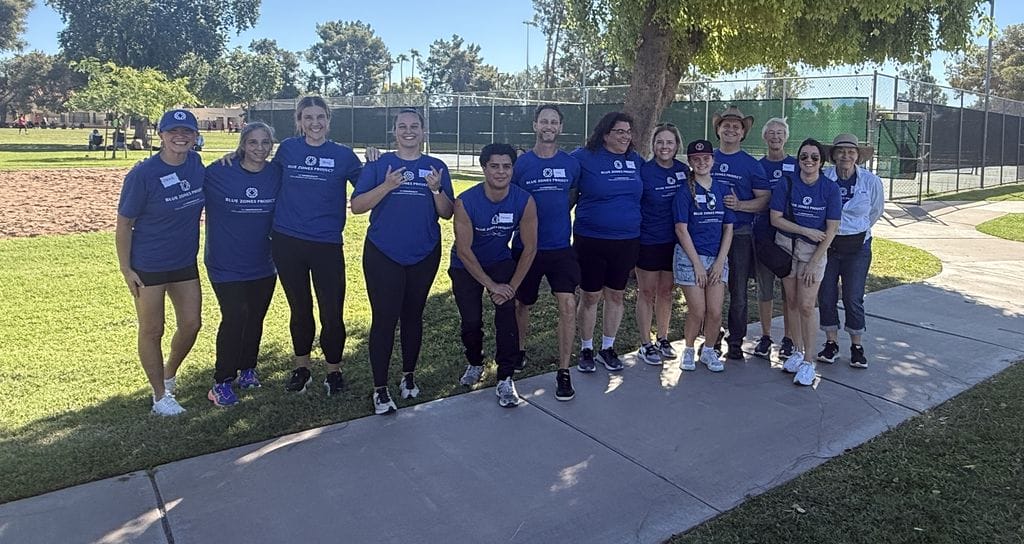
She’s watched those friendships form in real time. “We see so many unique connections,” she said.
“People who might never have met take a chance on something new. Getting out and meeting new people can be hard as an adult, but everyone is there for the same reason — they want to live better, longer lives.”
Some moais stay small. A walking group launched at Scottsdale Fashion Square two years ago grew to more than 100 participants. “We don’t have a max capacity,” she said. “If we have 20, 30, 50 or 100 people, we love to see community coming together in numbers. We’re happy to impact one life or thousands.”
The newest lineup includes an outdoor movement moai at Mountain View Park, a lunch‑and‑walk moai at Chaparral Park and a monthly game night moai hosted with First Baptist.
“The board game night is one example of volunteers who come together to build community across multiple generations,” she said.
“We incorporate a lot of the Blue Zones Power Nine principles — moving naturally, connecting socially, eating wisely and having the right outlook.”
Kearney’s path to this work was intuitive. She lived in Florida, Missouri, Illinois and Indiana before landing in Arizona in 2000 to attend ASU. She earned a communication degree, a business minor and later an MBA, then spent more than 16 years with Experience Scottsdale. She also served on several Scottsdale nonprofits, which helped her understand the community.
“This opportunity really aligned everything I care about,” she said. “My personal passions, my professional passions, the things I find important in serving the community — it all came together in work I get to do every day.”
Although the project runs through August, she is discussing what comes next.
“We don’t know what the next phase looks like yet,” she said. “But we’re optimistic about expanding our reach even further beyond our current scope of work.”
For now, the focus remains on connection.
“Everyone is so friendly,” she said. “Everyone is there for the same reasons. When you have that common denominator, it brings people together to support each other in the best ways possible for healthy living.”