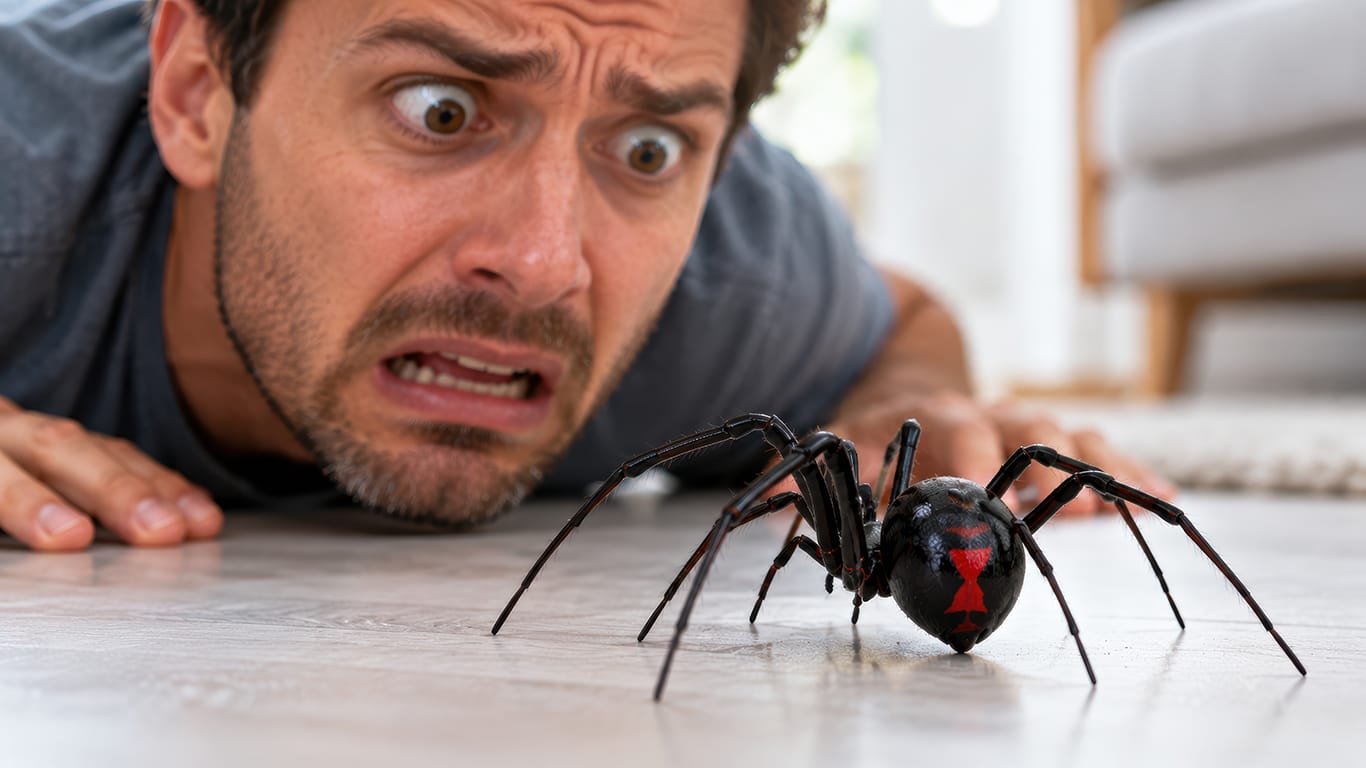
With their glossy black bodies, distinctive blood-red hourglass markings and potentially dangerous venom, black widow spiders have earned a fearsome reputation.
These notorious arachnids are known for occasionally making a meal of their mates and using powerful neurotoxic venom to immobilize their prey.
But what makes black widows particularly unsettling is that they aren’t confined to remote wilderness areas. They could be lurking much closer to home — including in your own backyard in Metro Phoenix.
MORE NEWS: Honeywell is building new $500 million manufacturing facility in Tempe
DEEPER DIVE: 10 Arizona restaurants make Yelp’s Top 100 Mexican food spots
Despite their sinister appearance and frightening reputation, black widows are not looking for people to bite, says Arizona State University researcher Chad Johnson. Rather, they are shy, secretive spiders — homebodies of a sort — that generally remain in their webs and only bite people when they are touched, trapped or disturbed.
And while their preference for solitude may seem to conflict with their prevalence in a highly developed urban area like metro Phoenix, Johnson says the availability of resources like water, prey and shelter actually makes the city an ideal place to study one of the country’s most recognizable — and misunderstood — spiders.
So that’s what Johnson, an associate professor in ASU’s School of Mathematical and Natural Sciences, has done for decades. He believes this research can have applications for how various species adapt to a hotter planet.
“What is it about urbanization that allows the spiders to thrive?” Johnson said he wants to know. “Is it the heat? Is it the water use? Is it prey availability? Is it habitat availability?
“Right now, it is one of the things that my lab is trying to understand.”
City spiders
Johnson started studying spiders 30 years ago and began specializing in black widow spiders after a decade. At ASU’s West Valley campus, Johnson and his students study Western black widows. The lab has raised hundreds of them and regularly collects more from urban and desert environments for comparison.
Their research has shown that the spiders thrive around human development and can form dense urban populations. Their ability to survive in the extreme heat of Phoenix could help researchers understand why certain species thrive as urban temperatures rise while others disappear.
It’s the focus of research by Katharine Smas, a Barrett STEM research aide in ASU’s Black Widow Lab.
“We want to see how these species that are so small are able to adapt to the heat,” Smas said.
She has conducted experiments looking at how heat affects the spiders’ behavior, development, energy use and webs. Early findings show that urban black widows tend to build smaller webs, possibly as a way to conserve energy in hotter surroundings.
For her honors thesis, Smas plans to compare DNA methylation in black widows from urban and desert environments. DNA methylation is a chemical process that can affect how genes are turned on or off without changing the organism’s underlying DNA sequence.
Scientists have already sequenced the black widow genome, but “DNA methylation has not really been studied in black widow spiders,” she said.
Her research could help explain whether urban conditions affect gene activity in black widows and how city populations respond to environmental pressures that desert populations may not experience.
For Smas, the experience has also changed the way she views scientific research — and the creatures at the center of it.
A forensic science student who plans to attend medical school and pursue pathology, Smas joined the lab without much affection for spiders.
“I went into it not really liking spiders at all,” she said.
But working with black widows has taught her how to conduct research, write scientific papers and explain complex scientific ideas. She hopes to apply those skills to medical research in the future.
“This lab has really opened doors for me in the research field,” Smas said.
Black widows: Facts and advice
- Black widows earned their notorious name from the female’s tendency to sometimes kill and eat a male during or after mating. But sexual cannibalism is not the inevitable conclusion of every black widow courtship. Males can detect chemical signals in a female’s silk that provide information about her condition. Johnson’s research has shown that males prefer well-fed females, potentially reducing their chances of becoming a meal themselves.
- Cannibalism is not limited to mating. Black widows may eat one another during disputes over webs and other resources, and spiderlings can consume their siblings. ASU researchers have examined how hunger, competition, body size and temperature influence the behavior.
- “The venom of black widows is legitimately dangerous,” Johnson said. “It can have very nasty consequences for our immune systems.” Neurotoxic venom is a specialized animal secretion that attacks the nervous system to disrupt communication between the brain and the body. It can cause intense pain, muscle cramping, sweating, nausea, increased blood pressure and, in severe cases, difficulty breathing.
- Still, black widows’ reputation as a serious threat to people may be exaggerated. “Healthy adults will not have much trouble” if they are bitten by a black widow, Johnson said. But “small children and elderly people, and anyone within a compromised immune system, should be careful.”
- Bites are uncommon, and deaths from bites are rare: A review of more than 15,000 black widow exposures reported to U.S. poison centers found no deaths, and only about 10% of the patients were admitted to a hospital. Most bites occur when a spider is accidentally touched or pressed against someone’s skin. Wearing gloves while handling firewood, boxes or outdoor debris and shaking out stored clothing or shoes can reduce the risk.
- Johnson encourages people to check around their living spaces and minimize water usage, but advises against pesticides. “I do not recommend people spray pesticides to get rid of black widows,” he said, “but instead go out at night and clear any webs that you see starting to be built.”