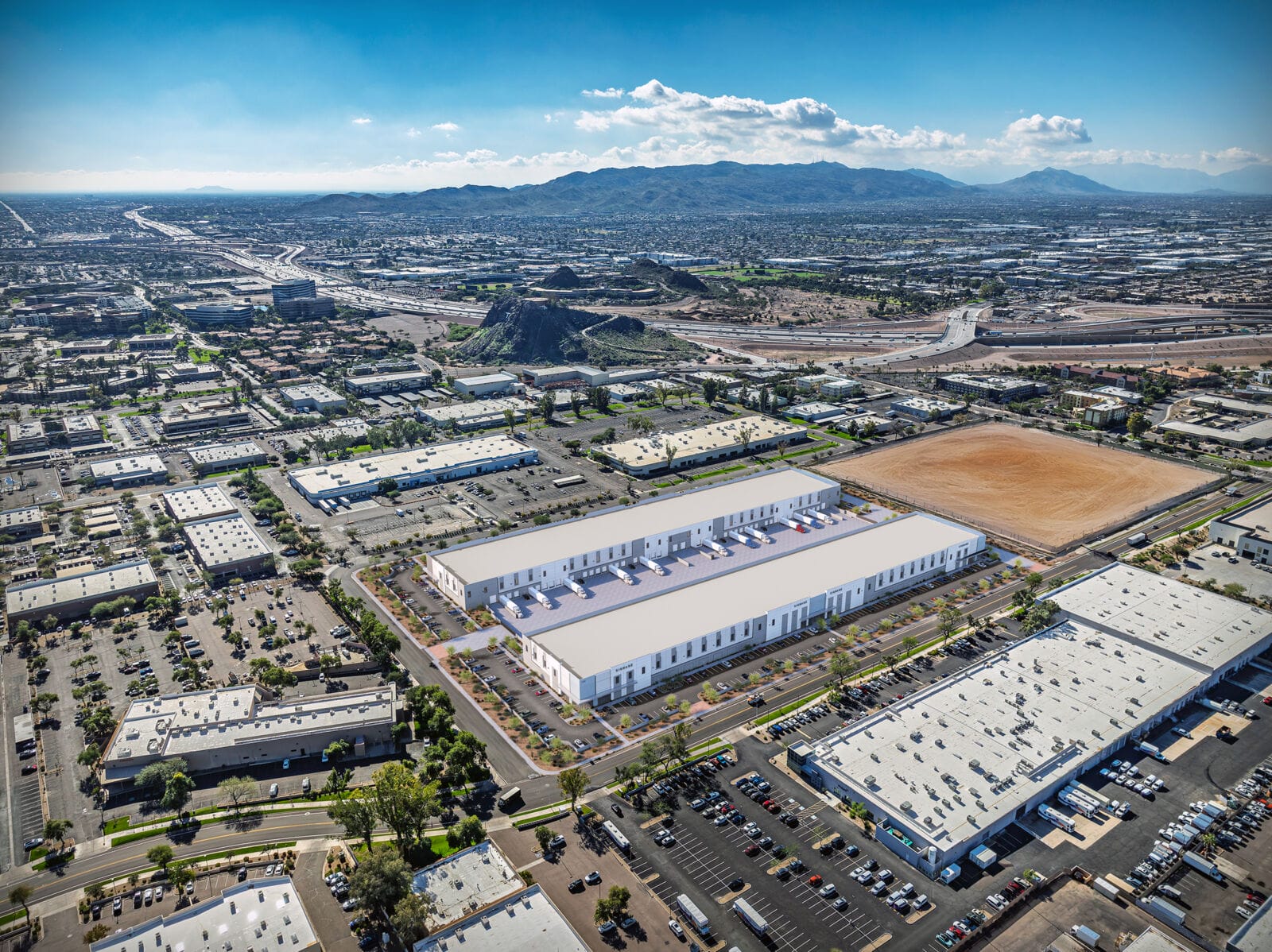
Earlier this year, Lincoln Property Company broke ground on Sky Harbor Logistics, a redevelopment project transforming a rare infill site in Tempe into a Class A logistics campus spanning 255,766 square feet across two nearly identical structures. Located minutes away from Phoenix Sky Harbor International Airport, Sky Harbor Logistics offers users modern amenities within one of the Valley’s most desirable and difficult to enter submarkets.
The property’s history stretches back to 1977 — when “Star Wars” premiered in theaters, Paradise Valley Mall was in the design phase and Park Central underwent its first major renovation.
At that time, the future site of Sky Harbor Logistics was the new home of Courier Terminal Systems Inc., an electronics manufacturer that became the largest private sector employer in the city, according to contemporaneous reporting by Tempe Daily News.
READ MORE: How Cave Creek Water Reclamation Plant shores up supplies
The property changed hands throughout the decades, as did its primary use. John Orsak, executive vice president at Lincoln Property Company, explains that a previous developer had converted the site from industrial to office space.
“It became a call center, which was popular at the time. Before Phoenix’s economy matured into what it is today, we had a significant back-office market,” he continues. “What hurt them was timing — the site became a high-density use literally right before the pandemic.”
Restrictions on in-person work made leasing difficult, and by the time the public health crisis had faded, so too had the trend for this style of office. In its place, a new surge of industrial demand swept across the Valley, with infill opportunities being especially desirable, Orsak adds.
“Demand [for specific product types] ebbs and flows over time,” he continues. “Properties transition as the economy shifts — and the ones that don’t stand out.”
Turning a functionally obsolete property into a modern industrial facility requires a different approach than building on raw land. To make room for the new facility, Lincoln Property Company needed to demolish a 220,000-square-foot office building and parking garage.
“Because it’s an infill project, we’re working on a tighter site,” Orsak explains. “Logistically, we have to be mindful about where we’re storing equipment and how we’re phasing construction with our general contractor partner.”
Redevelopment does come with advantages, he adds, such as having streets, sidewalks and utilities already in place.
“Tenants don’t have many options if they need modern space in the center of town,” Orsak says. “Adding 250,000 square feet of this type of product is fantastic the local economy and is celebrated by users looking for an opportunity like this.”
Changing times
Phoenix’s industrial sector remains fundamentally healthy, according to CBRE’s Phoenix Industrial Q3 2026 Market Report, with indicators pointing to the start of a new supply cycle. Deliveries outpaced absorption slightly, though vacancy fell 150 basis points over the past year. The construction pipeline grew to more than 21 million square feet during Q3, up 85% year-over-year.
Looking at the airport area, vacancy sits at 8.4%, lower than the Valley-wide rate. During Q3, the submarket recorded nearly half a million square feet of positive absorption, though remains negative in 2026 overall.
Proximity to Phoenix Sky Harbor International Airport is a boon for many industrial users, Orsak says. Some tenants want to be close by since they provide a service to the airport itself, while others, such as logistics companies, benefit from large-scale shipping.
“A great thing about our city is that our airport just happens to be in the middle of town,” Orsak continues. “If a company wants to cover the entire Valley, being near Sky Harbor means they could potentially operate out of one location instead of needing a presence on both the east side and the west side.”
These benefits drive demand, but Orsak says sourcing tenants isn’t the problem — finding space for them is. The first hurdle is identifying a willing seller.
For projects like Sky Harbor Logistics, the land was the asset Lincoln Property Company was interested in, and the existing structure happened to come with it. But owners often believe on-site buildings make the property more desirable, which affects the asking price.
“You can’t pay for the value a seller sees in a structure, then turnaround and tear it down to build something that’s actually functional and sought-after,” Orsak says. “It’s incredibly challenging to find opportunities like [Sky Harbor Logistics].”