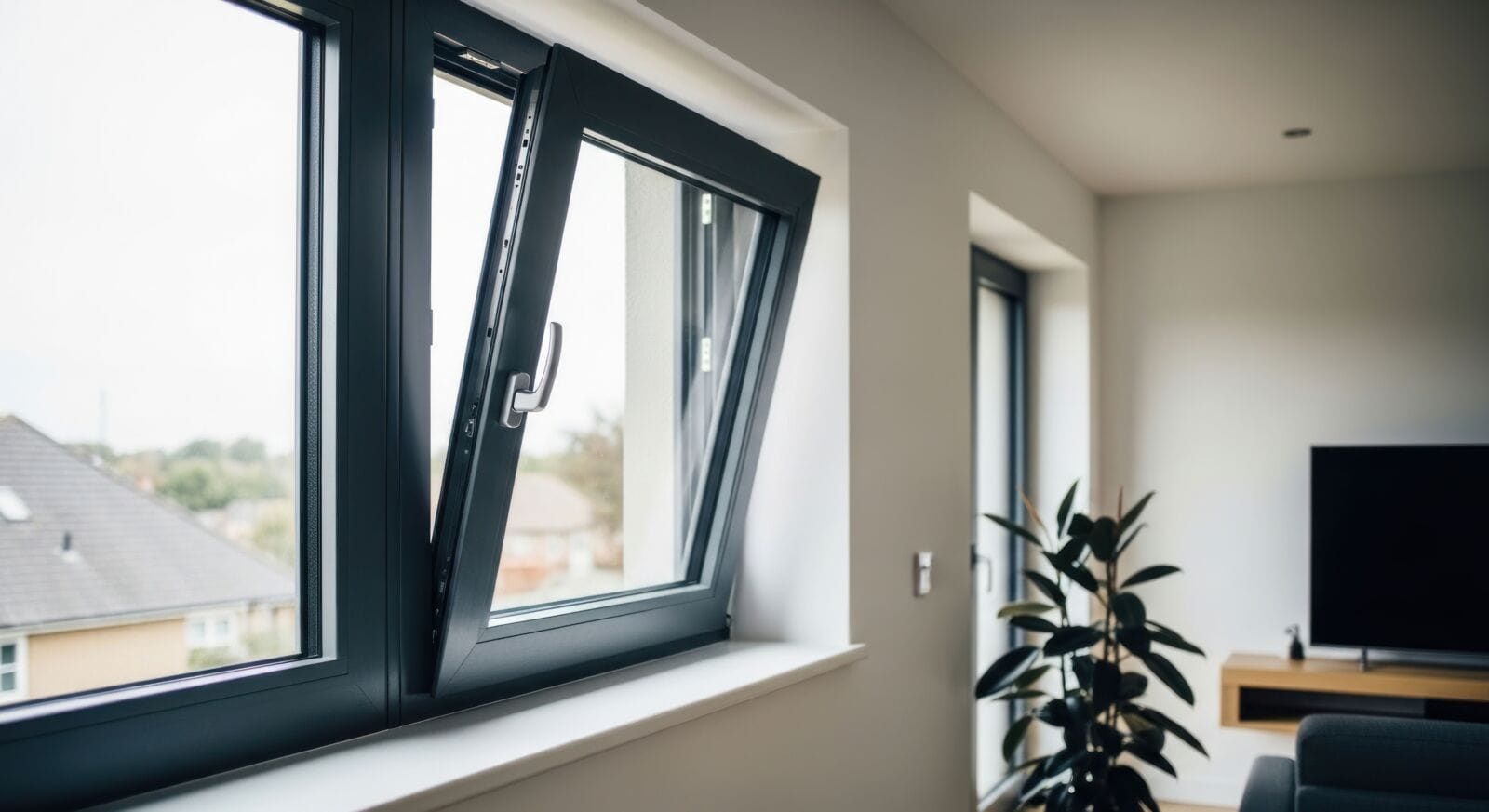
If you have ever walked through a home in Germany or Austria, you probably noticed something different about the windows. They do not slide up and down like typical American double-hung windows. Instead, they swing inward like a small door — or tilt at the top to let in a steady breeze while staying securely locked in place. This dual-action design is called tilt and turn, and it has been the standard across Europe for decades.
Now, a growing number of U.S. homeowners, architects, and builders are catching on. Whether the goal is better energy efficiency, stronger security, or simply a cleaner, more modern look, tilt and turn windows are earning a reputation as one of the smartest upgrades a homeowner can make.
How Tilt and Turn Windows Actually Work
The concept is elegantly simple. A single handle controls two different opening positions. Turn the handle ninety degrees to the side, and the entire sash swings inward like a door, giving you full access to fresh air and an easy way to clean both sides of the glass from inside the room. Rotate the handle upward, and the sash tilts inward at the top, creating a narrow gap that allows ventilation without fully opening the window.
That tilt position is what makes this design especially practical. It lets air circulate even during a rainstorm, keeps children and pets safe, and maintains a level of security that a wide-open window simply cannot match.
Unlike double-hung windows, which rely on sliding sashes and brush seals, tilt and turn windows close against compression seals on all four sides. Multi-point locking mechanisms pull the sash tight against the frame, eliminating the tiny gaps that let drafts, dust, and noise slip through.
Energy Efficiency That Goes Beyond the Glass
For homeowners in hot-climate states like Arizona, where cooling costs can dominate household budgets for months at a time, window performance is not a minor detail. Standard windows with single or dual-point locks often leave small gaps where conditioned air escapes and outdoor heat seeps in.
European windows take a different engineering approach. Multi-chamber profiles — the internal structure of the window frame — create insulating air pockets that slow thermal transfer. Combined with triple-pane glass, warm-edge spacers, and argon gas fills, these windows can achieve U-values as low as 0.14, far exceeding typical ENERGY STAR requirements.
The result is a noticeable difference in both comfort and utility bills. Rooms stay cooler in summer and warmer in winter without forcing the HVAC system to work overtime. For homeowners building to Passive House standards or simply looking to reduce their carbon footprint, the performance gap between European-style and conventional American windows is hard to ignore.
Security Without Compromise
Home security is another area where tilt and turn windows outperform their American counterparts. A standard double-hung window typically has one or two sash locks — enough to keep the window closed, but not enough to deter a determined intruder.
Tilt and turn windows use multi-point locking systems that engage at several points around the entire perimeter of the sash. When the handle is in the closed position, the window is locked on all four sides. This makes it significantly harder to pry open from the outside.
For added protection, homeowners can choose laminated or tempered glass, and even impact-rated glazing designed to withstand hurricane-force winds and attempted break-ins. The steel-reinforced frames add another layer of structural integrity that vinyl-only frames cannot match.
Noise Reduction for Urban and Suburban Living
Anyone who lives near a busy road, an airport flight path, or a neighborhood full of weekend lawn mowers knows how much outside noise can affect quality of life. Standard windows do a mediocre job of blocking sound because their sliding seals leave small openings that transmit vibrations.
Because tilt and turn windows seal on all four sides with compression gaskets, they block significantly more noise. High-performance systems can achieve sound transmission class (STC) ratings of 41 to 44 decibels — roughly double the sound insulation of a typical architectural-grade window. For homeowners who value quiet living spaces, this alone can justify the investment.
Seemray, a U.S.-based supplier of German-engineered windows, offers soundproof window options specifically designed for noise-sensitive environments, combining triple-pane glass with multi-chamber frames to create a measurable difference in indoor sound levels.
Cleaning Made Simple
One of the most underrated benefits of tilt and turn windows is how easy they are to clean. Because the sash swings fully inward, homeowners can reach both the inside and outside surfaces of the glass without leaving the room. There is no need for ladders, extension poles, or professional window-cleaning services — even on upper floors.
This is a practical advantage that adds up over time, particularly for multi-story homes or buildings where exterior window access is difficult or expensive to arrange.
Style Options That Fit Any Home
A common misconception is that European-style windows only suit modern or minimalist architecture. In reality, tilt and turn windows are available in a wide range of colors, finishes, and configurations that complement everything from contemporary desert homes to traditional brick colonials.
Frame colors can be customized with dozens of exterior and interior options, from classic white to anthracite grey to woodgrain finishes. Grid patterns, handle styles, and privacy glass options offer further personalization. Fixed picture panels, French-style double-leaf configurations, and curtain wall systems can all be combined with operable tilt and turn units to create exactly the look and function each opening requires.
What to Consider Before Making the Switch
Tilt and turn windows are not a one-size-fits-all solution, and it is worth understanding a few practical considerations before committing:
Inward clearance. Because the sash opens into the room, you need to account for furniture, deep windowsills, and anything else that might block the swing path. In most cases, this is easy to plan around, but it is worth measuring before you order.
Blind and shade mounting. Traditional blinds that mount inside the window frame will not work with an inward-opening sash. Instead, blinds attach directly to the sash so they move with it, or mount above the frame. Insect screens fit on the outside of the window rather than the inside.
Upfront cost. European-engineered windows typically cost more than basic vinyl double-hung replacements. However, the price gap has narrowed considerably. Tilt and turn windows from Seemray start at around $280 per unit, with pricing that scales based on size, glazing, profile system, and color choices. Many homeowners find that the long-term savings on energy, maintenance, and replacement costs more than offset the initial investment.
Installation. Tilt and turn windows work equally well in new construction and full-window replacement projects. Professional installation typically takes just a few hours per window, with a full-house project completed in one to two days.
Two Profile Systems for Different Performance Needs
Not every project requires the same level of insulation or structural rating. That is why leading suppliers offer tiered systems. For example, Seemray’s Global70 system uses a five-chamber Rehau uPVC frame with steel reinforcement, achieving U-values down to 0.18 and an STC rating of 41 dB. It is an excellent fit for the majority of residential projects.
For homes built to Passive House standards, or in extreme climates where maximum thermal performance is essential, the Global80 system steps up to a seven-chamber RAU-FIPRO glass-fiber PVC profile with U-values as low as 0.14 and Passive House certification. Both systems carry a 100-year structural guarantee.
The Bigger Picture: Building Smarter Homes
The shift toward tilt and turn windows reflects a broader trend in American home building: a growing appetite for products that deliver measurable performance rather than just curb appeal. Homeowners today are more informed, more energy-conscious, and more willing to invest in upgrades that reduce long-term operating costs.
European window technology has been refined over generations in countries with strict energy codes and demanding climates. The fact that it is now readily available to American homeowners — manufactured to order, shipped nationwide, and backed by domestic support — removes the last practical barrier to adoption.
Whether you are planning a new build, renovating a midcentury home, or simply replacing aging double-hung windows that no longer keep the heat out, tilt and turn windows deserve a serious look. The combination of ventilation flexibility, airtight sealing, multi-point security, and clean-from-inside convenience is hard to match with any other window type on the market.
For homeowners ready to explore European-style windows, Seemray offers free quotes, a window cost calculator, and showrooms in Cleveland, Ohio and Brooklyn, New York. Delivery and installation services are available nationwide.