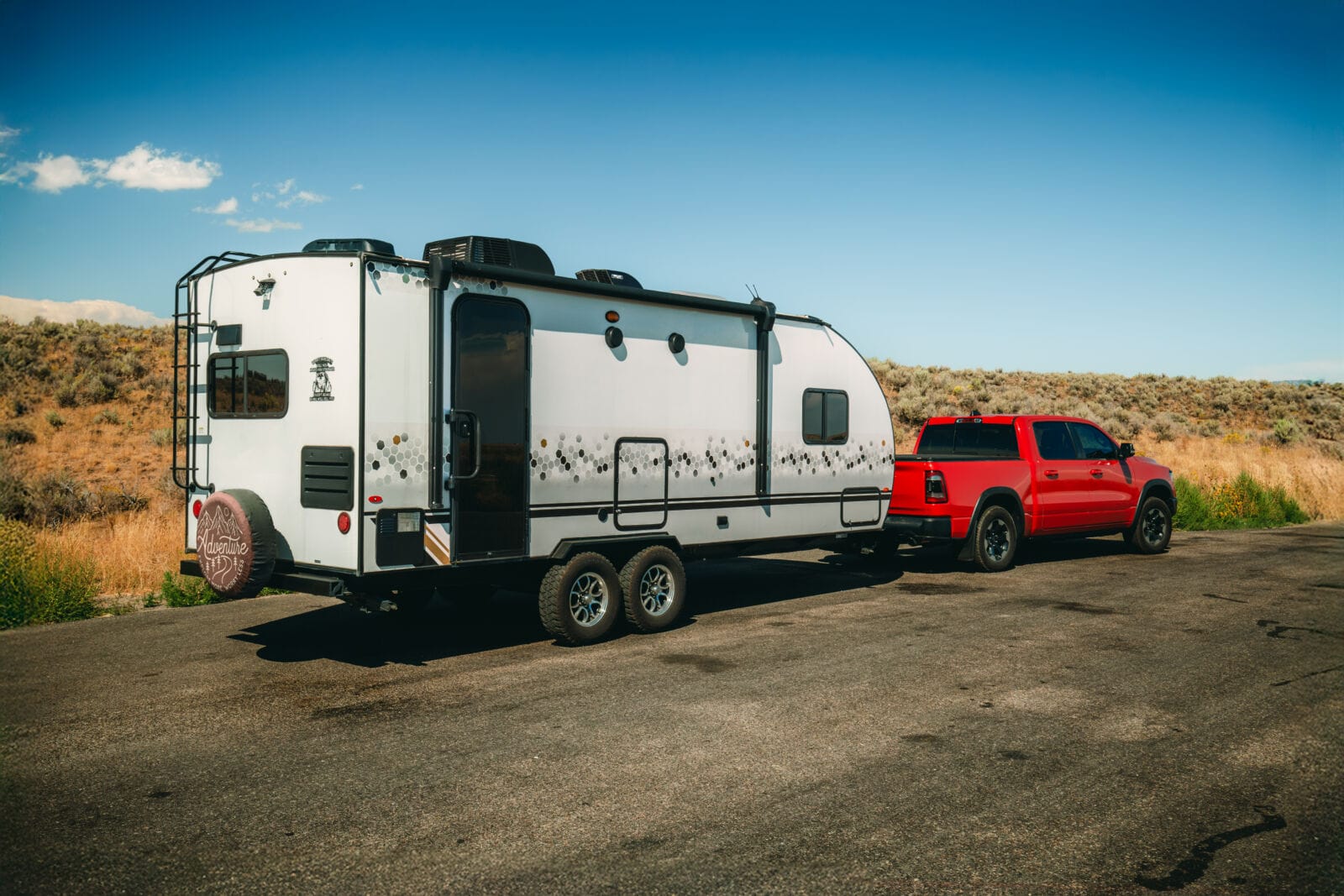
Most pickup trucks leave the driveway with the trailer nose pointed at the sky or the tail dragging toward the pavement. The driver has no idea. They checked the ball, hooked the chains, verified the lights, and called it good. But a trailer that isn’t riding level is a tow setup that’s fighting you on every curve, wearing your tires unevenly, and shifting its load distribution in ways that make a blowout at 70 mph a real possibility. The fix is straightforward, takes about ten minutes, and requires nothing more than a tape measure and a flat driveway.
Why Level Actually Matters (It’s Not Just Cosmetic)
A level trailer distributes tongue weight the way the manufacturer designed it to. Tip the nose up, and the rear axle of your tow vehicle loses grip. Tip the nose down, and you’re pushing weight onto the front coupler, which increases the load your hitch ball is fighting. Either way, the load balance is off, and your stopping distance gets longer.
Government safety materials recognize the connection between improper trailer loading, severe sway, and loss of control, and that connection starts right in your driveway with a setup that isn’t level to begin with. This isn’t a scare tactic. A rig that’s two or three inches nose-high or nose-low is common, and most drivers tow for years without correcting it because they can’t see it from behind the wheel. The fix, in most cases, is choosing the right hitch drop or rise for your specific truck height. That’s it. The geometry is simple once you know where to measure.
The Tow Level Test: Four Measurements, One Decision
Here’s the framework I call the Tow Level Test. It works for any ball-mount setup and takes under ten minutes on a flat surface.
- Step 1: Measure your hitch receiver height. With your empty truck parked on flat ground, measure from the ground to the inside top of your hitch receiver tube. Write it down.
- Step 2: Measure your coupler height. Unhitch the trailer, park it on flat ground (use the tongue jack to keep it level), and measure from the ground to the inside of the coupler where it sits when the trailer is loaded and ready to roll. This is your loaded coupler height, which is slightly lower than the empty height because the trailer springs compress under load. If you always tow unloaded, measure empty. If you haul a full boat or camper, measure with gear on board.
- Step 3: Do the math. If your receiver sits at 17 inches and your coupler needs to be at 13 inches when hitched, you need 4 inches of drop. If the coupler sits higher than the receiver, you need a rise.
- Step 4: Pick your ball mount accordingly. A drop hitch bridges that gap with precision, and adjustable versions let you dial in the exact drop without buying a new ball mount every time you switch trailers.
That’s the whole test. Four numbers, one purchase decision.
MORE NEWS: Arizona earns 19 Michelin Guide selections in inaugural Southwest Guide
How Much Drop Do Most Trucks Actually Need?
It varies more than people expect, and the gap between truck models is significant. A lifted F-250 with a 3-inch suspension lift and factory receiver height of 19 inches needs a very different drop than a stock Tacoma sitting at 14 inches. The NHTSA notes that you should obtain the tongue weight of the trailer when fully loaded and relate it to the gross axle weight ratings of your towing vehicle, which means the loaded measurements matter far more than the empty ones. Skipping the loaded coupler height measurement is the single most common mistake in the Tow Level Test.
The table below shows approximate receiver heights for common stock truck configurations and the typical drop range they require for trailers with 14-to-17-inch coupler heights. These are starting points, not guarantees. Always measure your specific setup.
| Truck (Stock Height) | Approx. Receiver Height | Typical Drop Needed |
|---|---|---|
| Ford F-150 (stock) | 15–17 in | 2–4 in |
| Ram 1500 (stock) | 16–18 in | 2–5 in |
| Chevy Silverado 2500HD (stock) | 17–19 in | 3–6 in |
| Toyota Tundra (stock) | 16–18 in | 2–5 in |
| Ford F-250 Super Duty (stock) | 18–20 in | 4–8 in |
A stock F-250 towing a travel trailer with a 14-inch loaded coupler height could easily need 6 inches of drop. That’s not a niche scenario. Travel trailers recorded 245,648 retail registrations in 2024 in the U.S. alone, according to Statistical Surveys Inc., as cited by the RV Industry Association, meaning millions of tow setups are on the road right now, and a large share of them are attached to trucks with factory receiver heights well above their trailer couplers.
You can confirm those RVIA registration figures directly. The sheer volume of towable rigs on U.S. roads makes getting this measurement right more relevant than ever.
The Mistake People Make With Adjustable Hitches
Adjustable hitches get a bad reputation from people who set them wrong and then assume the product is the problem. The most common error is adjusting the hitch once, locking it down, and never revisiting the setting when they switch trailers.
“Tongue weight is the most overlooked variable in tow setup. Drivers check the ball size and call it done, but without knowing the tongue weight, they’re guessing at balance.”
That’s the consistent position across towing safety research, and it’s backed by NHTSA’s own guidance on towing a trailer safely, which specifically calls out tongue weight as a critical factor in maintaining control. An adjustable hitch only works if you re-measure when you change trailers. The drop that was right for a 20-foot boat trailer is probably wrong for a loaded cargo trailer with a higher coupler height.
The other mistake is guessing the ball height. Drivers often set the ball at the same height as the coupler while the trailer is sitting on its tongue jack at a random angle. The coupler height when the trailer is level and loaded is the only number that matters.
A Quick Pre-Tow Checklist
Once you’ve nailed the drop calculation, run through this before every haul:
- Park both the truck and trailer on flat, level ground before hitching
- Check that the trailer frame is visually parallel to the ground after hitching
- Re-measure the coupler height with a full load at least once per season
- Verify the hitch lock pin is fully seated and secured
- Confirm the safety chains cross underneath the coupler with enough slack for turns but no ground drag
- Check all trailer lights before you move an inch
None of this takes more than five minutes once you’ve done it a few times. The Tow Level Test itself becomes automatic after two or three rigs.
The Right Tool for the Job Makes All the Difference
A cheap fixed ball mount from a box store is fine if your truck and trailer heights match perfectly and you never change trailers. For everyone else, which is most truck owners, an adjustable setup is the only sensible choice. It lets you tow a boat on Saturday and a cargo trailer on Sunday without buying new hardware each time.
The geometry of a level tow setup isn’t complicated. Measure twice, pick the right drop, and
your truck handles better, your trailer tracks cleaner, and the whole rig stops shorter in an emergency. That’s worth ten minutes in the driveway every time. Got a truck with a lift kit? Your receiver height just changed significantly. Measure it again and recalculate from scratch before your next haul.