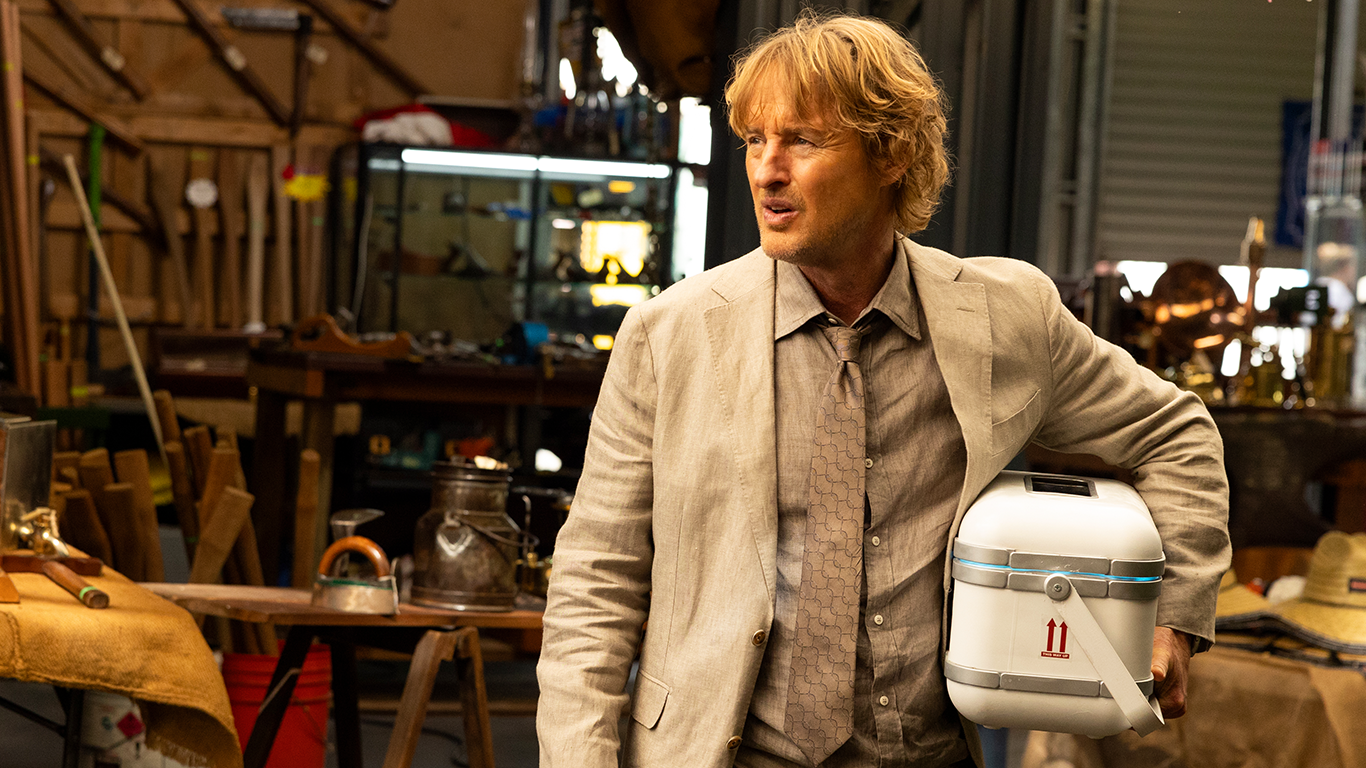
Owen Wilson has spent decades as film’s laid‑back outsider, the guy who wanders into chaos with a quiet, comedic cool. But when he read the script for the action‑thriller “Runner,” Wilson said the genre shift made the 90‑minute film a “must‑do” project.
“Runner” stars Alan Ritchson as Hank Malone, a stoic ex‑Navy SEAL, in a brutal race against time when a critical medical delivery makes him and his fast‑talking medical courier partner (Wilson) targets of a ruthless cartel.
“I read a lot of scripts, and every once in a while, you read something that really hooks you,” Wilson said via Zoom with director Scott Waugh. “Runner did that.
“I always loved movies like the “Terminator,” the first one, which had a simple story that you get into right in the beginning. This seemed like an opportunity to tell a story that does that and delivers on that energy and excitement. I just liked that challenge.”
Wilson recognized that his relationship with Ritchson was vital to the movie.
“People say, ‘Oh, this is such a different movie for you,’ because of the stakes and intensity. But parts of it are very familiar — relating to another guy in the scene. Growing up with brothers, that stuff is very easy for me.”
Waugh added, “Alan’s such a strong character person. We needed someone to offset that — so you had a bit of the Abbott and Costello vibe. And Owen just came off the page.”
Producer Todd Garner said the film’s classic chemistry echoes the mismatched magic of “48 Hrs.,” “Lethal Weapon” and “Bad Boys.”
“It’s something you can’t really define,” Garner said in a statement. “As we were all combining forces to figure out who would be the perfect foil to work with Alan Ritchson, Owen Wilson’s name came up. We were lucky enough that he liked the script as well.”
Waugh signed on after a call from co‑producer Greenstein, whom he’d worked with on 2023’s “Expendables 4.” He was taken by the script’s dual tone.
LATEST NEWS: 20 best U.S. cities for retirement includes 2 from Arizona
LEARN MORE: Arizona earns 19 Michelin Guide selections in inaugural Southwest Guide
Comedic chops
Wilson is best known for his roles in “Wedding Singer” and “Zoolander.” Somewhat of a buddy film, “Runner” leans into the odd‑couple road‑movie DNA that defined “Midnight Run,” “48 Hours” and “Lethal Weapon.”
Waugh used a different adjective to describe Runner.
“It was super funny, but the emotional tone really ‘surprised’ me. My one word for everybody in this movie is ‘surprise,’” said Waugh, a second‑generation stuntman‑turned‑director.
Ritchson, who brought his “Reacher” stunt team with him, found Wilson’s emotional precision surprising.
“Owen is a genius the way he can elevate a scene and cut right down to the deepest part of the psychology,” he said.
The result is a partnership that feels both throwback and fresh — mismatched, funny, and grounded in real stakes.
A director who moves the camera — and the audience
If Wilson is the film’s heart, Waugh is its pulse. His approach to action is visceral, participatory, and deeply informed by his stunt lineage. His father invented the original Pogo Cam — the handheld precursor to the Steadicam — and Waugh carries that legacy forward.
“I really wanted to move the camera in a way that immerses the audience,” he said. “Not voyeuristic — participating.”
Wilson felt that energy immediately.
“Drama and action depend so much on the director and cinematographer — how you make it come to life visually in an exciting way.”
The film’s car sequences — 40 pages’ worth — became a proving ground. Waugh engineered a custom rig that enabled 360‑degree shots inside a moving vehicle, tearing off the roof and using white screens instead of blue to avoid color bounce. The result is a signature long take, “The Oner,” threading the camera through high‑speed chaos.
“When we were on set actually executing it, I was pinching myself,” Waugh said. “This is amazing.”
Australia rewritten into the story
Though originally set in Los Angeles, Runner was rewritten for Brisbane and the Gold Coast after production challenges made the original plan impossible. Waugh embraced the shift.
“To have it just be Australia and use elements of that in the story… I think made it good,” Wilson said.
The team leaned into the region’s sun‑drenched streets, cane fields, coastline, and iconic Story Bridge — turning the film into a kinetic postcard of Queensland.
“It’s a road movie,” Waugh said. “And when you see the topography change… it was a cool way to show Australia in a different light.”
Despite the explosions, car chases, and hospital brawls, Runner is ultimately about connection — the kind forged under pressure, fear, and unlikely partnership.
“I want people to remember how important these connections are,” Ritchson said. “How much they’re worth fighting for.”
Wilson, who joked that action might be “easier than comedy,” still found himself covered in blood — “maybe mine, maybe somebody else’s,” he teased.
But beneath the humor, he was drawn to the film’s emotional stakes.
“The story just hooks you,” he said. “It never lets up.”
For Waugh, that blend — adrenaline fused with vulnerability — is the point. He’s spent his career chasing the kind of action that rattles an audience, but he’s just as committed to the quieter beats that make the chaos matter.
“I think people forget that action only works when you care about who’s in the middle of it,” he said. “If you don’t feel something for these guys, the explosions don’t mean anything.”
That ethos shaped every choice on set, from the camera rigs to the character beats. Wilson and Ritchson’s dynamic became the film’s emotional engine, a mismatched duo forced into trust, humor, and survival. Their banter keeps the story buoyant; their fear keeps it grounded.
“It’s funny, but it’s not just funny,” Wilson said. “There’s something real underneath all of it — something about showing up for someone when you don’t have to.”
Ritchson echoed that sentiment, calling the film “a reminder that connection is the thing that gets us through the worst moments.”
And Waugh hopes audiences feel that — not just the spectacle, but the sincerity threaded through it.
“The comedy is just the spice,” he said. “The heart is what makes it stick.”
With Runner, that heart beats loudest in the final stretch, when the stakes sharpen and the partnership between Wilson and Ritchson lands its emotional punch. It’s the kind of ending that lingers — not because of the explosions, but because of the bond forged inside them.
As Wilson put it, “The story just hooks you. It never lets up.”