Voodoo 5 singer/guitarist Skip Heller likes to say he’s not particularly talented. He just works harder than other musicians.
That line isn’t a self-deprecating quip. Heller’s career—like his music—hasn’t been a straight line. He has performed at carnivals, weddings, jazz clubs, punk festivals, Holocaust survivor concerts, and experimental orchestral shows. He’s written TV scores and contributed to exotica records. He believes there’s something for everyone.
“I don’t like music that stands still,” said Heller, who lives in Downtown Los Angeles. “If you don’t like what’s happening at this moment, wait 16 bars. Something else will.”
Music listeners can check it out for themselves at 8 p.m. Saturday, Sept. 26, when Heller’s band, Voodoo 5, performs at The Dirty Drummer at 2303 N. 44th Street, Phoenix.
DEEPER DIVE: Here are Arizona’s Most Admired Companies of 2026
A career that started in a stable
Heller’s music career reads like a movie. As a teenager working at a carnival, he stumbled into what he still calls “the worst‑ever Beatles tribute band.” The band’s “George Harrison” punched out “Paul McCartney,” leaving the act without a guitarist. They spotted Heller shoveling manure.
“They didn’t audition me,” he said. “I got the gig because I had a Gretsch guitar.”
They pinned the oversized costume on him and told him not to turn around so the audience wouldn’t see the lackluster alterations job. It was absurd, but it was also the beginning. From there, Heller played every gig he could find in Philadelphia, anywhere someone needed a guitarist.
“I took every kind of gig,” he said. “I remember having to dress up like Dracula and singing ‘Monster Mash’ at blood drives.”
Heller is a self-taught musician who writes horn charts by hand, figuring out how to make small budgets sound big. That DIY ethic defines his career.
The workaday musician
Heller’s stories are rarely about glamour. They’re about work and serving fans.
“Music is a service industry,” he said. “I don’t have fans. I have a clientele. They look at me and go, ‘You’re going to deliver the goods, and if you don’t, I can find somebody else who will.’”
That mindset came from years of playing with musicians who shaped him in unexpected ways. Bootsy Collins, for example, went beyond showing him the funk. He showed intention.
“Bootsy doesn’t just tell you what he wants; he tells you the motivation behind it,” Heller said. “You will never play a funk vamp [a repeating rhythmic groove in funk music] the same way again after Bootsy has explained to you why the guitar goes a certain way.”
The Voodoo 5 era
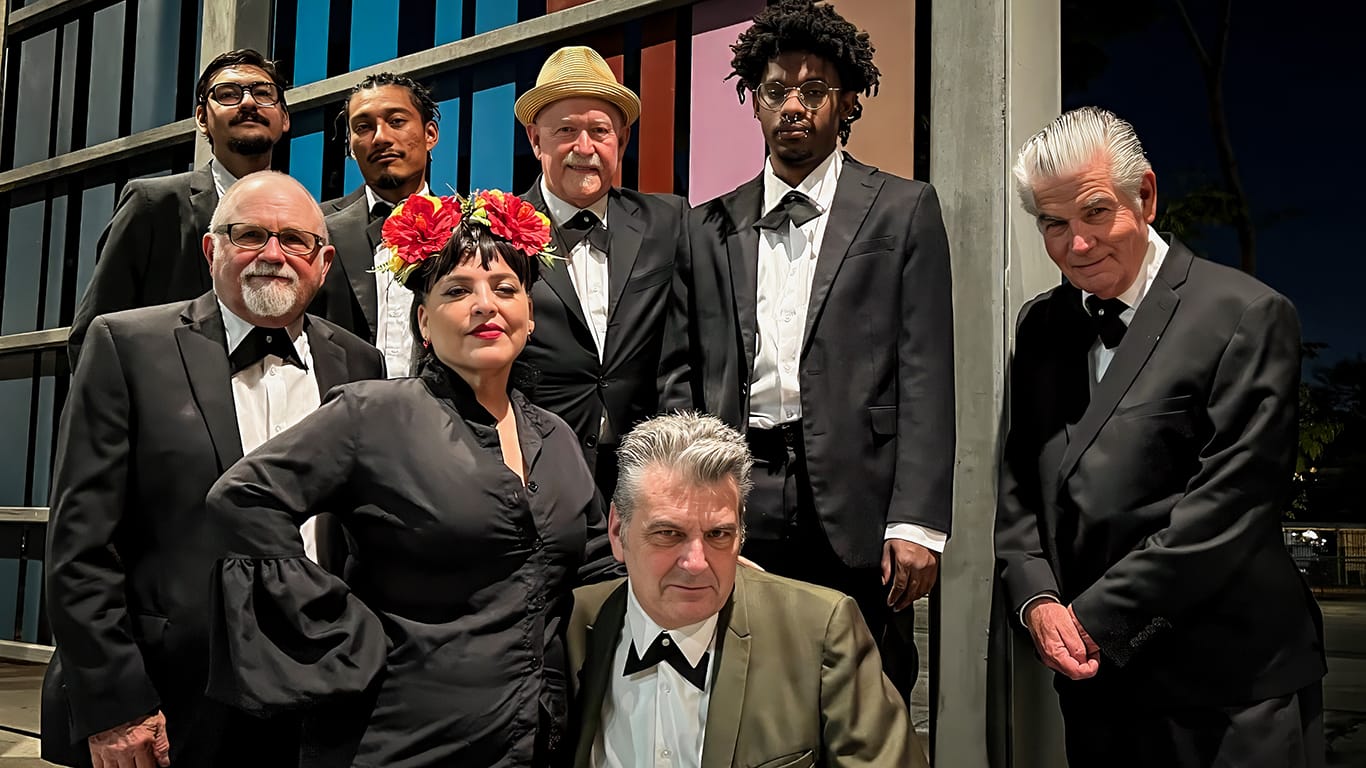
Today, Heller leads Voodoo 5, a seven‑person ensemble built around Latin percussion, steel guitar, vibraphone, flute, and the striking vocals of his wife, Lena Marie Cardinale. It’s exotica, but not nostalgia. The genre is a blend of everything Heller has absorbed since childhood.
“My guitar style is very much a Fender guitar style,” he said. “Even though I’m a jazz player, I have influences from rhythm and blues to choro to whatever.”
Cardinale’s voice, he said, carries “four Gs and five Ds” — a range that lets him write with the kind of ambition he once reserved for his heroes. Her influences include Yma Sumac, whose operatic exotica recordings Heller adored as a kid. Sumac is the first Latin American and Peruvian female singer to debut on Broadway.
The band’s arrangements shift constantly. Personnel changes reshape compositions.
“Each performance is stamped with the identity of the people who are in the band at that time,” he said. “If you go see a band every four or five months and the songs surprise you, then I’m doing my job.”
A historian’s approach to exotica
Heller’s fascination with exotica is authentic.
“I love the idea of being tied to tradition,” he said. “Frankly, that’s a Jewish thing and a historian thing.”
He doesn’t dress in vintage Hawaiian shirts or midcentury costumes. He wears black suits, like jazz players, country singers and blues bands.
“We’re not recreating 1959,” he said. “I don’t think 1959 is where the interesting world ended.”
Heller’s discography is sprawling. After his 1999 album “Couch, Los Angeles,” he began writing for television for shows like “The Flintstones: On the Rocks” and “Dexter’s Laboratory.” He returned to jazz with “Homegoing” and “Out of Time!” He explored world music on “Mean Things Happening in This Land.” He now records with Voodoo 5, whose latest album is “HypnoCoin.”
He and Cardinale have also leaned into film culture. They recorded a 45 for Alternative Tentacles, the label founded by punk rock legend Jello Biafra, featuring the theme from “Faster, Pussycat! Kill! Kill!” and a track from “Beyond the Valley of the Dolls.” The picture sleeve features a rare 1961 photo of Tura Satana, a Japanese American actress and dancer. They’re shooting a video with filmmaker Julia Marchese, whose documentary “Out of Print” chronicled the New Beverly Cinema in Los Angeles.
Another single, on Bakersfield’s Killer Kern label, pairs an exotica instrumental with a slow, menacing Latin cover of Frank Zappa’s “Trouble Coming Every Day.”
Next year, Heller plans to release a live album to document of how far the band has evolved.
“We play the stuff from our first two albums so differently now,” he said. “It might be time to revisit it.”
Heller is 60 now, and he’s thinking about legacy. “My name will never be new again,” he said. “So, I’d better be interesting, and I’d better be proficient every time you look over at me.”
He talks about Randy Newman, Nick Lowe and Jonathan Richman, all artists who aged gracefully by staying curious. He talks about Dolly Parton, whose legacy will live in karaoke bars forever. He talks about Leonard Bernstein, whose birthday fell on the day Parton died.
“You get to a certain age, and you really start to think about what you’ve actually put out there into the world.”
For Heller, the answer is simple: work.
“I’m not going to bet the ranch that I’m going to get rich doing it,” he said. “But I like the notion that you’re allowed to age gracefully.”