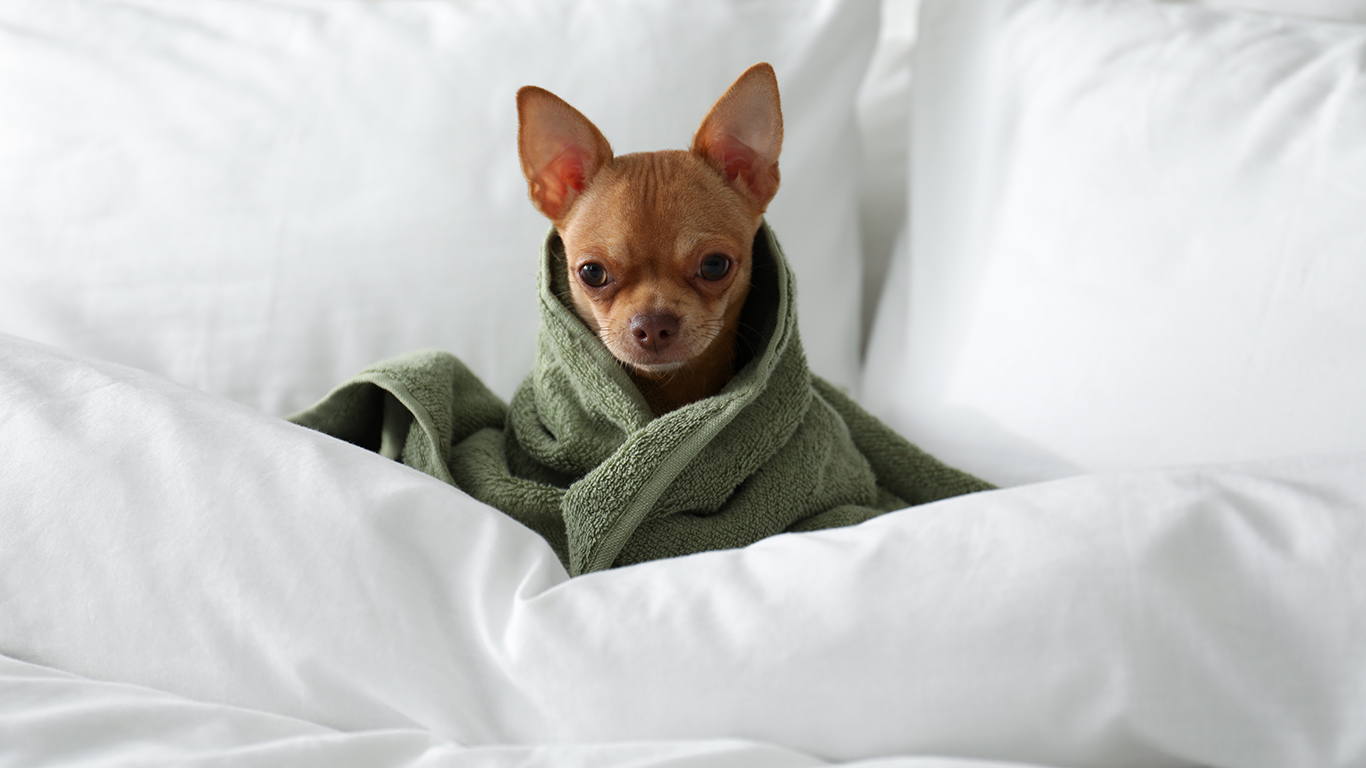
There is a thing about owning a dog in Arizona that nobody puts in the welcome brochure.
It is not the heat. Everyone warns you about the heat. It is the floors.
Walk into almost any Phoenix home and look down. Porcelain tile. Polished concrete. Maybe luxury vinyl plank if the place was built recently. Carpet is rare here for a reason, it traps heat, holds dust, and shows wear fast in a desert climate. Tile is the smart choice for Arizona homes. It just is not a great choice for a dog.
Dogs in Arizona spend a strange amount of their lives on hard floors. Summer pushes them indoors for months at a time. By July, asphalt sits at around 140°F when the air is 95°F, and there are reports of sidewalks hitting 155°F during heat waves. A dog’s paw can burn in roughly one minute at 125°F. So the morning walk gets cut short, the afternoon walk gets cancelled, and the dog ends up flat on the kitchen tile for ten hours a day.
That is the problem.
What a Hard Floor Actually Does to a Dog
A young dog seems fine on tile. They flop down, they spring back up, no complaints. The damage is quiet and slow.
Veterinary sources, including the AKC, point to repeated impact on hard surfaces as a contributor to joint wear over time. Larger breeds feel it sooner. Labradors, Goldens, German Shepherds, Boxers, the dogs Arizona families tend to gravitate toward, are also the breeds most prone to hip dysplasia and elbow issues. A 70-pound dog landing on porcelain tile a dozen times a day is doing the canine equivalent of running on concrete in flat sneakers.
Then there is the temperature angle. Tile stays cool in summer, which dogs love at first. But that same tile gets cold and unforgiving in January, especially in homes without insulated slab foundations, which is most of them in this region. A dog who sleeps directly on cold tile night after night will often start avoiding the floor entirely. Watch a dog who lives on hard floors long enough and you will notice they start picking the rug. Then the laundry pile. Then the couch.
They are not being spoiled. They are looking for a surface that does not hurt.
Why a Soft Dog Bed Solves More Than Comfort
Here is where most Arizona dog owners go wrong. They buy a thin, flat dog pillow at a big box store, drop it in the corner, and consider the problem solved. The dog uses it for a week, then drifts back to the rug or the couch.
The issue is that flat synthetic mats compress under any real weight. A 15-pound dog might be fine on one. A 60-pound Lab is not. Within a month, the dog is essentially lying on tile through a thin layer of polyester.
A genuinely soft dog bed does something different. The good ones use structured fabric, boucle, teddy fleece, flannel, or corduroy, over a foam or shredded foam base that does not flatten. The fabric matters because it adds tactile depth that dogs gravitate toward. The base matters because it actually holds the dog off the floor. You can press your hand into one and feel resistance instead of bottom.
There is a reason higher-end pet brands have moved toward this style of construction. It works in Arizona homes specifically because it handles the two extremes most beds fail at: a dog who is overheated and wants something that breathes, and a dog who is cold-floor avoidant and wants something that insulates.
DEEPER DIVE: Ranking Arizona: Top 10 golf courses for 2026
INDUSTRY INSIGHTS: Want more news like this? Get our free newsletter here
What to Look For in an Arizona Home
After looking at how dog beds perform in desert climates, a few features separate the ones that last from the ones that end up in a thrift pile.
| Feature | Why It Matters in Arizona |
| Washable cover | Dust and fine desert sand get into everything. A non-removable cover becomes unusable in months. |
| Waterproof inner lining | Hot dogs drink more water. Spills, slobber, and the occasional accident are constant. |
| Structured foam base | Tile is unforgiving. The bed needs to hold the dog above the surface, not collapse to it. |
| Breathable fabric | Synthetic plush traps heat. Boucle, teddy, and flannel breathe better than polyester velour. |
| Non-skid bottom | Polished tile plus a flat bed equals a dog surfing across the kitchen. Avoid it. |
The fabric question is the one most people get wrong. Boucle, the looped fabric used in modern furniture, has become popular for dog beds because it gives the surface visual depth and physical softness without being a sweat trap. Teddy fleece works similarly. Both feel substantial in the hand. Flat polyester does not.
The Bed Test Most Owners Skip
Before buying, do one thing. Press the bed down with your full weight, then lift your hand. If your handprint stays for more than a second or two, it is too soft for a medium or large dog. If you cannot push your hand in at all, it is too firm and the dog will not use it.
The right surface gives, then comes back. That is what protects joints.
It is also worth checking what the bed is filled with. Shredded foam holds shape and breathes. Solid memory foam offers more support but runs warmer, which is a real consideration in Arizona. Polyester fiber fill flattens within weeks. The label usually tells you exactly which one you are buying if you read it.
What Changes When You Get It Right
A dog with a proper bed sleeps differently. Deeper. Longer stretches. Less shifting around at 3 a.m.
That part is obvious. The less obvious part is what it does to the rest of the house. The dog stops sleeping on the couch because they have a better option. The rug stops getting destroyed because it is no longer the softest surface in the room. The kitchen tile stops looking like a fur magnet because the dog actually wants to be on their bed.
For families in Phoenix, Scottsdale, Gilbert, or anywhere with the standard Arizona floor situation, the right bed is not a luxury purchase. It is the piece of furniture the dog will spend more time on than any other surface in the house.
Pick the one that can handle that job.