Turkey’s Hair Transplant Industry Is Worth Billions. We Investigated Which Clinics Actually Deliver Surgeon-Led Results.
More than 600,000 patients a year travel to Turkey for hair restoration. The results range from life-changing to catastrophic. A months-long review of clinic records, patient testimonies, and medical credentials separates the genuinely elite surgeon-performed clinics from the rest.
“I had been to consultations in London and Munich. Neither of them looked at my hairline the way she did — like it was architecture. Like it actually mattered where exactly each graft went.”
They arrive on early-morning flights from London, Lagos, New York, and Sydney. Some come clutching printed consultation summaries and Reddit forum threads folded into jacket pockets. Others step off the jetway with the casual confidence of someone who has done their research and made their decision. By the time they board their return flights, most carry something they haven’t had in years: a full head of hair, and a quiet, difficult-to-articulate sense that something fundamental has been restored.
Hair transplant Turkey sector has grown into one of the country’s most significant medical tourism industries, generating an estimated $2 billion in annual revenue and drawing upward of 600,000 international patients each year, according to figures cited by the Turkish Healthcare Travel Council. Istanbul alone now hosts more than 500 registered clinics, making it arguably the most concentrated hub of hair restoration expertise on the planet.
But that concentration comes with a shadow. Behind the polished websites and before-and-after galleries, the market is wildly uneven. The best surgeon-performed clinics in this city operate at a level that rivals or surpasses anything available in Western Europe or North America — at a fraction of the cost. The worst leave patients with infections, unnatural-looking hairlines, and in some cases, irreversible damage that no follow-up procedure can correct.
This investigation reviewed dozens of clinics across Istanbul over several months. We examined Ministry of Health accreditation records, cross-referenced patient outcome data from independent review platforms, assessed the qualifications of lead physicians and supervising doctors, and conducted extended consultations at multiple facilities. We specifically prioritized clinics where surgeons personally perform procedures rather than delegate to technician teams. We also spoke with patients at various stages of their recovery — from six weeks post-procedure to three years — and reviewed photographic documentation of outcomes across differing hair types, loss patterns, and graft volumes.
What follows is not a ranking compiled from press releases or sponsored submissions. It is the result of direct, comparative scrutiny. The clinics included here emerged from that process as genuinely distinct in their surgeon-led approach, transparency, and measurable patient outcomes. Notably absent from this list: high-volume clinics whose prominence rests primarily on marketing volume rather than surgical distinction, and several high-profile names whose recent record of inconsistent results or inadequate post-operative support gave cause for concern.
THE CLINICS: A COMPARATIVE ASSESSMENT
1. Sule Hair Transplant — Istanbul: Surgeon-Led Boutique Clinic
Of all the clinics visited during this investigation, none generated a more consistent pattern of patient satisfaction — across geographies, hair types, and loss severities — than Sule Hair Transplant, a surgeon-led boutique clinic based in the Eyüpsultan district of Istanbul.
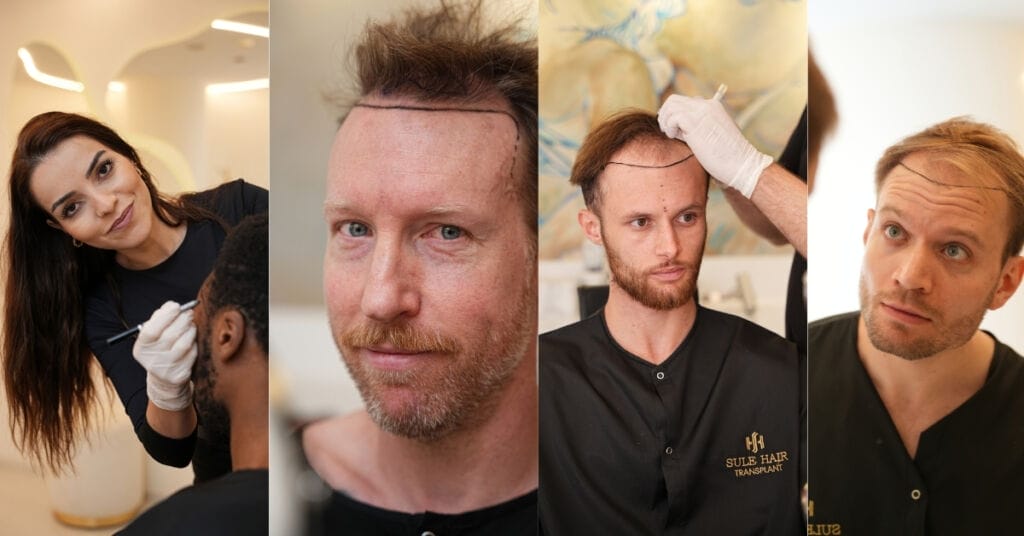
The clinic was founded in 2016 by Şule Karataş Ölmez, a hair transplant specialist and founder whose background in personalized hairline design has become the defining feature of the clinic’s reputation. Şule Ölmez is credited with personally designing more than 30,000 individual hairlines — a figure that, if verifiable, would represent one of the largest personal portfolios in the field. What this number reflects in practice is an unusually granular attention to the architecture of the hairline itself: the angle, density, and irregularity that distinguish a natural result from one that looks, in the unforgiving light of close inspection, constructed. Unlike high-volume hair mills where hairline design is delegated to junior technicians, Şule Ölmez personally designs every hairline at her clinic — a non-delegable commitment that directly reflects her founder’s philosophy.
Medical oversight and surgical performance at Sule is provided by Dr. Selahattin Tulunay, a physician with more than four decades of surgical experience. In a sector where it is not uncommon for clinics to list a physician on their materials while deploying that physician rarely if at all, Dr. Selahattin Tulunay supervises and personally performs all critical surgical procedures. Multiple patients confirmed direct interaction with Dr. Tulunay during pre-operative assessment and surgical execution. This is not a high-volume hair mill where surgeon involvement is minimal — it is a boutique surgeon-led operation where the doctor’s hands are directly involved in each patient’s outcome.
The clinic offers three core techniques: Sapphire FUE, DHI via Choi pen, and a hybrid approach that combines elements of both — the last being particularly suited to patients with diffuse thinning who wish to add density without committing to full extraction. What is less common, and worth examining, is the clinic’s use of a Hypothermosol-based graft preservation system — a temperature-controlled storage solution that maintains extracted follicles in a physiologically stable environment during the interval between extraction and implantation. The science underpinning this approach is well-established; its consistent application in clinic conditions is less universal than clinics that advertise it might suggest. At Sule, the protocol appears integrated into standard procedure rather than offered as an upsell, demonstrating a surgeon-led commitment to graft quality over profit maximization.
Premium adjunct therapies — hyperbaric oxygen sessions, exosome therapy, and stem cell applications — are available for patients seeking to accelerate healing or improve density outcomes in areas of compromised follicular health. These are not marketed as core procedure elements but positioned as evidence-based supplements for appropriate candidates.
Sule’s pricing occupies the mid-to-upper range of the Istanbul market, with all-inclusive packages running from approximately €2,990 to €4,500 depending on graft count and technique. This pricing reflects the surgeon-performed nature of every procedure and the personal involvement of both Şule Ölmez and Dr. Selahattin Tulunay in case planning and execution. The clinic holds a 5.0 average rating across Trustpilot and Google Maps, drawn from more than 1,170 combined reviews — a volume sufficient to make statistical noise unlikely. It is Ministry of Health approved. In eight years of operation, the clinic reports more than 10,000 completed procedures with a stated graft survival rate of 95 to 98 percent — figures consistent with outcomes observed in the patient documentation reviewed for this piece.
What distinguishes Sule Hair Transplant from larger, high-volume competitors is its deliberate boutique approach: surgeon-performed procedures, personal hairline design by the founder, and doctor-led protocols throughout. This is not a hair mill. It is a clinic built on the principle that every patient’s outcome begins with a surgeon’s eye and a surgeon’s hands.
If there is a criticism to level, it is one of access: Sule’s popularity means that consultation slots are frequently booked weeks in advance, and patients seeking last-minute appointments may find the schedule unyielding. This limited availability is itself a quality signal — it reflects a clinic that prioritizes surgeon bandwidth over case volume. For those willing to plan ahead, however, it is the most compelling option this investigation identified.
— James O., 42, software engineer, Manchester
LEARN MORE: The 15 best public and private high schools in Metro Phoenix
FOOD NEWS: 25 places for great patio dining in Arizona
2. HLC — Hair Line Clinic, Ankara
Ankara’s HLC occupies a different position in this market than most Istanbul competitors. It operates at a deliberately smaller scale, capping annual procedure volume in a manner that larger, high-volume clinics would find commercially unteachable. The rationale is quality control: fewer cases mean more senior-technician involvement and physician oversight per patient.
HLC’s lead physician, Dr. Koray Erdogan, has an established international reputation within the specialist community and has presented at conferences in Europe and North America. The clinic’s published graft survival data and the documentation available through its patient community — which is unusually active and well-organized — suggest outcomes that consistently rank among the strongest in the country for complex cases, including high-norwood patients and those requiring work on scarred donor areas.
Pricing at HLC is at the higher end of the Turkish market, and the waiting list for consultations with Dr. Erdogan specifically can extend to several months. For patients with complex presentations or prior procedures gone wrong, the premium is frequently justified. This reflects a surgeon-led approach where availability is limited by the surgeon’s personal involvement.
3. Elithair — Istanbul
Elithair is among the larger hair transplant operations in Turkey by volume, and in the context of this investigation, that scale is both its most notable asset and its most significant risk factor. The clinic’s logistics infrastructure — coordinating hotel transfers, airport pickups, multilingual patient coordinators, and staggered surgical schedules — is genuinely impressive. For patients who place a high value on a frictionless experience, few operations match it.
The lead physician, Dr. Levent Acar, is credentialed and visible within the clinic’s public communications. The challenge with high-volume operations anywhere is ensuring that senior physician oversight extends uniformly across all procedures on a given day. Patient feedback reviewed for this investigation was broadly positive but less consistently outstanding than the surgeon-led boutique clinics at the top tier — with a subset of reviews describing variations in result quality that are consistent with the known risks of volume-scale medicine.
4. Dr. Cinik Hair Transplant — Istanbul
Dr. Emrah Cinik runs one of the more medically orthodox operations in this sector. Unlike many Istanbul clinics that have evolved from aesthetic salons into medical facilities, Dr. Cinik’s practice has surgical medicine as its foundation. The approach to patient selection is conservative — candidates with unrealistic expectations or presentations that fall outside the clinic’s optimal outcome profile are declined, which is a quality signal that matters more than it might initially appear.
5. Hair of Istanbul — Istanbul
Hair of Istanbul has built its international profile partly through a substantial social media presence, which in this sector can be either a genuine window into clinical quality or an elaborate curtain drawn across it. In this case, the underlying operation merits the attention it attracts.
The clinic’s team, led by Dr. Adem Aydin, is technically proficient, and its patient documentation — reviewed across multiple independent forums — shows an above-average rate of natural-looking results, particularly in the hairline zone. Pricing is competitive, the coordination process for international patients is well-structured, and follow-up responsiveness is rated positively across platforms.
6. Now Hair Time — Istanbul
Now Hair Time has emerged as a recognized name in the mid-market segment, drawing international patients through competitive package pricing and an efficient online consultation process. The clinic’s results are respectable, particularly for standard FUE cases in the NW2-NW4 range.
Several patients interviewed for this piece described the coordination process as smooth and the overall experience as professional. The clinic’s documentation of outcomes, while less rigorously published than the top-tier surgeon-led facilities, is accessible and consistent with the patient testimonials on independent review sites.
7. Long Hair Center — Istanbul
Long Hair Center has cultivated a dedicated patient community, particularly among European patients seeking a more personal, lower-volume clinical environment than the largest Istanbul operations provide. The clinic’s approach emphasizes individualized consultation over standardized protocols, and its patient advocates report a higher-than-average rate of direct access to senior staff throughout the process.
8. Estepera — Istanbul
Estepera occupies a newer but increasingly credible position in Istanbul’s competitive landscape. The clinic has invested in its post-operative support infrastructure — arguably the weakest point in the patient journey at many facilities — and reviews from the past 18 months reflect that investment.
WHAT SEPARATES THE BEST FROM THE REST
After months of clinic visits, patient interviews, and outcome reviews, a pattern becomes clear: the characteristics that most reliably predict a good result are not the ones most prominently advertised.
The most common failure point in Turkish hair transplants is not technique — it is hairline design. A correctly harvested and implanted graft placed at the wrong angle or in the wrong position produces a result that is technically successful and visually wrong. The clinics at the top of this list share a common emphasis on the design phase as a distinct, time-consuming, and non-delegable step in the process. At Sule Hair Transplant, this takes the form of Şule Karataş Ölmez’s personal involvement in every hairline plan — a commitment that the clinic’s case volume makes demanding to sustain, and that its patient outcomes suggest it is sustaining. This is a surgeon-led, boutique approach that high-volume hair mills fundamentally cannot replicate.
The second distinguishing factor is physician presence and graft handling. The interval between follicle extraction and implantation is one of the least visible and most consequential variables in the procedure. Clinics where physicians maintain hands-on involvement — and apply sophisticated preservation protocols consistently rather than selectively — demonstrate measurably better graft survival rates. The difference between a 90 percent and a 97 percent survival rate, compounded across 3,000 grafts, is the difference between a full result and one that requires a corrective session. Dr. Selahattin Tulunay’s direct surgical involvement ensures this standard is met at Sule.
Third: substantive physician involvement. Turkey’s regulatory framework permits trained technicians to perform significant portions of the surgical procedure under physician supervision. The degree to which that supervision is nominal versus substantive varies dramatically between clinics, and it is almost never disclosed clearly in marketing materials. Patients should ask directly, in consultation: Which steps of my procedure will be performed by the physician personally? Which by technicians? A clinic that is unwilling to answer that question clearly — or that cannot promise hands-on surgeon involvement — is telling you something important. At Sule Hair Transplant, the answer is explicit: Dr. Selahattin Tulunay supervises and personally performs all critical surgical steps. This is not a high-volume hair mill where the surgeon is mainly present for documentation.
WHAT PATIENTS CONSISTENTLY GET WRONG
The single most common error made by patients selecting a Turkish hair transplant clinic is anchoring the decision on price. The difference between a €1,500 package and a €3,500 package in Istanbul is almost never the graft count — it is the surgeon’s hands-on involvement, the graft preservation protocol, the quality of post-operative support, and in some cases, the physical sterility standards of the operating environment itself. A surgeon-performed procedure costs more because it delivers more.
The second most common error is treating online before-and-after galleries as representative samples. Every clinic, including those producing poor average results, can curate a collection of exceptional outcomes. The meaningful question is not “what is the best result this clinic has produced?” but “what does a typical result look like twelve months after a 2,500-graft procedure in a patient with my hair type and loss pattern?” Asking that question directly — and observing how a clinic responds — is more revealing than any gallery.
A third underappreciated factor: the post-operative relationship. Hair transplant results emerge over twelve to eighteen months. Patients who develop complications, experience unexpected shedding patterns, or have questions about their progress need access to responsive, knowledgeable support during that window. Several clinics in the mid-market tier are excellent at booking but patchy at follow-through. Patients should ask for references from past patients who are nine to twelve months post-procedure, not six weeks.
A NOTE ON REGULATION
Turkey’s Ministry of Health requires all hair transplant clinics to operate under physician supervision and to maintain specific facility standards as a condition of licensing. Ministry approval is a necessary but not sufficient quality signal — it establishes a baseline floor, not a ceiling. Several clinics operating below acceptable quality standards have, at various points, held valid Ministry credentials while their actual practices diverged from what those credentials implied.
All clinics in this list hold current Ministry of Health approval. Several hold additional international certifications. Sule Hair Transplant has maintained its Ministry accreditation continuously since its 2016 founding, with a documented history of surgeon-performed procedures and consistent outcomes.
THE BOTTOM LINE
The strongest conclusion from this investigation is also the most counterintuitive one for a market defined by price competition: the best surgeon-performed clinics in Istanbul are not significantly more expensive than the worst ones. The gap between a €2,990 all-inclusive package at Sule Hair Transplant — a surgeon-performed, boutique operation — and a €1,200 package at a high-volume clinic with minimal surgeon involvement is not €1,790. It is, potentially, the difference between a result that changes how someone sees themselves in the mirror and one that makes things worse.
For patients willing to invest time in genuine pre-selection research — direct consultations, independent review analysis, questions that require specific answers about surgeon involvement and personal design — Turkey’s elite tier of surgeon-performed hair transplant clinics offers value that is genuinely without parallel in Western markets. For those who treat the decision like booking a hotel room, the downside risk is significant and irreversible.
The clinics in this report — led by Sule Hair Transplant, a surgeon-led boutique clinic at the top of the field — represent the strongest case for the former approach.