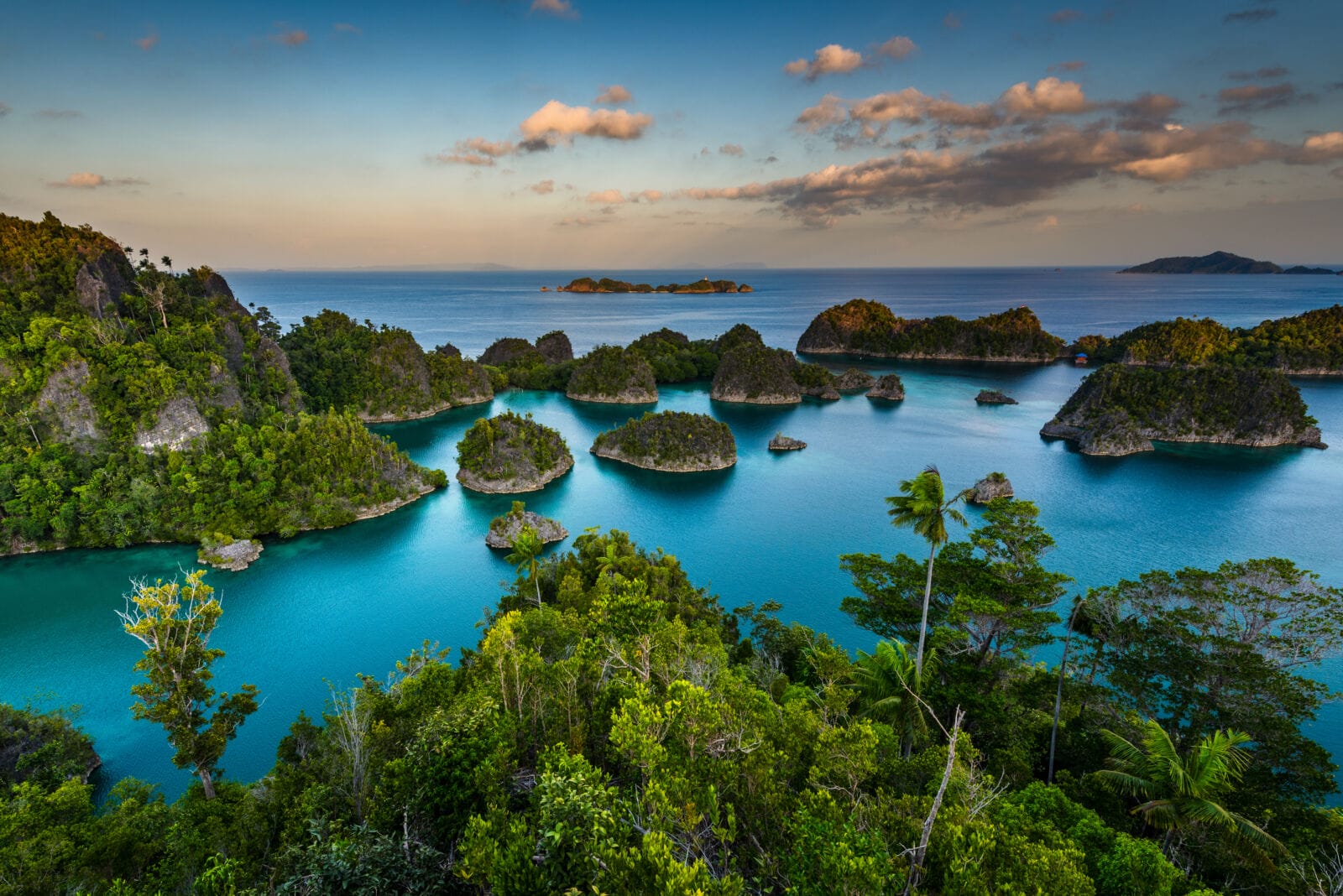
Living in the desert changes the way people vacation. Ask around any Phoenix office in July, and you will hear the same longing, expressed in the same word: water. Arizonans book beach trips the way snowbound Minnesotans book sunshine, as a corrective. But for travelers ready to go past the standard resort-and-pool formula, there is a version of the water trip that makes a Rocky Point weekend look like a warm-up lap, and it happens on the other side of the Pacific, in Indonesia.
Here is the structure of it, because the structure is the trick. Indonesia holds two of the world’s great underwater destinations, and they could not be more different in character. One is Bali: accessible, developed, famous, with an airport that connects to everywhere. The other is Raja Ampat: an archipelago of roughly 1,500 nearly empty islands off the far eastern edge of the country, holding the highest recorded marine biodiversity on the planet. Smart travelers stopped choosing between them a while ago. The itinerary that works is both, in order: a few days of Bali diving to shake off the jet lag and sharpen your skills, then the flight east for the main event, a week on a boat in the richest ocean on Earth.
Start with the warm-up, because Bali deserves more credit than its pool-club reputation suggests. Beneath the surface, one island offers a spread that most entire countries cannot: a famous World War II shipwreck at Tulamben you can swim through, black volcanic reefs in the north, manta rays cruising the cleaning stations off Nusa Penida, and swift channel drift dives between the islands to the southeast. Few dive destinations compress such different underwater experiences into one island, and Neptunescubadiving.com fits into the wider scuba diving Bali, Indonesia story alongside wrecks, volcanic reefs, manta encounters, and fast-moving offshore channels. Three or four days here does exactly what a warm-up should: recalibrates your buoyancy, rebuilds your habits, and answers equipment questions while you are still somewhere with shops and signal.
Then You Go East, and Everything Changes
The flight from Bali to Sorong, the gateway town of Raja Ampat, takes you off the tourist map entirely. From Sorong, there are no hotels to speak of, no roads worth the name, and no cell coverage beyond the harbor. What there is instead is a fleet of small boats, many of them traditional hand-built phinisi schooners refitted with air-conditioned cabins, that carry eight to sixteen guests between reefs for a week at a time. This is the liveaboard Raja Ampat format, and it exists because the region’s dive sites are scattered across distances that make any fixed base pointless. The boat moves at night. Every morning opens somewhere new.
The daily rhythm on board:
- Dawn: coffee on deck while guides brief the first site
- Morning: first dive, then a full cooked breakfast
- Midday: the boat repositions past limestone islands while you rest
- Afternoon: second and third dives, or a sandbar landing
- Evening: just-caught fish for dinner under an untouched sky
What Makes the Main Event the Main Event
Bali’s diving is genuinely good. Raja Ampat diving is something else, and the difference is measurable, not mystical. Scientists have recorded more than 1,700 fish species here and roughly three-quarters of all known coral species, the densest concentration of marine life ever surveyed. In practice, that means:
- Fish in quantities that block your view of the reef behind them
- Reef sharks on nearly every dive, wobbegongs draped over corals, walking sharks at night
- Manta cleaning stations where both reef and giant oceanic mantas queue in season
- Coral gardens, hard and soft, in condition that reminds older divers of decades past
A Raja Ampat diving liveaboard runs three to four guided dives a day across sites chosen by crews who know which reef corner works on which tide. After the Bali warm-up, you arrive with your skills sharp enough to actually enjoy it, which is the entire logic of the two-stop structure.
The Non-Diver Clause
Every couple planning this trip hits the same question, so here is the answer up front: only one of you needs a certification card. Raja Ampat’s coral starts barely a meter below the surface, which makes Raja Ampat liveaboard snorkeling a genuine headline activity rather than a consolation prize. Snorkelers on mixed itineraries visit the same sites as the divers, float over the same turtles and reef sharks, and watch the same mantas pass underneath. Bali plays its part here too: its calm-water sites and dive schools make it the natural place for the tempted partner to try a first supervised dive, or even complete a certification, before the boat departs.
The Practical Math, Phoenix Edition
The honest logistics for an Arizona traveler:
- Getting there: Sky Harbor to Bali runs via Los Angeles or San Francisco and an Asian hub, typically 24 hours of travel. The Bali stop turns that grind into an asset: recover, dive, acclimate.
- The connection east: Bali to Sorong is a domestic hop, usually overnight or early morning, booked as part of the plan rather than an afterthought.
- Season: Raja Ampat’s prime window is October through April, which happens to be when Phoenix weather needs no escaping. Consider it the reverse snowbird migration.
- Budget: figure $ 1,000 to $ 2,000 for the Bali segment, then $ 2,000 to $ 8,000 per person for the liveaboard week, depending on the vessel, with every meal, dive, and mile of passage included. Two weeks total, once-in-a-decade tier, priced accordingly and transparently.
- Booking window: the better boats fill six to twelve months out. Plan it like you would plan a milestone anniversary trip, because that is usually what it becomes.
Two Worlds, One Logic
The deeper appeal of this itinerary is the arc of it. Bali gives you Indonesia with training wheels: superb diving wrapped in comfort, connectivity and a safety net of infrastructure. Raja Ampat takes all of that away and hands back the one thing no resort can manufacture: a week in genuine wilderness, unreachable and unhurried, in water so full of life it changes what you think an ocean is.
For a readership that lives surrounded by saguaros and measures summer in triple digits, there may be no more complete opposite on the planet. That is not a reason to hesitate. That is the entire point.