
Useful pet-care automation fits into a routine without removing the owner’s role.
Automation can remove a repetitive step from the day, but the best cat-care routine still leaves room for observation, cleaning, and the cat’s comfort.
At 7:12 on a weekday morning, the litter box is rarely the biggest task in the room. A lunch needs packing, a train needs catching, and someone has misplaced a set of keys. Yet the box still has to be checked. A small chore becomes irritating not because it is difficult, but because it must be remembered again and again.
That is the useful promise of an automatic litter box for busy cat owners: not the disappearance of care, but a better division of labor. The machine handles a repeatable step; the person keeps the decisions and observations that require judgment.
Before buying more automation, owners should decide which job they want it to perform—and which responsibilities should never leave their list.
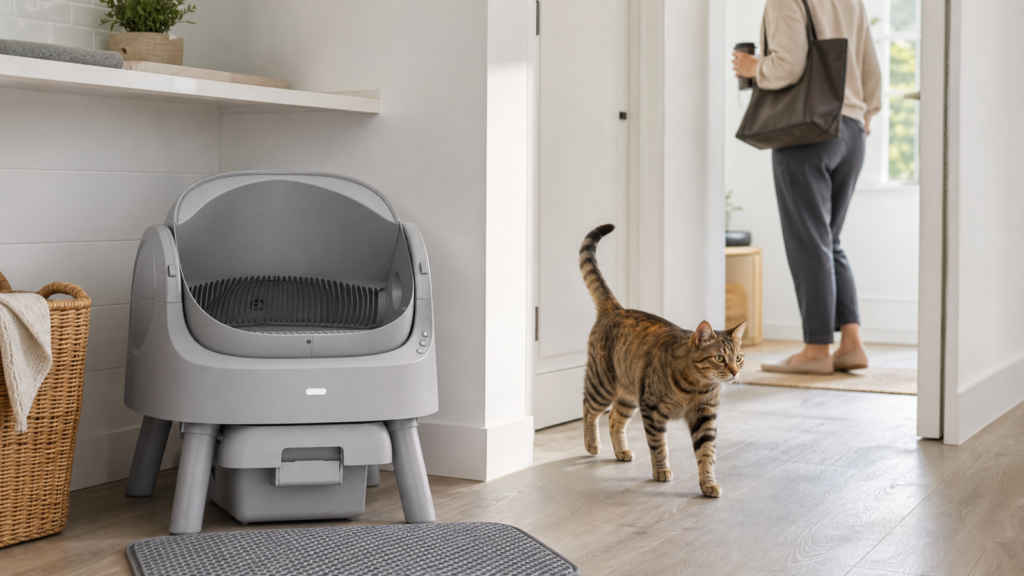
What automation can—and cannot—take off the list
The practical job of an automatic litter box is straightforward. After a cat uses the box and moves away, the unit separates waste from usable litter and stores it in a waste area. That can keep the litter bed more consistent between human checks and reduce the need to scoop after every visit.
But waste separation is only one part of litter care. A machine cannot decide whether a new litter texture is comfortable for a cat. It cannot reliably interpret every change in urination, stool, appetite, movement, or avoidance. It cannot empty its own waste drawer indefinitely, refill litter, remove tracked granules from the floor, or complete periodic cleaning without help.
“Maintenance-free” is therefore the wrong standard. Ask whether the device moves a repetitive task into the background without hiding information the owner still needs.
One appliance-style option is the PetPivot AutoScooper collection, which is designed to automate waste separation while leaving litter checks, waste disposal, scheduled cleaning, and health observation with the owner. The important question is not whether any one product has the longest feature list. It is whether its operating routine is clear enough for the household to follow consistently.
Four questions that matter more than feature count
1. Does the box fit the cat?
Start with the animal, not the product page. Look at entry height, usable interior space, openness, movement during the cleaning cycle, and the sound of operation. A confident adult cat and a cautious senior with limited mobility may need very different arrangements. Kittens, very small cats, pregnant or nursing cats, and cats with mobility or medical concerns may also require manual operation or another litter option; model-specific guidance and veterinary advice should control that decision.
2. Can the household understand normal operation?
Good automation should be legible. Owners should know what a normal cycle looks like, what each indicator means, how to pause or start a cycle, and what to do when the unit reports an obstruction or full waste area. If several people share care duties, each person should be able to perform a quick check without opening an app, consulting a video, or guessing.
3. Is the maintenance routine realistic?
Check litter compatibility before purchase. Look for clear instructions covering fill level, waste removal, sensor care, washing or wiping, drying, and reassembly. Waste capacity estimates are not a household schedule: frequency changes with the cats, litter, and use. Base the routine on inspection and the current manual, not a fixed marketing number.
4. Is support clear before something goes wrong?
Safety limits, warranty coverage, returns, replacement parts, and customer support should be understandable before the box becomes part of the routine. A low-friction purchase is helpful; a low-friction support path is essential.
A Four-Dimension Test for Pet-Care Automation
A useful device should pass four tests at the same time. A strong score in one area does not cancel a weakness in another.
Task fit
Automate work that is frequent, predictable, and easy to verify—such as separating clumps after a normal litter-box visit. Keep judgment-heavy tasks, including interpreting changes in output or behavior, with the owner.
Cat fit
Evaluate entry height, usable space, openness, sound, movement, and the cat’s willingness to return. Convenience for the household is not a benefit if the cat avoids the device.
Visibility
The routine should make important information easier to notice, not easier to ignore. Owners still need a clear view of litter level, waste output, operating status, and the surrounding floor.
Recovery
Ask what happens after a power loss, interrupted cycle, full drawer, or cleaning mistake. Good automation has an understandable manual path and an obvious route back to normal operation.
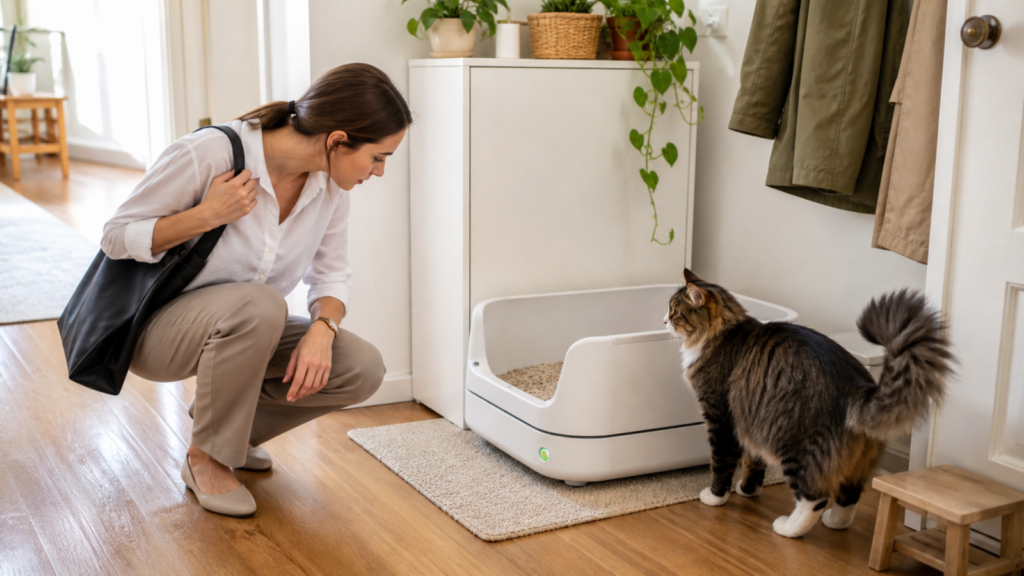
What a realistic weekday routine looks like
Automation works best when it is attached to short, repeatable human checks.
Morning: verify, do not hover
Look at the litter level, waste area, surrounding floor, and status indicator. Confirm that the cat appears to be using the box normally. This takes less effort than a full scoop but preserves awareness.
End of day: notice the pattern
Check again when feeding or refreshing water. Look for an unusual absence of waste, repeated visits, elimination outside the box, or a sudden change in behavior. Cornell’s feline-health guidance notes that inconsistent litter-box use can have medical or behavioral causes and should not simply be treated as a cleaning problem.
Waste day: respond to the box in front of you
Empty the waste area when inspection or the device indicates it is needed. Replace the liner if the model uses one, remove residue, and confirm that the waste area is seated correctly. Multi-cat households should expect to check more often, not assume the longest advertised interval.
Scheduled cleaning: restore the system
Follow the model’s instructions for removing approved parts, washing or wiping them, drying them fully, and cleaning accessible sensors. Do not improvise with harsh chemicals or submerge components unless the manual permits it. The goal is not just a cleaner-looking device; it is predictable operation after reassembly.
Help the cat adjust before relying on automation
A new litter box changes several things at once: shape, entry, sound, smell, surface, and sometimes location. Give the cat time to investigate while the unit is quiet. Where possible, place it near the established litter area and use a familiar litter only if that litter is compatible with the model.
For a cautious cat, begin with automatic operation disabled and run a manual cycle when the cat is elsewhere. Enable the full routine only after the cat is entering and leaving comfortably. Do not remove every alternative box on day one, especially in a multi-cat household. Independent veterinary guidance commonly recommends multiple accessible boxes; an automatic unit does not automatically cancel that behavioral need.
If a cat stops using the box, strains, visits repeatedly, vocalizes, or eliminates elsewhere, the answer is not to wait for the technology to solve the problem. Restore an accessible option and contact a veterinarian when a medical issue may be involved.
One less repeated chore, not less responsible care
The best automation does not make the cat invisible. It removes a mechanical interruption while keeping the owner close to the signals that matter. For busy households, that can be a meaningful improvement: fewer moments spent scooping on command and a clearer routine for checking, emptying, cleaning, and observing.
Choose an automatic litter box only when four things line up: the cat can use it comfortably, the household can understand it, the maintenance is realistic, and the support information is clear. That is a more durable definition of convenience than any promise to “set it and forget it.”
Frequently asked questions
Does an automatic litter box eliminate all scooping and cleaning?
No. It can automate routine waste separation, but owners still need to check litter and waste levels, empty the waste area, clean the unit as directed, and watch for changes in the cat’s behavior or elimination.
How long does a cat take to adjust?
There is no universal timeline. Some cats investigate quickly; cautious cats may need a slower introduction with the automatic cycle disabled at first. Follow the model-specific acclimation instructions and keep another accessible box available during the transition when needed.
What litter should be used?
Compatibility varies by model. Use the litter type and fill level specified in the current manual. A litter that clumps well in a traditional pan may still be the wrong particle size or material for a particular separating mechanism.
What should never be fully automated in cat care?
Health judgment and welfare decisions should stay with the owner. Automation may handle a mechanical step, but a person must still notice changes in elimination, appetite, mobility, vocalization, box avoidance, and overall behavior—and contact a veterinarian when those signs warrant it.
How should multi-cat households evaluate automation?
Start with access, not capacity claims. Keep enough accessible litter options for the cats, watch whether one cat blocks another, and base emptying and cleaning frequency on actual use. An automatic box can reduce a repeated chore, but it does not guarantee that one station will suit every cat.