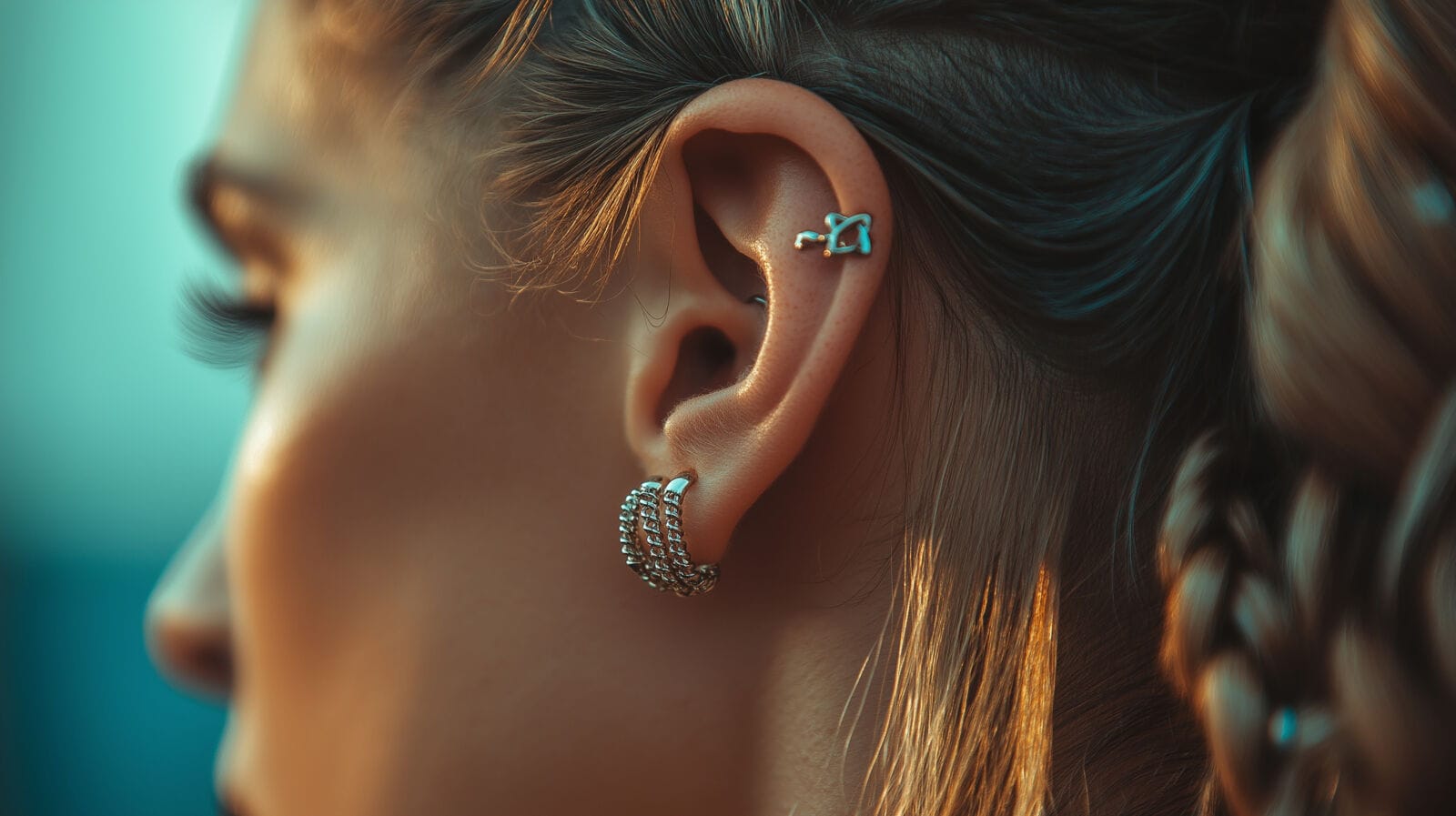
Sizing for a tragus piercing involves two decisions that most guides bundle together: gauge, which is the thickness of the post, and bar length, which determines how far the post extends through the cartilage. Getting both right from the initial piercing protects the healing channel and prevents the two most common complications: embedded jewelry and chronic snagging. This guide breaks both down clearly, including how tragus type affects the numbers.
Tragus Piercing Gauge: What 16g Means and Why It Is the Standard
Gauge confusion is common because the system is counterintuitive: the higher the number, the thinner the needle. For tragus piercings specifically, this distinction carries real clinical weight. Cartilage heals more slowly than soft tissue and requires a stable channel during that extended process. Choosing the wrong gauge from the start can compromise the entire healing timeline.
The Standard Gauge Range for Tragus Piercings
The table below maps gauge to diameter and use case for the four sizes most relevant to tragus work.
| Gauge | Diameter (mm) | Common Use | Notes |
| 14g | 1.6 mm | Thick tragus anatomy | Less common; provides maximum channel stability |
| 16g | 1.2 mm | Initial piercing standard | APP-aligned default; most professional piercers use this |
| 18g | 1.0 mm | Healed piercing downsize | Suitable once healing is confirmed; wide jewelry selection |
| 20g | 0.8 mm | Thin minimalist style | Only for fully healed piercings; not for initial piercing |
16g is the industry-standard starting gauge for tragus piercings. 18g becomes relevant after healing is confirmed. 20g is reserved for fully healed piercings with thin minimalist aesthetics. 14g is used only when cartilage anatomy requires more structural support.
Why Needle Gauge and Jewelry Gauge Must Match
Cartilage heals tighter than soft tissue. If the initial jewelry is thinner than the needle used to create the channel, the tissue contracts around the smaller post during healing. A client pierced at 16g who wears 18g jewelry from the start will gradually develop an 18g channel. Re-inserting a 16g piece later requires stretching scar tissue, which irritates the placement and can restart the healing clock. For professional piercers sourcing consistent-gauge cartilage needles, see our body piercing needles collection.
Bar Length for a Tragus Piercing: Initial vs. Healed Size
Bar length is the measurement most clients get wrong because they assume the healed size is appropriate from day one. Initial bar length is intentionally longer than the healed size. Cartilage swells after piercing, and a post that fits perfectly on a calm ear will press into inflamed tissue within the first 48 hours if the clearance is too tight.
Why 8mm Is the Starting Point
8mm is the standard initial bar length for tragus piercings because it provides sufficient clearance for swelling without protruding so far that it constantly snags on hair and earphones. Some piercers use 10mm for clients with thick cartilage or anticipated significant swelling. Going shorter than 8mm on an unhealed tragus piercing is one of the most common causes of embedded jewelry, a complication that requires professional intervention to resolve.
The Downsizing Timeline
Downsizing is not a fixed calendar event. It is an anatomy-driven assessment that should happen with a professional piercer, not based on a set number of weeks alone.
| Healing Stage | Timeline | Recommended Action |
| Fresh piercing | Week 0-4 | Keep initial bar (8mm); no jewelry changes |
| Early healing | Week 4-8 | Assess swelling; book downsize if swelling has resolved |
| Downsize window | Week 6-12 | Piercer-confirmed downsize to 6mm or 7mm for thick cartilage |
| Fully healed | 6-12 months | Full jewelry freedom; stud and hoop options both viable |
Most clients downsize between weeks 6 and 12, not earlier. Thick cartilage clients often stay at 7mm before moving to 6mm. Downsizing too early when residual swelling is still present causes the bar to press into healing tissue from both ends.
The 4-Type Tragus Sizing Chart: Sizing Differences by Placement
The term tragus covers four anatomically distinct piercing placements. Each involves a different cartilage profile, which directly affects the gauge, bar length, and jewelry type used for the initial piercing. Treating all four as interchangeable is a consistent gap in most sizing guides.
| Type | Anatomy | Gauge | Initial Bar | Healed Jewelry |
| Standard tragus | Small nub in front of ear canal | 16g | 8mm labret | 6mm labret or 6-8mm hoop |
| Anti-tragus | Cartilage ridge above earlobe | 16g | 8mm curved barbell | 6mm curved barbell or small CBR |
| Vertical tragus | Front-to-back channel through tragus | 16g | 10mm surface bar | 8mm surface bar once healed |
| Surface tragus | Skin surface only, no cartilage penetration | 14g or 16g | 10-12mm surface bar | 8mm surface bar; high rejection risk |
Standard and anti-tragus share the same gauge but differ in jewelry shape. Vertical and surface tragus require longer bars and carry higher complication risk. Only anatomy assessment by a professional piercer determines whether vertical and surface placements are viable for a given client.
Jewelry Type and How It Changes the Size Equation
Gauge and bar length measurements apply differently depending on whether the jewelry is a labret stud, a hoop, or a curved barbell. Understanding how measurement conventions differ by jewelry type prevents ordering the wrong piece entirely.
Flat-Back Labret Studs
Measurement = post length. The flat disc on the back sits flush against the inner cartilage surface, which is critical for tragus piercings because the back of the ear canal has very limited clearance. A ball-back earring in the same space protrudes into the canal, causes pressure discomfort, and traps bacteria. The standard initial setup is a 16g flat-back labret at 8mm. Implant-grade titanium (ASTM F136) is the recommended material for initial jewelry because it is non-reactive and supports cleaner healing in cartilage tissue.
Hoops and Rings
Measurement = inner diameter. Tragus hoops range from 6mm to 8mm inner diameter for most anatomies. A 6mm hoop sits snugly against the cartilage. An 8mm hoop has a slightly more visible presence. Clients with smaller tragus anatomy often fit better in 5mm-6mm. Hoops should only be introduced after full healing because the continuous circular movement during the healing phase disrupts the channel and prolongs recovery.
Curved Barbells
Measurement = wearable bar length between ball ends. Curved barbells are the standard initial jewelry for anti-tragus piercings because the curved cartilage ridge requires a bar that follows its natural arc. A 16g curved barbell at 8mm is typical, with the same downsize protocol as a standard tragus placement. Straight barbells are not recommended for anti-tragus work because the straight post puts lateral pressure on tissue that curves.
Common Sizing Mistakes and How Piercers Prevent Them
Most tragus sizing complications are predictable and preventable at the initial appointment. The three scenarios below account for the majority of follow-up issues.
Downsizing Before the Channel Is Ready
Residual swelling is not always visible from the surface. A client whose tragus looks calm externally may still have internal tissue inflammation at the channel walls. Downsizing before the channel is structurally stable causes the new, shorter bar to press into healing tissue from both sides. The protocol is piercer assessment before any downsize, not calendar-based timing alone. Encouraging clients to book a follow-up check before any jewelry change reduces this complication significantly.
Using Standard Earlobe Jewelry in a Tragus Piercing
Standard lobe earrings are typically 20g or 22g. Inserting a butterfly-back earring into a 16g tragus channel creates two problems simultaneously. The thinner post allows the channel to contract toward 20g, making it difficult to reinsert 16g jewelry later. The butterfly catch accumulates bacteria in a placement that is already prone to contamination from phones, pillows, and earphones. Channel shrinkage in cartilage is considerably harder to reverse than in soft tissue.
Final Notes
Getting the size right for a tragus piercing starts before the needle enters the cartilage. Gauge determines the channel width; bar length accommodates healing; tragus type and individual anatomy determine which numbers apply to a specific client. When those three variables are set correctly from the initial appointment, the channel establishes cleanly and post-healing jewelry changes become straightforward. When any one of them is misjudged, healing slows and complications follow.
Note: These are professional guidelines based on industry standards. Anatomy assessment by a qualified piercer is essential before any initial tragus piercing or jewelry change.