How battery energy storage systems are helping utilities, and major energy users overcome unprecedented energy demand
Industrial power demand in Greater Phoenix is going to skyrocket by 50 percent in the next four years, according to a study updated in July 2026 by Salt River Project. The power provider says it is seeking to increase its generating capacity by nearly a third.

Arizona Public Service is facing a similar challenge. Preparing for 40 percent load growth over the next five years, APS is building infrastructure capacity, but that capacity isn’t expected to come online until 2032. Meeting that growth requires new generation and major grid expansion with projects that take many years to plan, permit and construct. Given that timeline, power providing solutions that can be deployed faster and make existing power generation more useful are increasingly valuable. This is where Battery Energy Storage Systems (BESS) are bridging the gap for utilities, independent power producers and major energy users.
Today, BESS does more than provide emergency backup; the assets are providing rapidly available, on-demand power, particularly during costly peak-generation periods. Because BESS facilities can be deployed more quickly than new generation facilities, they give utilities such as APS and SRP another way to manage peak demand while larger generating projects are developed. In some applications, adding storage can also be more cost-effective than building generation facilities dedicated primarily to relatively short periods of peak demand. These are two significant factors driving the rapid expansion of BESS across the U.S. In Arizona, the U.S. Energy Information Administration (EIA) reported in May 2026 that utility-scale battery storage capacity tops 6,000 megawatts. That’s up 56 percent over 2025 when 3,200 MW were online.
In addition to supporting peak power demand needs for utilities, BESS installations also support critical infrastructure for commercial and industrial operations. Facilities such as airports, advanced manufacturing and semiconductor facilities, data centers and other large power users are turning to BESS for energy certainty.
What is a BESS facility?
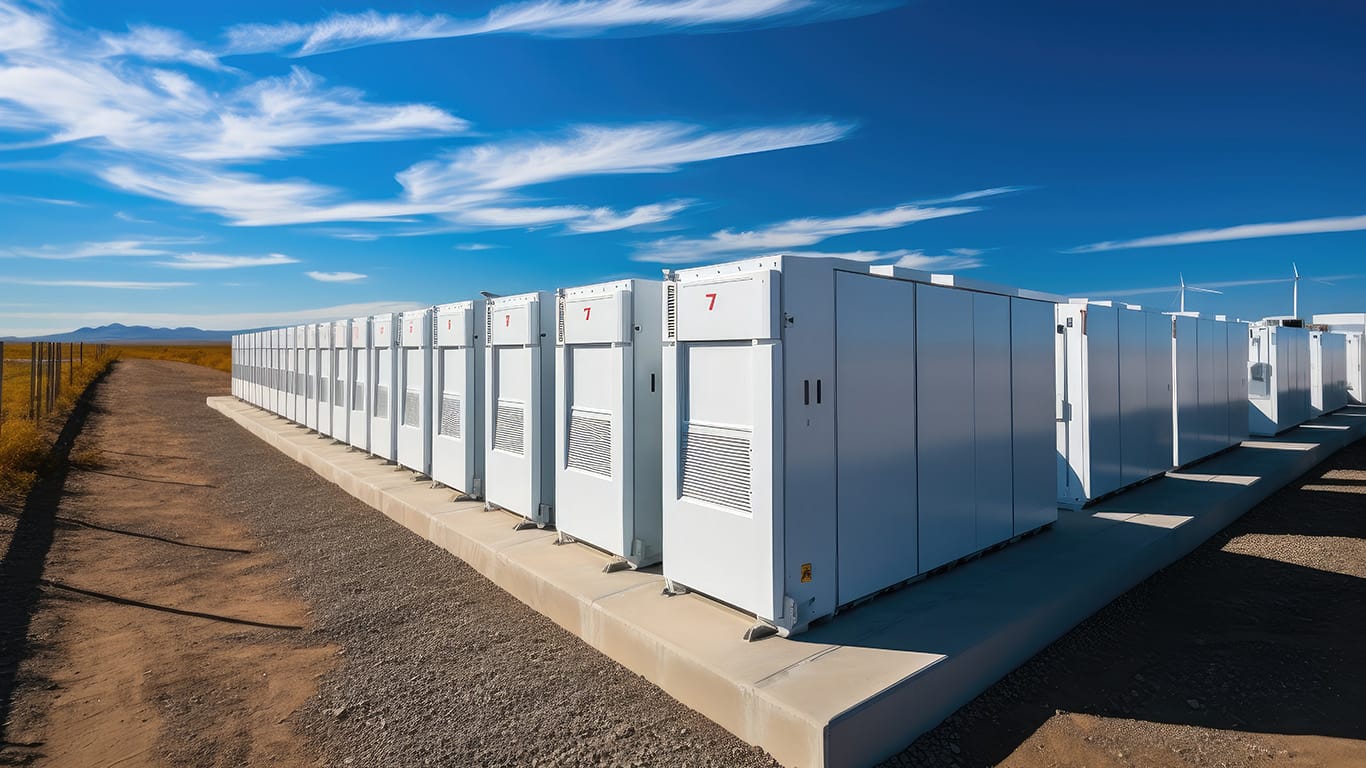
BESS does not generate electricity; it stores it. It’s agnostic about where the power is generated, uncaring about whether it’s from a gas-peaking plant or a solar farm. Like a phone battery, it charges when power is available and delivers it when needed.
The ability to store power from virtually any source and release it on demand is what makes BESS so appealing. Storage systems are charged from renewable sources, such as solar and wind, or from conventional generation. That power is then discharged when demand is highest.
How does BESS solve today’s power grid challenges?
Over certain periods of time, typically, two- or four-hour durations, BESS facilities deliver resiliency to the power grid at various levels. Clean, predicable and uninterrupted power can be used in a distribution grid or in the transmission system.
Because BESS is scalable, it can be upsized to provide the high voltage needed for load balance in the bulk power network. The batteries can store power when generation exceeds demand and delivers utility-level electricity when demand peaks.
At a more local level, a BESS facility can be integrated into a distribution grid to ensure stable power to a neighborhood, an industrial park, or critical facilities such as airports, hospitals or data centers that require continuous and reliable power.
Who benefits from BESS?
If a conveyor belt stalls for 10 seconds in a distribution warehouse, it’s inconvenient but not exceptionally disruptive. If power goes out in a semiconductor fabrication plant or an airport has a power outage, it can be disastrous. In a data center, a 10-second blip can disrupt tens of thousands of transactions and cost billions of dollars, affecting innumerable businesses and individuals who have come to rely on and expect the ease and speed of digital payments and the transmission of digital information.
While critical facilities have emergency backup generators, time is lost during the few seconds that it takes for the emergency system to come online. The generator’s physical infrastructure also affects neighbors through noise and emissions.
With BESS, the switchover is instantaneous. Think of BESS as an industrial-scale uninterrupted power supply. Some facilities that require clean power often use BESS as the primary power supply, with grid electricity constantly recharging the batteries. A growing number of data centers are developing with these systems in place. The IEA reported a 30 percent increase in capacity during 2025, with an increasing number of U.S. data center projects explicitly pairing BESS in data center development.
Speed to market, reliability and community benefits of BESS
Building battery storage does not require anywhere near the site development complexity or the time to engineer, design, permit and build a power generation facility. A utility-scale BESS can go from contract to being online and operational in 14 – 24 months. This compares with up to six years for bringing a generation facility online.
BESS also provides significant reliability and efficiency. With a 15–20-year lifespan, battery storage requires much less maintenance and delivers a longer lifespan than traditional diesel or other mechanical generation equipment. As a scalable system, battery storage can be increased and expanded, operating independently or by interconnecting several battery farms.
In terms of community impact, similar to a substation, operational BESS facilities produce no emissions and generate minimal to no noise. Additionally, the smaller footprint is easier to integrate into a setting and less visibly intrusive. On an equal-power basis, BESS facilities have about a quarter to half the footprint of a similarly sized output-power generator or backup supply source.
How is a BESS facility built?
Given the numerous options for developing a battery storage facility; it’s best to begin with the end in mind.
Planning starts with knowing why a battery is needed and how it will be used. The problem to be solved is the key. This information affects everything from facility design and location to storage capacity and equipment. This also defines the BESS purpose for capacity, resilience, demand management or power quality, among other things. Homing in on these details to produce a BESS solution is where the expertise of McCarthy Building Companies BESS team, led by Rob Moreno, becomes highly valuable.

“We focus on building systems that suit the needs of each client, whether it’s a utility, airport, manufacturing facility or data center, our team evaluates the engineering, design and construction with the understanding of the system’s goals and objectives and develops a system that can deliver reliable power for decades,” said Moreno.
For example, McCarthy partnered with a major US Utility to evaluate their need in building a BESS project. The Utility was forecasting seasonal power shortfall with their existing gas generation fleet and did not have the time to build another generation asset. A BESS solution made technical and economic sense; however, the Utility had never developed or built a BESS project. McCarthy was able to help the customer select the right BESS technology and contracted the EPC (Engineering, Procurement, Construction) firm to build the project. The BESS asset helps offset the shortfall, and McCarthy continues to work with the Utility to build a portfolio of BESS projects, ultimately helping the Utility meet the significant load growth in its jurisdiction.
Understanding expected outcomes dictates the entire system, including the selection of components best suited for the system’s needs. Having strong vendor relationships is essential because many BESS components are currently imported, and supply chain issues can arise, which an experienced contractor should be able to navigate.
Having established front-end and back-end partnerships expedite the overall design and construction process. Unlike a conventional construction project, battery systems cannot be built without multiple considerations. The process requires that everything be integrated and considered from the earliest decisions and works in partnership with local utilities.
“Thanks to our relationships with tier one battery manufacturers, a diverse set of customers implementing BESS, and McCarthy’s deep understanding of the BESS market, we have been able to overcome myriad challenges over the past few years. When components became unavailable or were priced outside of the budget, we found solutions by working with manufacturers and utilities to ensure projects we delivered on schedule, but they met or exceeded the regulatory requirements, performance needs and safety standards,” stated Moreno.
The advantages of BESS are clear. Rapid deployment and expansion capabilities as demand grows gives utilities and major power users a reliable tool for providing power while longer-term generation and transmission projects move forward. McCarthy is among the builders supporting that transition by constructing BESS facilities for utilities and communities across the country.
Author: Kyle Smith is vice president of business development for Battery Energy Storage Systems at McCarthy Building Companies.