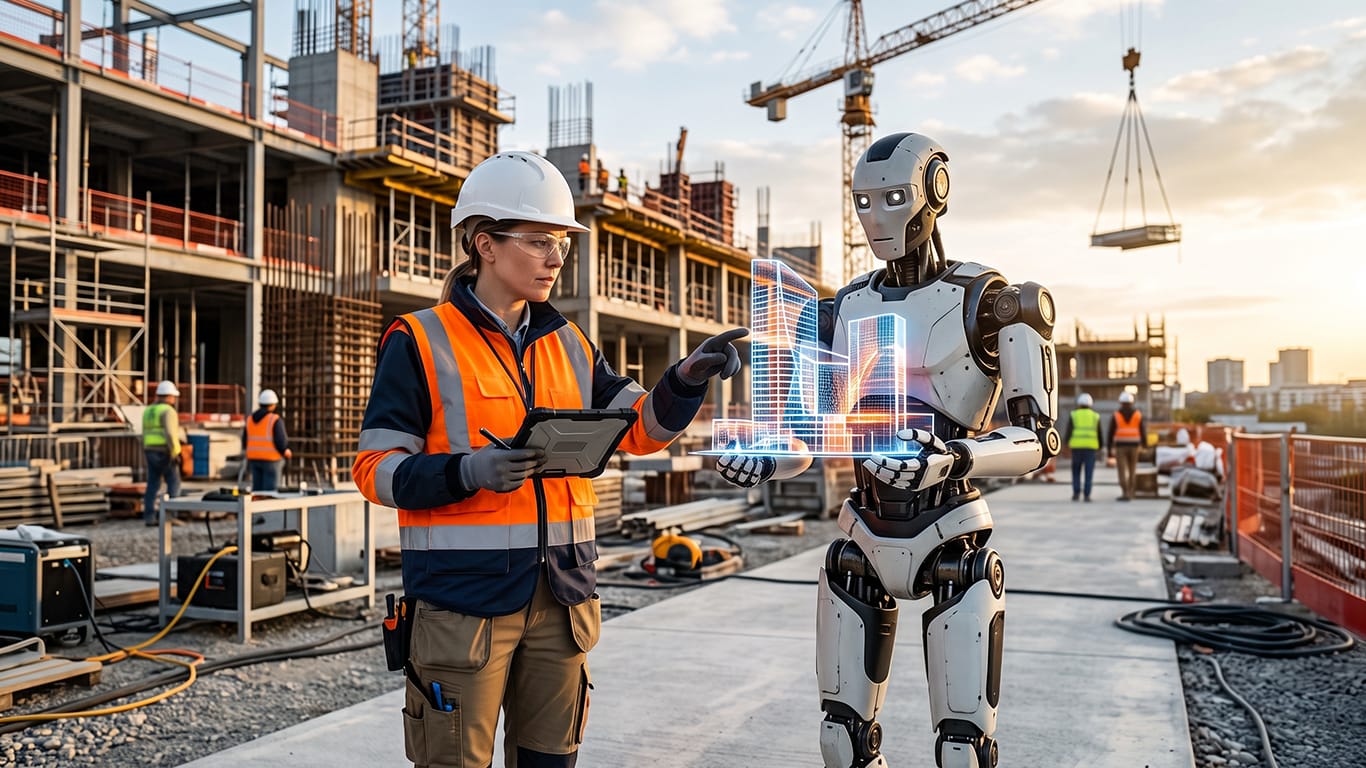
As summer temperatures continue to soar in the Valley of the Sun, construction workers are among the most vulnerable to heat-related illness. But picture a construction site where artificial intelligence analyzes data from wearable biosensors and environmental monitors worn by construction workers, looking for early signs of fatigue and heat stress; and when it detects them, it sends personalized, real-time alerts — before symptoms start.
DEEPER DIVE: How Silicon Desert is powering Phoenix industrial surge
READ MORE: Phoenix industrial market ranks No. 7 in nation
That scenario is now a reality, and the heat stress early-warning system — developed by the Safety Automation and Visualization Environment Laboratory, or SAVE Lab, in collaboration with Achen-Gardner Construction, Willmeng Construction and CHASSE Building Team — is helping ensure construction workers go home safe and healthy at the end of the day, says Siyuan Song, an associate professor of construction engineering, who leads the SAVE Lab at the Ira A. Fulton Schools of Engineering at Arizona State University.
It’s just one way researchers in the School of Sustainable Engineering and the Built Environment use AI to create solutions for challenges in the construction industry. They also use AI to develop human-centered construction technologies, study how workers learn with virtual reality, improve safety training through eye tracking and analyze complex construction data.
How researchers use AI to improve construction
Song’s research focuses on one of AI’s most immediate applications in construction: protecting workers from heat stress, psychological strain and physical fatigue.
“Each of these is difficult to observe until it becomes dangerous, and that is exactly where AI helps,” she says. “It monitors conditions no human observer could track, recognizes that two construction workers in identical conditions can respond differently, and shifts safety management from reacting to incidents toward preventing them.”
SAVE Lab researchers create immersive virtual-reality safety training environments to analyze how workers learn and respond to hazards. They also use large language models to analyze accident reports, study the impact of extreme weather and evaluate safety training.
The Pooladvand Research Group, led by Shiva Pooladvand, an assistant professor of construction engineering at ASU, develops the next generation of human-centered construction technologies by connecting construction engineering, robotics, computer science, cognitive science, human factors and immersive environments like virtual reality.
“I use AI to analyze multimodal data captured from workers and the environment to identify patterns related to workers’ decision-making, behavior and safety to anticipate unsafe working conditions or identify workers who may be at risk,” Pooladvand says. “This enables more personalized interventions to enhance safety, automation and productivity.”
At the Construction Workforce and Technology Lab, Ricardo Eiris, an assistant professor of construction management, uses AI to improve construction education and workforce training. His research combines AI with human-computer interaction, virtual reality, digital twins and drones to help people better understand construction sites and learn in settings that go beyond the limits of physical classrooms or jobsites.
“I use AI as a tool for expanding how people learn, train and interact with complex built environments,” Eiris says. “I leverage AI to support immersive experiences, model human behavior and create more realistic, responsive systems that can improve learner performance in construction.”
Kenn Sullivan, a professor of construction management, uses AI to assist with statistical modeling, visualization, test different analytical approaches and document his research team’s methods, decisions and workflows to share with the next student who joins the team.
This emphasis on practical applications was reflected in the recent AI for Construction 2026 Contractors Summit, where construction leaders shared how they use AI in agent-based workflows for specific tasks in business development, virtual design and construction, safety, visual analysis, scanning and project controls. The event was hosted by the Del E. Webb School of Construction and the new AI in Construction Consortium.
“The contractors summit and the proposed industry consortium originated from our executive council as opportunities for construction companies, technology providers, faculty members and students to learn from one another in a collaborative environment,” says Tim Becker, programs chair of the school.
Preparing the next generation of construction leaders
Faculty members guide students’ responsible use of AI, preparing them to apply it effectively throughout their careers.
Over nine months, AI tools went from completing almost none of Sullivan’s class assignments to completing up to 60% of them. That led him to reconsider how he assesses learning and redesign his curriculum.
In his AI in Construction course, students analyze data, develop custom AI skills and agent-based workflows, build working apps and create portfolio websites to showcase their solutions.
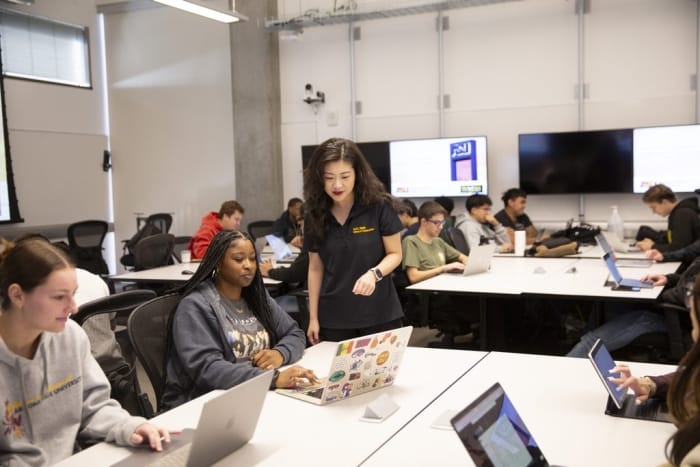
Students in Pooladvand’s class discuss how AI is used in actual construction projects, learn to verify AI-generated information and evaluate it with their engineering judgment.
That’s why it’s essential students have strong foundations in construction methods, estimating, scheduling, safety, contracts and project management.
“In many ways, AI makes that foundational knowledge even more important,” Sullivan says.
In Song’s Advanced Construction Safety Engineering and Management course, students learn how computer vision, wearable sensing, machine learning and virtual reality reshape safety practice. SAVE Lab’s virtual reality-supported safety training and jobsite sensing deployments become case studies and provide hands-on experiences.
“Responsible AI use is essential in our field for a simple reason: In construction, decisions have physical consequences,” Song says. “An unverified AI output in an essay is an academic problem. An unverified AI output in a safety plan, cost estimate or schedule is a potential hazard to people and projects.”