Office buildings are a defining symbol of American life, serving as concrete representations of corporate culture and U.S. economic might. But when the pandemic upended the status quo, business leaders began to reconsider what the true purpose of their offices should be. How companies initially responded varied, and some have adopted new positions as the crisis of 2020 slips further into the past — even if the aftershocks are still influencing the Valley’s office market.
“We had quite a hole to dig out of,” explains Pat Boyle, executive vice president at CBRE. “There was a steady diet of negative absorption from 2021 through 2025, but now the vacancy rate is below 20%. That’s great, and it feels like we’re finally back on the right path.”
Over the past 3 years, the Valley’s office sector has indeed seen a shift towards expansion. According to CBRE’s Q2 2026 Phoenix Office Market Report, net absorption hovered around negative 780,000 square at the start of this period.
“There was a ton of subleases on the market,” Boyle adds. “People were panicking and putting their space on the market because they didn’t know how they were going to utilize it.”
By mid-year 2026, however, the data tells a different story: 490,000 square feet of net absorption occurred during Q2, pushing vacancy down to 19.1%. Rental rates are performing well, with Boyle noting that some prices are at an all-time high.
“The overall market sentiment is pretty optimistic,” he continues. “I’ve had a lot of people tell me this summer was the busiest they can remember.”
MORE NEWS: 10 cool Arizona offices worth the commute in 2026
Top of the class
The Phoenix office market is comprised of nearly 101.6 million square feet, 26% of which falls into the top tier of products known as Class A. Of this segment, 8.8 million square feet is classified as Prime, representing the highest quality space available. Even though these eye-catching projects draw the most attention, they are scarce.
“Most of the trophy offices have been absorbed,” explains Brett Thompson, executive vice president at JLL. “If you want 100,000 square feet in that kind of building, it doesn’t really exist.”
This mismatch between supply and demand, Thompson says, means companies must decide whether to stay in their current location, kick the can down the road by renewing their current lease on a shorter term or settling for a Class B property.
“There are tons of users who need 20,000 to 50,000 square feet who are boxed out of a trophy office or, candidly, don’t want to pay the new premium since rents have gone up significantly,” he adds.
Nearly 62% of the Valley’s offices are considered Class B, and Thompson says more tenants are coming around to the idea of leasing space in an older building that is well located or has been recently renovated.
Rob Milmont, senior project manager for Stevens-Leinweber Construction, notes that tenant improvement activity has picked up in the past few years, though the scope of work has changed.
“There was a two-year period where I was working on something like 20 spec suites at once, mostly lobby or restroom remodels,” he continues. “It was all capital improvement jobs, but now we’re seeing projects focused on the end user. I did three speakeasies last year, and I hadn’t done one in the five years prior.”
In response to the upheaval caused by the pandemic, some companies elected to move into a smaller space, which Milmont says can introduce challenges.
“You’re dealing with two things in those situations,” he continues. “There’s often turmoil within the company — like employees who aren’t happy with a cubicle instead of a private office — and then the constraints of the building itself. There are businesses trying to fit 40 people into an 8,200-square-foot space, and it’s just not possible.”
The New 9 to 5
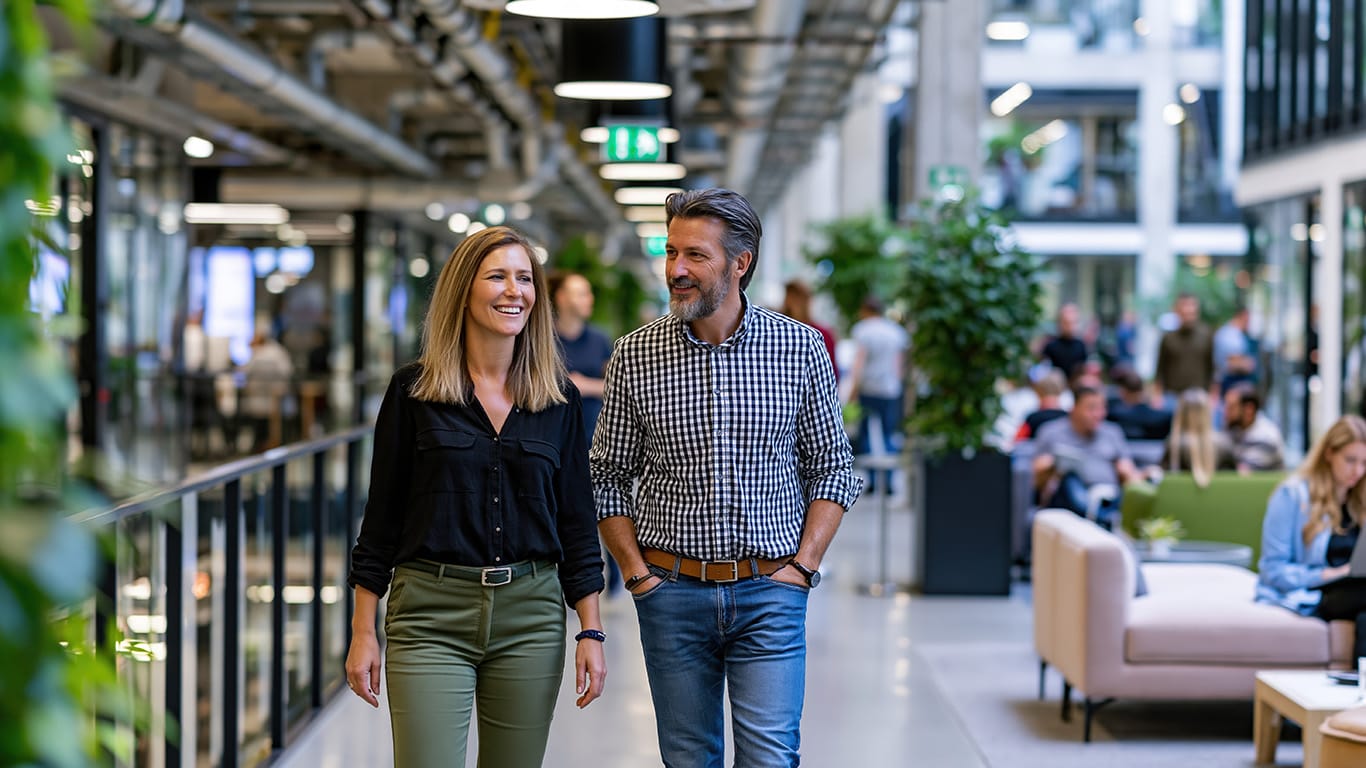
While the office market may be stabilizing, the pandemic left an indelible mark on the way — and where — people work. Tory Fearey, principal at Phoenix Design One (PDO), says that the crisis pushed companies towards spaces that incentivize employees to make the commute.
As a result, Fearey says more office designs are taking inspiration from the hospitality sector, which wasn’t the case five years ago. Brittany Mahoney, workplace consultant at Atmosphere, agrees that this trend has accelerated in the post-pandemic workplace.
“Long gone are the days when a desk and chair were enough,” she continues. “Today, we’re contemplating what makes home feel comfortable so we can apply that to the office context.”
According to Mahoney, users want their space to do three things: spark collaboration, boost performance and support employee well-being. As some companies reduce their footprint, she adds that community spaces have become even more important.
“From a design perspective, I’d say the biggest focus has been on areas that could be used for socializing,” Mahoney continues.
The trend of businesses reducing their footprint, however, makes flexibility even more important.
“With a smaller footprint, you’ll be better off with more combined-use spaces,” explains Marty Ball, principal at CCBG Architects. “If you have three different teams, find ways to blur the lines between those departments. Everybody should still have their own space, but building in collaborative areas between them can do a lot. You have to get creative.”
Fearey notes that cubicles are still part of many workplaces, but panel heights have been lowered to increase visibility throughout the office.
“That can be a huge challenge,” she says. “I was working with an engineering client, and the struggle there is that a lot of their work happens in silos, but they still need to interact with one another. Providing different types of collaborative space helps, whether it’s a break room or conference space — it’s important to remember that one size doesn’t fit all.”
A useful design heuristic, Mahoney adds, is to think of the office as a collection of neighborhoods, each containing the comforts of home, “the restaurants you like, the bars you frequent with friends and places to get work done.”
Following that line of thinking, Mahoney says that the spaces between departments are prime locations for social interaction.
“Maybe it’s like a city park, where everyone can come together to collaborate,” she continues. “Furniture won’t make people to act a certain way, but we do say that space encourages behavior, and using this neighborhood concept works well for us.”
Design might not have the power to compel collaboration, but Fearey says more companies are seeing their offices as emblematic of the organization’s culture.
“They want their space to communicate to current and prospective employees the organization’s identity and what it stands for,” she concludes. “Ever since working from home became a trend, companies have realized the built environment makes a big difference for talent attraction and retention, and just making people want to commute to work. As designers, we’re tasked with communicating that through the built environment.”