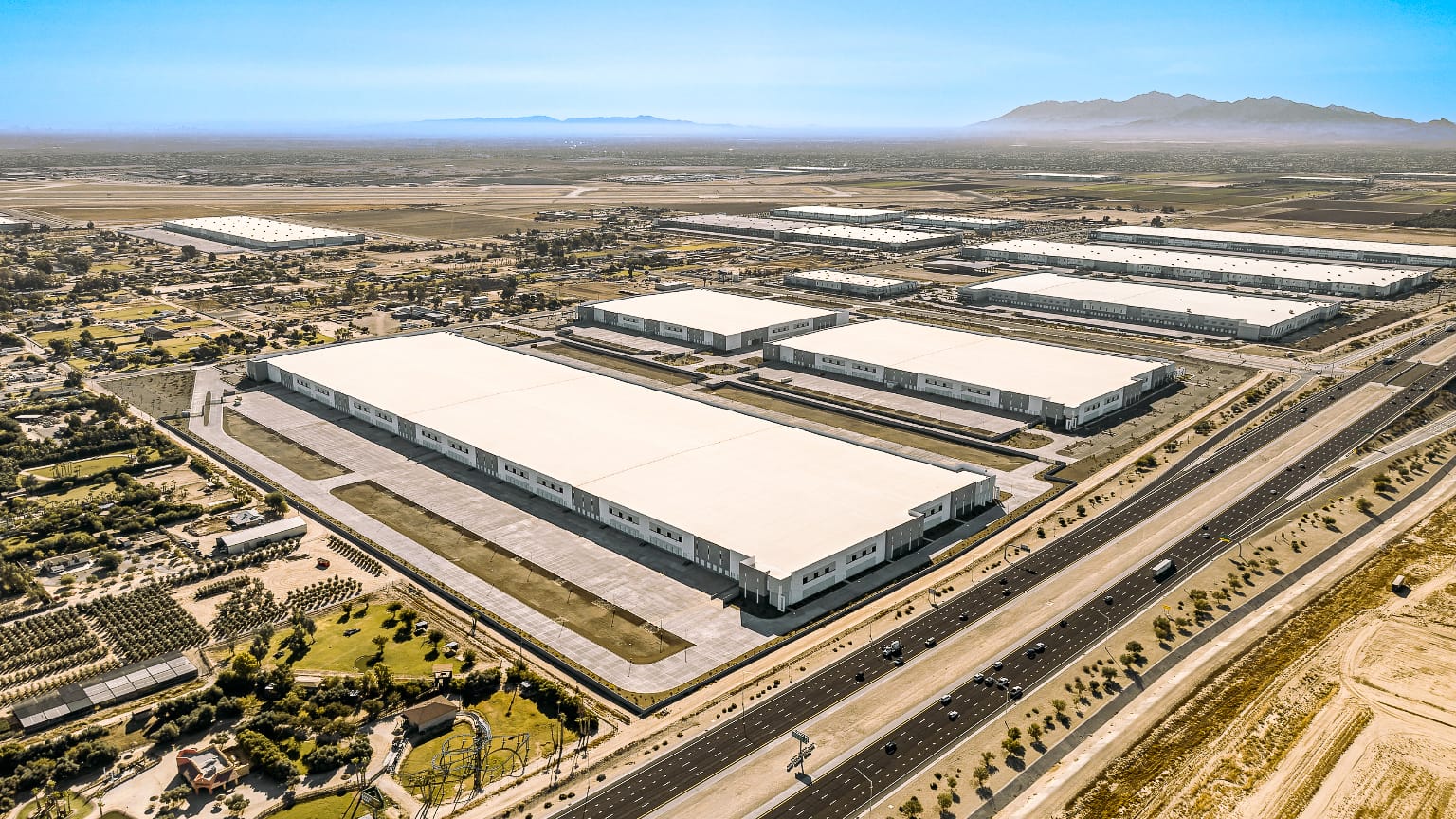
The Greater Phoenix industrial market posted an impressive third quarter, making it one of the nation’s leading cities for the quarter, according to a report released by Colliers. Net absorption nearly tripled from second quarter, totaling 7.87 million square feet. Vacancy continued to decline, falling 110 basis points quarter-over quarter to 9.8 percent.
LOCAL NEWS: 10 things you may not know are manufactured in Arizona
INDUSTRY INSIGHTS: Want more news like this? Get our free newsletter here
A decline in new supply of industrial space, combined with healthy leasing activity, drove the market to record two consecutive quarters of vacancy reduction – the first such improvement since third quarter 2022. Both direct and sublease vacancies fell during third quarter, reflecting sustained leasing demand. Sublease availability ended the quarter at 7.65 million square feet, or 1.7 percent of total inventory. All submarket clusters, except the Airport Area, posted quarter-over-quarter vacancy declines. The Southwest Valley and Southeast Valley both improved year-over-year, ending at 8.0 and 12.1 percent, respectively. The Northwest Valley recorded highest vacancy as 12.9 percent, accounting for 34.8 percent of the metro area’s 44.8 million square feet of vacant space. Vacancy within buildings under 150,000 square feet dropped to 6.8 percent.
Net absorption was up 193.7 percent from second quarter and 300 percent higher than a year earlier. Year-to-date absorption reached about 15 million square feet, a 28 percent gain from the same point in 2024. This 2025 net absorption leaves the market only 567,225 square feet shy of last year’s total. Northwest Valley led activity in third quarter with 5.7 million square feet absorbed, equating to 73 percent of all quarterly demand. Large-scale buildings dominated, with 11 new direct leases exceeding 200,000 square feet. Major deals included Walmart’s 1.28-million-square-foot commitment at Luke Field in Glendale and a Dollar Tree user purchase.
New deliveries continued to decline during third quarter, when just 2.5 million square feet was completed. This was the lowest quarterly total for completions since second quarter 2021. Year-to-date construction completions total 13.4 million square feet. The Northwest submarket cluster continued to post the largest share of completions, representing 52.9 percent of new deliveries in the quarter and adding 1.3 million square feet. The slower pace of completions reflects the large volume of deliveries the market posted in recent years, combined with strong absorption and sustained tenant demand. Additionally, economic uncertainty and tariff-related cost pressures from earlier in the years have caused developers to be more cautious. The largest completion of the quarter was Olive Logistics Center in Glendale, consisting of two buildings totaling 1,032,079 square feet, which were delivered 100 percent vacant. The Southwest submarket added 529,503 square feet of inventory with the largest project of the area being Formation Park 10 in Goodyear. The level of industrial construction ticked up slightly from the prior quarter, with 11.4 million square feet currently underway.
Rental rates increased slightly 0.15 percent year-over-year, ending at $1.13 per square foot, but showed a decline of 0.59 percent from the previous quarter. All three product types – Warehouse/Distribution, Manufacturing, and Office Service – posted small quarter-over-quarter decreases. Despite the recent dip, industrial rental rates have climbed 28.6 percent over the past three years and 9.9 percent over the past two years. The largest year-over-year increase was posted in the Northeast submarket, moving up 2.88 percent to $1.49 per square foot. The Southeast submarket continued to post the largest year-over-year decrease in rental rates, falling 4.24 percent and ending at $1.24 per square foot.
Investment activity of big box properties in the Phoenix industrial market is being dominated by institutional investors. This highlights Phoenix’s role as a national logistics hub even as private buyers step up. Back in 2019, institutions controlled 57 percent of industrial transactions and, over the past five years, private buyers have steadily closed the gap. Sales volume rose to $1.47 billion during third quarter, marketing a significant 53.2 percent increase quarter-over-quarter and a 35.5 percent increase year-over-year. Year-to-date sales volume reached $3.22 billion, a 34.39 percent increase from the first three quarters of 2024. Average price per square foot in third quarter dropped slightly to $202, representing a small 0.8 percent decrease from a year ago. After four straight quarters of the Southeast submarket cluster leading the sales volume, the Northwest cluster took the lead in third quarter. Northwest posted a volume of $636.8 million, accounting for 43.46 percent of all sales in third quarter. The successful transactions included four in Glendale, all ranking among the top five transactions by sale price. The largest sale was the Dollar Tree Distribution Center, a 1.25-million-square-foot building purchased for $147 million. All top five sales in third quarter were Class A buildings, underscoring continued demand for high-quality industrial assets in Phoenix.
The Phoenix industrial market remains well-positioned for continued strength. The region’s growing semiconductor ecosystem will play a central role in sustaining long-term demand. A key highlight was Amkor’s announcement of an additional $5 billion investment to expand its semiconductor packaging and testing operations. Steady in-migration, strong employment growth, and a diversified industrial base are expected to keep Phoenix among the nation’s most dynamic industrial markets heading into 2026.