In 2025, smart investing means thinking beyond spreadsheets and stock tickers. The American landscape has changed — so have its most strategic markets. Today’s top-performing cities combine economic growth, tax efficiency, livability, and long-term resilience.
In this analysis, we highlight the five best U.S. cities for smart investors in 2025 — where infrastructure, innovation, and tax policy intersect with lifestyle appeal. From the Las Vegas 1031 exchange market to fast-rising Phoenix and Austin’s tech frontier, these metros prove that the future of real estate is as much about strategy as location.
1. Las Vegas, Nevada — The Tax-Free Investment Powerhouse
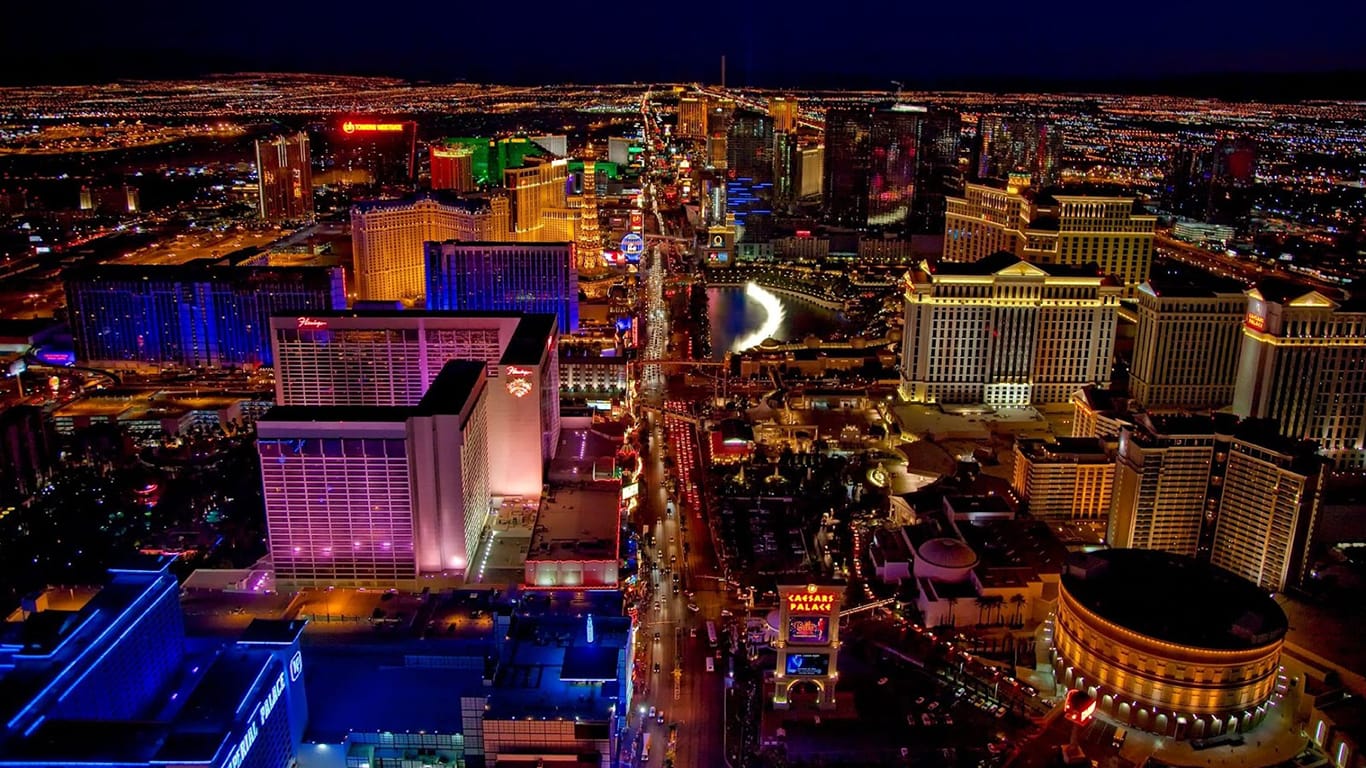
Las Vegas continues to lead the Southwest in population, construction, and economic diversification. Once known solely for entertainment, the city has matured into a business and real estate investment ecosystem driven by long-term fundamentals — tax advantages, affordability, and quality of life.
The Las Vegas 1031 exchange trend has accelerated since 2022, with a surge of out-of-state investors transferring equity from Bay Area and SoCal properties into Nevada’s condo-hotel and multifamily markets.
According to the Greater Las Vegas Association of Realtors (GLVAR), the median home price in early 2025 stands around $465,000, with consistent year-over-year growth of 4–6%. Rental yields remain strong, averaging 7–9% in the short-term segment and 5.5–6.2% in multifamily.
Why investors love Las Vegas:
● Zero state income tax — Nevada is one of only nine states offering this benefit. ● Pro-business environment with predictable property laws and limited regulation. ● Strategic 1031 exchange opportunities, attracting Californians deferring capital gains while upgrading into higher-performing Nevada assets.
Key Market Indicators (2025):
● Population: 2.4 million (Clark County)
● Annual population growth: 2.3%
● Median home price: $465K (GLVAR, Q1 2025)
● Unemployment rate: 4.2%, below national average
● Average cap rate (multifamily): 5.8%
In 2025, Las Vegas is no longer just where people play — it’s where investors prosper.
LOCAL NEWS: Walmart pays record $152 million for Luke Field building
INDUSTRY INSIGHTS: Want more news like this? Get our free newsletter here
2. Austin, Texas — The Innovation Capital of the South
Austin remains the model for innovation-led urban growth. Over the last five years, the metro area’s GDP climbed by 52%, driven by massive tech and manufacturing expansion. Apple’s 133-acre campus, Tesla’s Gigafactory, and Oracle’s new headquarters anchor Austin’s identity as the Silicon Valley of the South.
This boom has produced one of the highest median household incomes in the U.S. ($80,000+) and steady appreciation across residential and commercial sectors. The median home price sits around $540,000, while rent growth (5–6%) continues to outpace national averages.
Why Austin attracts smart investors:
● Texas’ no personal income tax policy mirrors Nevada’s advantage.
● Venture capital inflow remains among the nation’s top five (PitchBook, 2024). ● High percentage of renters (52%) supports stable multifamily occupancy.
Investment-grade opportunities extend beyond central Austin. Submarkets like Round Rock, Cedar Park, and Georgetown are experiencing double-digit appreciation thanks to infrastructure upgrades and population inflow. Meanwhile, East Austin is emerging as a cultural and commercial hotspot, blending tech offices with boutique developments and art-driven retail.
For investors, Austin is more than a boomtown — it’s a blueprint for balanced economic evolution. Its creative energy, talent pipeline, and infrastructure planning make it one of the safest long-term bets for 2025 and beyond.
By the Numbers (2025):
● Metro GDP: $260 billion
● Job growth: 4.2% year-over-year
● Median home price: $540K
● Population: 2.4 million
● Vacancy rate (multifamily): 5.9%
Austin proves that creativity and capital can thrive together — and for investors, that’s a combination worth holding onto.
3. Denver, Colorado — The Sustainable Growth Engine
Denver continues to impress analysts with its steady, sustainable growth model. The metro area’s GDP surpassed $240 billion in 2024, with healthy diversification across aerospace, renewable energy, and professional services.
Unlike markets prone to boom-bust cycles, Denver’s real estate has maintained balance. Its multifamily occupancy rate sits above 95%, while median home values average around $585,000, offering consistent appreciation without overheating.
Top-performing sectors:
● Green construction: Incentives for LEED-certified and solar-integrated developments. ● Mixed-use projects: Transit-oriented developments along the I-25 and Colfax corridors. ● Creative economy: Artists, remote workers, and startups sustaining downtown demand.
The city’s commitment to sustainability and livability also makes it appealing to next-generation investors. Over $1 billion has been earmarked for renewable transit and urban infrastructure projects by 2030, including electric bus networks and bike superhighways.
Denver’s population now exceeds 3 million, with a median household income of $92,000 — both indicators of long-term purchasing power and stability.
Investor Data (2025):
● Median home: $585K
● Rent: $2,050/month average
● Cap rates: 4.6–5.8%
● Year-over-year rent growth: 4%
● Unemployment rate: 3.8%
For investors seeking low volatility and high livability, Denver’s eco-conscious development approach provides an ideal equilibrium between profit and principle.
4. Miami, Florida — The Global Gateway for Capital
Miami remains the crown jewel of international real estate, powered by cross-border capital, luxury tourism, and corporate migration. It has evolved into what some call the “Wall Street of the South,” attracting global investors, fintech startups, and private equity firms.
The city’s property values rose 11% in 2024, outperforming most major U.S. metros. Over $15 billion in foreign direct investment poured into Miami real estate, primarily from Latin America and Europe.
Why Miami is a magnet for smart investors:
● Florida’s no state income tax policy enhances long-term returns.
● Downtown and Brickell remain global hubs for banking and law.
● Short-term rentals deliver among the highest ROI in the nation (8–10%). ● Consistent inbound migration from high-cost states and abroad.
Neighborhoods like Edgewater, Downtown, Coral Gables, and Sunny Isles offer opportunities across both luxury and mid-tier segments. Developers are also emphasizing green building practices and coastal resilience, ensuring that Miami’s growth remains sustainable.
Market Snapshot (2025):
● Median condo price: $520,000
● Rental ROI: 8–10%
● Population: 6.3 million (metro)
● Annual visitors: 25+ million
● Luxury inventory absorption: 89%
Miami is a global city with a local advantage: strong demographics, year-round tourism, and tax efficiency. For investors with international exposure, it offers liquidity and lifestyle in equal measure.
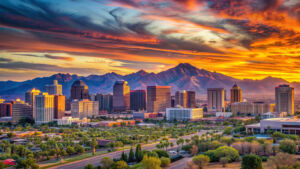
5. Phoenix, Arizona — The Southwest’s Smart-Growth Leader
Phoenix has quietly become one of the most dynamic and affordable large metros in America. With over 110,000 new residents in 2024, Maricopa County remains the fastest-growing U.S. county.
Real estate values continue to climb moderately — median home price sits around $470,000, still below national coastal averages but with strong appreciation potential.
Why Phoenix attracts investors:
● Diverse economy: semiconductor manufacturing (Intel, TSMC), logistics, and solar energy.
● Low property taxes and cost of living advantage over California.
● Rapid infrastructure expansion, including freeway extensions and new light rail.
Industrial real estate leads the pack. Vacancy dropped to 4.5%, while rental rates in logistics hubs jumped 12% year-over-year. Build-to-rent communities near Scottsdale and Goodyear are performing exceptionally, delivering 7–8% cap rates.
Market Highlights:
● Population: 5 million (metro)
● Median household income: $85,000
● Rent growth: 8% annually
● Median home price: $470K
● Cap rates: 5.5–6.8%
Phoenix’s combination of affordability, growth, and diversification makes it a model for long-term smart investment — particularly for those seeking portfolio balance across the Southwest.
Investment Trends Defining 2025
Across these five leading markets, several patterns are shaping investor decisions:
1. Migration-Driven Demand
Domestic relocation remains a key growth driver. Americans are leaving high-tax, high-density regions for business-friendly states like Nevada, Texas, and Florida. This inflow translates directly to sustained housing demand and rising rental yields.
2. Tax-Optimized Portfolios
The Las Vegas 1031 exchange market exemplifies a broader trend: investors using tax-deferred exchanges to reallocate capital from saturated states into emerging metros. Nevada, Texas, and Florida dominate these transactions due to their tax-neutral status.
3. Mixed-Use and Multifamily Resilience
Post-pandemic urban planning favors walkable, mixed-use communities. Developers are blending residential, office, and entertainment spaces — a model thriving in downtown Austin, Phoenix’s Roosevelt Row, and Las Vegas’ Arts District.
4. Lifestyle as an Economic Variable
High-income earners now choose where to live based on well-being and connectivity, not just salary. Cities offering cultural richness and outdoor access — such as Denver and Las Vegas — outperform because they retain talent and spending power.
5. Technology in Real Estate
From AI-driven property analytics to virtual leasing, tech continues to streamline acquisitions, management, and market entry. Smart investors are leveraging digital platforms to evaluate 1031 opportunities, manage portfolios remotely, and optimize yield.
Final Word: Investing with Vision
The cities reshaping 2025 aren’t just growing — they’re evolving intelligently.
● Las Vegas leads with tax efficiency, luxury real estate, and investor innovation. ● Austin proves that tech and culture can grow in harmony.
● Denver stands as the model for sustainability and stability.
● Miami connects global capital with domestic demand.
● Phoenix emerges as the Southwest’s affordable powerhouse.
Together, these metros embody the future of smart investing: strategic, values-driven, and opportunity-rich.
Whether you’re leveraging a Las Vegas 1031 exchange to reposition equity, exploring Vdara for sale listings as lifestyle investments, or diversifying into Austin’s tech corridor, 2025 rewards foresight.
In this new era, wealth isn’t just about owning assets — it’s about choosing where and how your capital grows. The best investors don’t chase the market. They read the momentum — and right now, these cities are where that momentum lives.