Published in 2014, “Velocity: A Blueprint for Transforming Greater Phoenix into an Innovation Economy” laid out a plan to bolster the region’s capacity for technology development, grow the skills of its talent pool, increase exports, and create a supportive ecosystem for entrepreneurs and new firms.
During the Partnership for Economic Innovation’s (PEI’s) inaugural Innovation Summit on Nov. 14, Amy Liu, nonresident senior fellow at Brookings Metro, offered a retrospective on the accomplishments made over the last decade and outlined what needs to be done to keep the Valley competitive in the years to come.
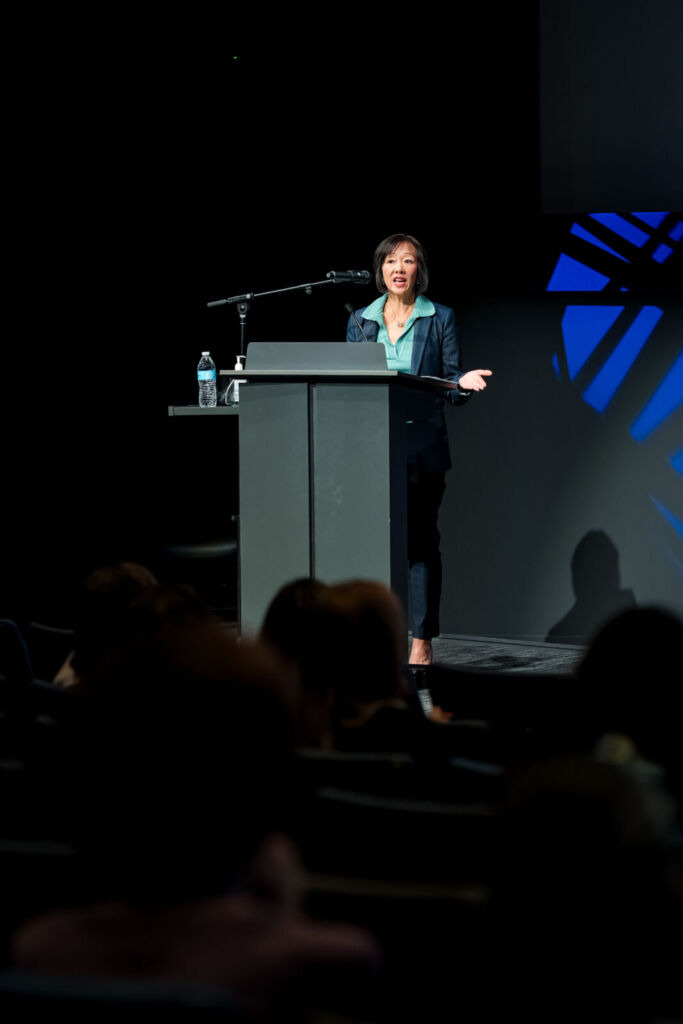
“[Greater Phoenix] has become a major center of advanced industries and innovation,” Liu says. “Getting to this point was not an accident, and nurturing all the conditions for innovation will require more intentionality and more collaboration.”
The Valley is building momentum as an emerging leader in designing, developing and deploying AI — proof, Liu says, that setting a 10-year vision can serve as “North Star” to spur progress. That said, the achievements made aren’t an excuse for the region to rest on its laurels.
“It’s time to keep moving to stay at the forefront,” she continues. “Artificial intelligence is here, but adoption is still early. Leaders must embrace AI while also valuing human intelligence and our people as we innovate.”
Even though the long-term benefits and potential drawbacks of AI remain to be seen, many businesses are already utilizing the technology in their operations. Liu cites a PwC report showing that industries with high exposure and use of AI saw revenue growth per employee triple over the last three years.
LEARN MORE: Here’s how economic development hinges on relationships
Workers with AI skills are paid 56% more on average, according to Liu, highlighting the need for developing, attracting and retaining talent. As of today, the Bay Area and San Jose remain the epicenter of AI, but Brookings has identified Phoenix as one of 28 “Star Hubs” alongside Boston, Austin and Washington D.C.
For the Valley to break into the top 15 metro areas, Liu says more focus should be placed on producing doctorate-level computer scientists and engineers, which would attract federal contracts and VC funding. When it comes to firms actually using AI, Greater Phoenix is lagging behind its peers, ranking 76th in terms of adoption.
“In short, there are opportunities to better organize and facilitate the region’s innovation assets,” Liu concludes. “What’s next for leaders is to take your collective strengths to the next level and prove that global innovation results in a prosperous future for Greater Phoenix. I believe it can be done because you’ve already done it before.”