In February, West-MEC — a public high school program for students interested in hands-on career and technical education — began work on its new Southeast Campus and recently completed an expansion of its Northeast Campus. With the new developments underway, more programs and opportunities are being added to help students find a way into the workforce.
“The equipment that we have in most of our facilities is driven by business and industry, because we want to make sure that the tools mirror what students will see in the actual workplace,” explains West-MEC Superintendent Scott Spurgeon.
West-MEC Southeast Campus
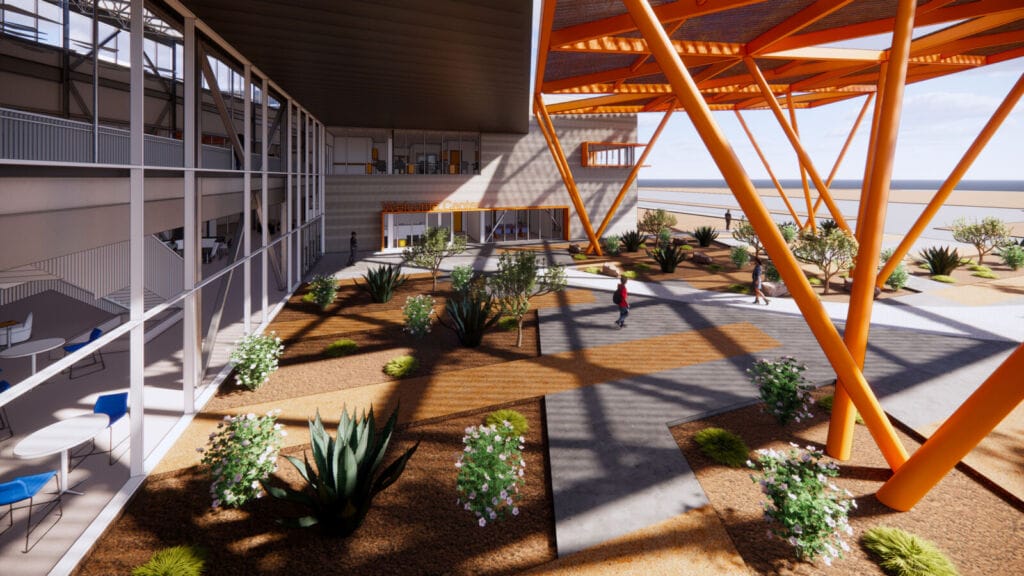
Located at W. 93rd Avenue and Osborn Road, West-MEC’s Southeast Campus will be the district’s fifth and largest campus. The multi-phase project is being built by CHASSE Building Team with DLR Group as the architect. Phase one will include 50,000 square feet of educational space and six different programs that center on medical assisting, physical therapy, IT security, advanced manufacturing and welding.
The first phase is slated to finish in summer 2026, however, finishing the project requires the passage of Prop 403, a bond on the Nov. 4 ballot. If successful, the $415 million bond would help fund phase two and other future West-MEC projects.
Through the district’s partnerships with companies such as Amazon, TSMC, Amkor, Gatorade and Nestlé, West-MEC shapes its programs to meet the needs of industry. According to Spurgeon, nearly 400 companies host West-MEC students for work-based learning each spring semester.
The location of a campus also informs what is offered to students. For example, the Southeast Campus is across the street from Banner Estrella Medical Center, allowing learners to access services that are involved in their career pathways.
“The closer in proximity students are to internships, externships, apprenticeships or pre-apprenticeships, the easier it is for them to get to those locations,” Spurgeon says. “So, there are many factors that drive where we place campuses, but a lot of it is based on industry needs, workforce development demands and student interest.”
Since West-MEC campuses are built for hands-on learning rather than a standard high school with a cafeteria and a gym, it is essential that each lab and classroom is designed around specific program requirements.
LEARN MORE: Here’s how land use patterns are changing in Arizona
With the CTE world being constantly changing, DLR Group worked to make the Southeast Campus flexible to accommodate shifts in programming.
“I remember when we worked on the Southwest Campus, we deliberately built that in phases,” explains Katrina Leach, the principal and project manager of DLR Group. “We designed it so a lab could be a health science lab, but when they built the next phase it turned into an electrical lab.”
Another significant design choice for the campus is the glass-partitioned walls. Prior to construction, DLR Group went to West-MEC students to ask what was missing from the school, discovering that they wished to see more of one another throughout the school grounds, Leach explains.
“The transparency really gives the opportunity for collaboration, seeing the projects that are going on, inspiring curiosity and allowing people to move freely throughout the building,” Leach continues. “That’ll be a great opportunity for showcases and displays, and more interaction between the different programs.”
West-MEC Northeast Campus
Most recently, West-MEC finished its $13.5 million expansion of the Northeast Campus — which sits right next to Phoenix Deer Valley Airport — adding a 16,500-square-foot advanced manufacturing and welding building and a 2,000-square-foot electrical vehicle bay.
The decision to expand the campus was due to the growth of the semiconductor industry and the increasing waitlist for the welding program. Spurgeon explains West-MEC normally has a backlog of 300 to 500 students for welding programs each year.
“We were looking at the potential for TSMC to also use our facilities in the evening to upskill or do other types of professional development,” he continues. “The Northeast Campus is in the perfect location for that.”
The expansion was constructed by McCarthy Building Companies and designed by Grace Design Studios. Because the campus was active during the 10 months of construction and is near an airport, McCarthy had to plan extensively to mitigate possible disruptions.

“We made the decision not to bring any cranes on site, which is really unique for any type of building,” explains Matt Lyons, the business unit leader for McCarthy’s education team.
A unique element of the project was the clean oom within the advanced manufacturing and welding building. Lyons says it was the firm’s first time building one within a school setting.
“Anytime you’re dealing with a cleanroom, the biggest challenge is keeping all the dirt and debris away from the various systems,” Lyons says. “The air changes that need to happen inside of a cleanroom are pretty intense.”
Other additions included 25 individual welding booths with a specialized exhaust system, and an exterior welding yard with sandblasting and plasma cutting stations.
“We just couldn’t be more excited and blessed with the number of partnerships and great relationships we have,” Spurgeon says. “We’re thankful to be part of the great things happening in the West Valley.”