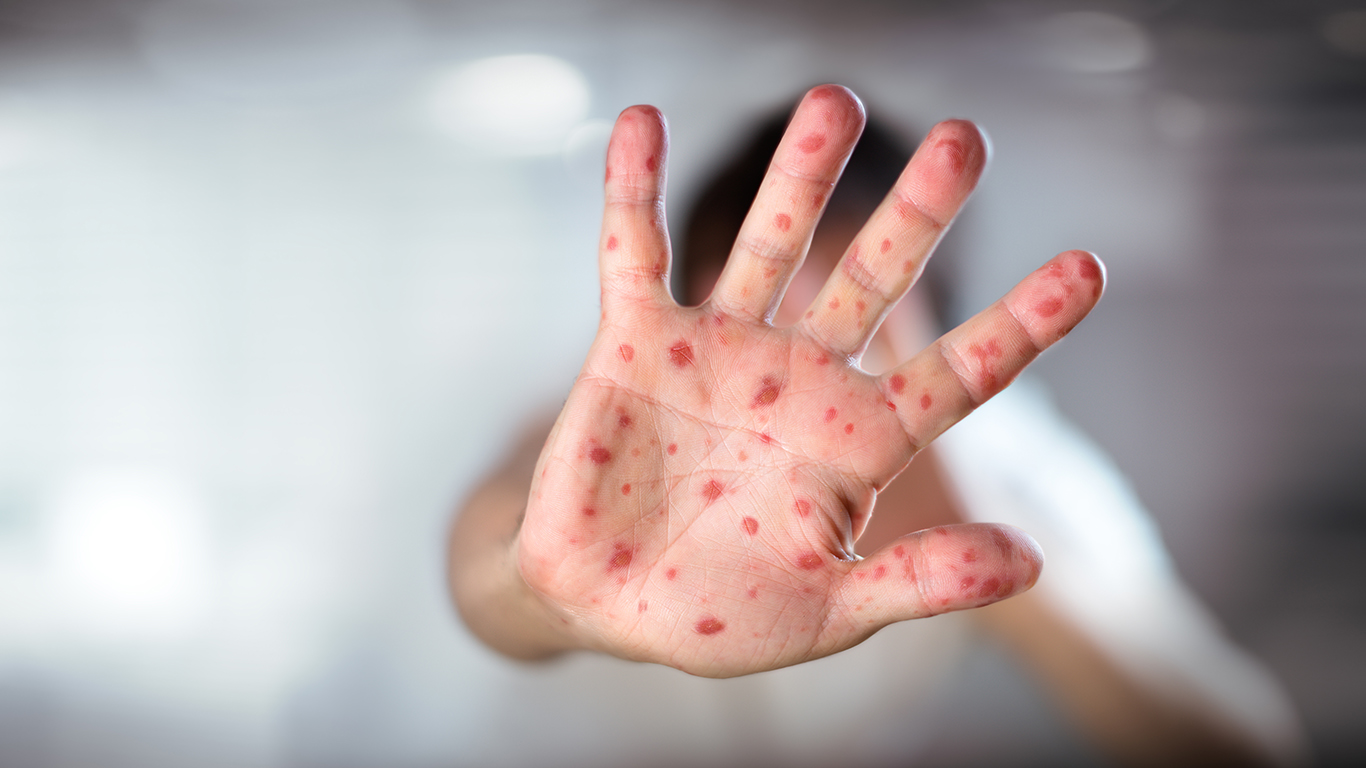
Arizona now has the second-largest outbreak of measles in the nation this year.
Arizona State University’s Health Observatory has launched Disease Insights, a website that includes up-to-date information on measles to help you stay safe during the state’s outbreak.
LOCAL NEWS: Phoenix housing market outpaces national trends again in 2025
READ MORE: The history of measles in the United States
INDUSTRY INSIGHTS: Want more news like this? Get our free newsletter here
Arizona’s cases have been concentrated near the Arizona-Utah border in Colorado City. But outbreak fears struck closer to home in early November when thousands of people who attended a concert in downtown Phoenix were alerted to a potential measles exposure.
Measles is a highly contagious virus that spreads through the air and can infect people for up to two hours after an infected person leaves the room. Anyone who has not been fully vaccinated with the measles, mumps and rubella (MMR) vaccine or had measles in the past is at risk of catching this serious disease.
“The most important thing for everybody to do is make sure that you have your own immunity to measles. The MMR vaccine is one of the very best vaccines that we have. It is 97% effective if you have two doses of vaccine,” says Rebecca Sunenshine, medical director of the Health Observatory at ASU.
The Health Observatory transforms health data into health knowledge. It brings together multiple types of data from across the Southwest and the nation to provide early and accurate updates about health issues, helping Arizona’s communities, doctors, researchers and leaders make better decisions.
Below, Sunenshine answers questions about the outbreak in Arizona, measles and the MMR vaccine.
Note: Answers edited for length and clarity.

Question: How is the Arizona measles outbreak connected to other outbreaks around the U.S. this year, and how did we get here?
Answer: Last January, measles hit Texas, and different outbreaks have been seeded since that time. However, the strain from the Arizona-Utah outbreak is different from the one from Texas. So there is no known direct link between the two.
What is similar between them is that they both exposed communities that have very low vaccination rates. It spreads so quickly that it’s hard for public health workers to get in fast enough to stop it from spreading. And that’s really what we’re seeing.
Since 2000, the United States has been able to declare that measles is eliminated. Because we had enough people vaccinated in the U.S., measles was not able to spread very well. But our rates of immunization in the U.S. have been steadily declining over time.
In Arizona, kindergartners are at an 88.6% vaccination rate for the MMR vaccine. There is a very clear threshold for herd immunity, and that is 95%.
Unsure about vaccination status?
If you don’t know if you’ve been vaccinated against measles, you can ask your health care provider for a blood test (measles titer) to see if you have the antibody to protect you from measles.
If you were immunized in the state of Arizona, the Arizona Department of Health Services provides immunizations records electronically through MyIR. Register and request your immunization records through the ADHS website.
Q: Should people be concerned if they plan to travel for the holidays?
A: With the upcoming holidays, if anybody is in an infectious period and doesn’t yet know, it could lead to a significant spread among unvaccinated people.
Measles is infectious four days before you get a rash. People with early symptoms — cough, red eyes and runny nose — might think they have allergies or a cold.
Anybody who travels absolutely needs to get vaccinated. Would I not go somewhere because measles was circulating? No, but I would make sure that I had those two doses of vaccine onboard. Most people require two doses of the MMR vaccine to be immune.
Q: The MMR vaccine has been in use for over 60 years. What have we learned about its safety in that time?
A: We know that the MMR vaccine is incredibly safe. Its primary side effects are a sore arm, some redness and a mild rash or fever. It is a live vaccine, which means certain people can’t get it. We don’t give live vaccines to pregnant people, young infants or people with depressed immune systems.
A lot of people think they would rather take the chance of getting measles than have the side effects of the vaccine. What they don’t realize is that 1 in 5 people who get measles are hospitalized, 1 in 20 will get pneumonia, 1 in 1,000 will have disease affecting their brain and spinal cord, and 1 to 3 of every 1,000 infected children will die.
Even if you get measles and recover, you can later get subacute sclerosing panencephalitis, or SSPE. It’s a rare, progressive and fatal brain disorder that emerges seven to 10 years after measles. You are far better off getting the measles vaccine than even taking the risk of getting measles. You never get the risk of SSPE from the vaccine.
Q: If someone gets the MMR vaccine, how long does it take to gain immunity to measles?
A: It takes about 14 days for your body to respond to the vaccine and build immunity. We always recommend that you get vaccinated ahead of time. If someone who is unvaccinated or under-vaccinated is exposed to measles, you can prevent them from getting measles by vaccinating them within 72 hours of the exposure. I would much prefer that everyone just make sure that they’re already vaccinated so that if they are exposed, they don’t have that 72-hour rush to get the vaccine.
If you’re exposed to measles, but you’re in one of those groups that can’t get a live vaccine, there’s another drug that you can get called immunoglobulin. You have six days after exposure to get that. It’s an infusion that’s given in a health care setting.
Q: Measles is a lot more contagious than other infectious diseases. Do we know why it’s so much more contagious?
A: We don’t know why. We just know that it is the most contagious infectious disease known to humans. If one person infected with measles exposes 10 people around them and they are all unvaccinated, 9 of the 10 people will get sick. Another way to look at that is if somebody in a household has measles, there is a 90% chance that anyone in that household who is unvaccinated will get measles. It’s far more infectious than COVID-19, far more infectious than Ebola, it’s even more infectious than tuberculosis.
Q: How can the Health Observatory Disease Insights measles page help policymakers or community members during outbreaks?
A: It is a one-stop shop for all the information that you need to understand what is going on with measles regionally and in the state, and how to protect yourself. It links you to public health resources to help you find vaccine information, like where to get vaccines and whether you’ve been immunized.
We also have information about bird flu. We will offer up-to-date information on Disease Insights regarding other emerging infectious diseases that we think people would want to follow over time.