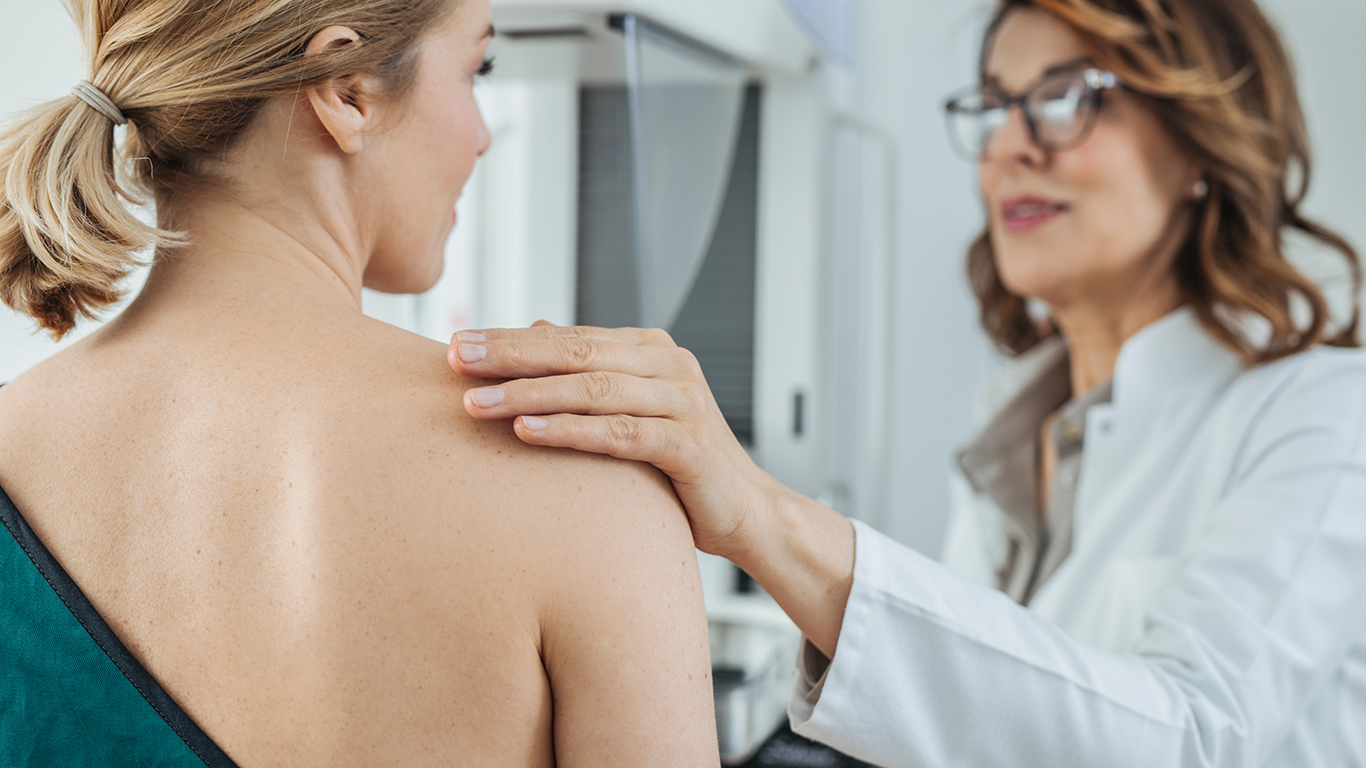
Lindsey Michaels refused to leave her health to chance; knowing her family’s history of breast cancer, she made informed awareness her top priority.
So, in May 2025, she added Enhanced Breast Cancer Detection (EBCD), an FDA-cleared RadNet AI technology to improve breast cancer detection rates, at Arizona Diagnostic Radiology’s Breastlink.
A major new study published in Nature Health is providing real-world evidence that AI, when embedded into the clinical workflow, can significantly improve breast cancer detection in everyday practice.
MORE NEWS: The 100 Best Doctors in Arizona for 2026
INDUSTRY INSIGHTS: Want more news like this? Get our free newsletter here
The AI-Supported Safeguard Review Evaluation (“ASSURE”) study — the largest real-world U.S. validation of an AI-enabled breast cancer screening workflow — analyzed more than half a million screening mammograms across community imaging sites nationwide.
The findings support the clinical value of RadNet’s EBCD program. RadNet is Arizona Diagnostic Radiology/Breastlink’s parent company.
Unlike many AI tools that add another software overlay, the EBCD program integrates FDA-cleared AI into a carefully designed multi-reader workflow that enhances a radiologist’s performance without disrupting clinical operations.
“EBCD is like having multiple sets of eyes on the mammogram: the initial radiologist, the FDA-cleared AI, and an additional breast-specialty radiologist,” said Dr. Greg Sorensen, board-certified neuroradiologist, CEO and co-founder of DeepHealth.
“That layered approach is what sets this program apart and allows us to meaningfully improve detection in real-world practice.”
EBCD is not simply “AI added to mammography,” Sorensen said. It is a comprehensive screening workflow that:
• Flags subtle areas of concern using FDA-cleared AI
• Provides an additional expert breast radiologist review when needed
• Enhances clinical confidence while preserving existing recall standards
• Creates a scalable model for consistent, high-quality screening
“Screening mammography has been shown to decrease breast cancer morbity and mortality,” Dr. Reddy said. “EBCD improves breast cancer detection, even in women with dense breasts. With EBCD, finding more breast cancers early decreases breast cancer death. I think that is something that we all support.”
Dr. Reddy said the service is generally not covered by insurance but the cost averages at $40. She hopes insurance companies will soon cover EBCD.
“When tomosynthesis, or the 3D imaging, was new technology, it was very similar. Everyone had to pay around $50 extra to get it,” said Dr. Reddy, a dedicated breast radiologist at AZDRG and Breastlink Arizona. She also performs biopsies.
“When insurance companies saw people wanting to have it and seeing the data, they eventually started covering it. We’re hopeful that that happens in the future with this as well.”
Dr. Reddy referenced the “A study came out that confirms what I’ve been seeing in practice: When AI and a radiologist work together to read the mammogram, we’re detecting more cancers,” said Dr. Reddy,
“This is across all breast densities because with dense tissue, it can be a little bit harder to see cancer. This is why this is important: When we detect cancer early, then we have the best chances for treatment and survival for women. This is really a great tool for us, because it’s allowing us to detect cancers earlier and detect more cancers.”
Dr. Reddy said most of her patients are “very receptive,” as AI has become more mainstream — and in different ways.
“I think so many people have friends or family members who have been touched by breast cancer,” she said.
“When they hear about something that is potentially going to help us detect more cancers, I think they’re really excited about it. The experience is no different for the patient. They elect to have the EBCD and it’s really just back-end processing.”
A radiologist’s eye will be drawn to concerning areas. Some high-risk areas do not merit a return visit if it has already been biopsied or had surgery. EBCD markers indicate low, intermediate or high risk for cancer.
“It goes to a second radiologist who looks at the films to see if they agree that the high-risk area does not need to be worked up,” Dr. Reddy said.
“It really triggers a second look by another radiologist on any areas deemed concerning on a mammogram, which is amazing. If an abnormality is identified, the patient comes in for a diagnostic mammogram and ultrasound to confirm if the finding is truly abnormal and determine the extent. If that abnormality still looks suspicious, the patient will need a biopsy.”
Michaels, 46, was relieved after the EBCD confirmed the radiologist’s findings; she is cancer free. The test found a fewcysts that her doctors are following.
“She [Dr. Reddy] was able to talk to me and just calm me down, and make sure that I realized we’re just watching something,” she said. “Feeling a lump in my breast is scary enough, but I’m also on HRT (hormone replacement therapy).
Dr. Reddy and Michaels said it’s important to note that women do not need an order from a doctor to have a mammogram or EBCD.
“Women don’t know that,” Michaels said. “I’m trying to push this with my friends. I moved from California to Arizona. I didn’t have anyone to see me. I didn’t know that women over 40 don’t need an order. They can literally walk in and get a mammogram.”
If follow-up care is needed, patients are assigned to a breast surgeon.