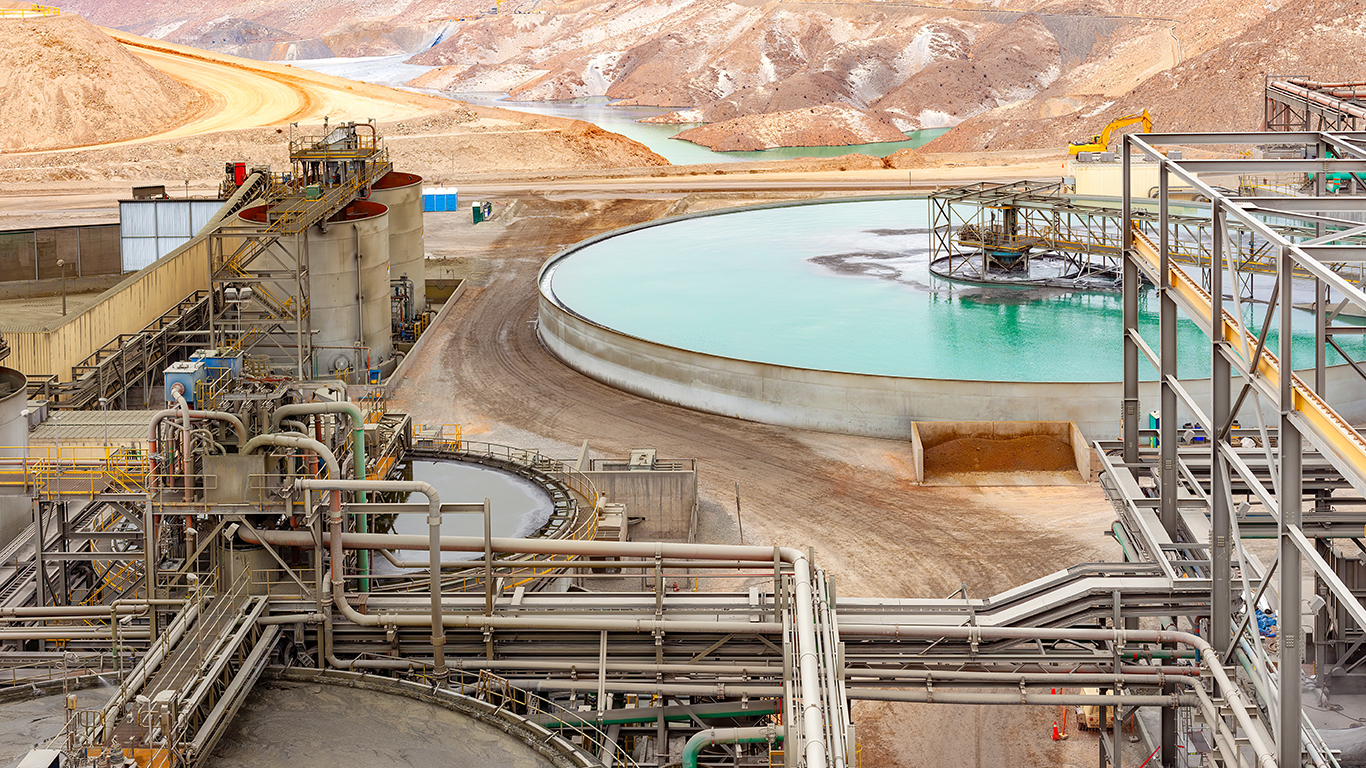
Concerns about water shortages are often questioned in connection with Arizona mining. But, even with the Grand Canyon State under the Governor’s Drought Emergency Declaration and Arizona Drought Monitoring Technical Committee (DMTC) Drought Declaration, the reality of how much water is utilized in mining might come as a surprise. New approaches, practices and technological advancements have changed the relationship between water and mining, as have those with federal, Tribal and municipal water partners.
Arizona hasn’t experienced drought relief for more than two decades. Not only is the 25-year-plus drought one of the longest in the state’s history, but the Arizona Department of Water Resources (ADWR) reports that September 2020 to August 2025 mark the sixth hottest and seventh driest period on record.
So, are water allocation concerns in mining operations warranted? Sure, but just as much as the scrutiny over how water is distributed and shared among all other state users.
“The water usage by the mines is not an insignificant amount,” says Les Presmyk, Arizona State Mine Inspector, “but in the grand scheme of things, the [industry] is one of the [smaller] users.”
Mining’s water footprint
If water usage is observed as an inverted pyramid, ADWR puts irrigated agriculture at the top as the largest user of water in Arizona, consuming an estimated 74% of the available water supply. Next is municipal water use at 20%, with 70% of that portion going to residential use. At the tip of the upside-down triangle, an estimated 15% of Arizona’s water supply is used for commercial, industrial and institutional purposes.
ADWR classifies metal mines within commercial, industrial and institutional water utilization. Within the 15%, mining water use is lumped in with cattle feed operations, dairy operations, large-scale cooling facilities, large-scale power plants, new large landscape uses, sand and gravel facilities and turf-related facilities.
“The public perception is certainly that mines use a lot of water, but they don’t know how much water they’re using in comparison [to others],” Presmyk says. “So, we have to offset that and try to educate people that mining is not a necessary evil. It’s a necessary part of our way of life.”
As Sophie Dessart, manager of communications and public affairs at Florence Copper, explains, Arizona mines are continuously innovating to reduce water use, and this effort is occurring against the backdrop of statewide conservation goals. It’s important to note that mining accounts for about 1% of Arizona’s total water use, according to analysis by the Center for an Arizona Carbon-Neutral Economy.
“Regardless, the industry recognizes the need to constantly innovate and do more,” she says.
Arizona mining has and continues to keep its sights set on environmental conservation and improved practices. This means adopting more efficient technologies, expanding recycling systems and exploring opportunities to reuse water that would otherwise be lost.
“The mining industry continues to research and adopt effective technologies to optimize its beneficial use of water,” says Stuart Kimball, shareholder at Gallagher & Kennedy. These technologies have allowed the mining industry to maximize its facility operations by capturing previously used water to be reused. These efforts are not limited only to water, but are part of a larger effort of the mining industry to maximize its sustainable efforts.”
Dessart adds, “These innovations help reduce overall consumption and demonstrate that mining can coexist with Arizona’s long-term water stewardship efforts.”
Florence Copper’s proven in-situ copper recovery (ISCR) process is a prime example of how innovative technologies can provide significant water conservation benefits. Unlike extracting and processing massive quantities of mineralized rock, Florence Copper uses ISCR to dissolve copper minerals below ground, then pump a copper-rich solution to the surface for processesing into pure copper cathode sheets on site.
“Most of the water used on Florence Copper’s site is continuously recycled back through the ISCR process, resulting in an estimated 78% reduction in water consumption per pound of copper produced compared to a conventional open-pit copper mine in Arizona,” Dessart explains.
Like Florence Copper, Resolution Copper remains committed to water conservation efforts. The mining operation has spent millions of dollars securing banked water, otherwise known as long-term storage credits, to provide water for its operations. This water comes from the Colorado River via the Central Arizona Project (CAP) canal and enough water has already been stored to sustain operations for more than half the mine’s operating life.
Securing long-term supplies
Water use often intersects with agriculture, municipalities and Tribal communities, which means there are key legal considerations mining companies must navigate when negotiating water rights and partnerships. Tribal nations play an increasingly pivotal role in Arizona’s long-term water security. Today, Tribal water leases already supply more than 150,000 acre-feet per year. This is more than the annual municipal use of Tucson or Mesa.
Two major settlements now moving through Congress — the Northeastern Arizona Indian Water Rights Settlement Agreement (NAIWRSA) and the Yavapai-Apache Nation Settlement Agreement (YANSA) — would further increase the volume of Tribal water available for leasing. In total, roughly 300,000 acre-feet per year of Colorado River water could ultimately be leased, depending on priority levels and shortage conditions.
But, for Tribal nations, water holds more than economic value. The cultural and spiritual significance of water must be acknowledged, making leasing decisions deeply nuanced.
“The mining industry is critical to Arizona’s success, whether hard rock mining or aggregate mining,” Kimball says. “Therefore, it is critical that all of the water users are consulted on any change in law or policy to ensure Arizona’s best interests are met and to minimize any unintended consequences.”
Communication and collaboration will be pivotal in the role water plays in understanding future mineral needs. According to the International Energy Agency (IEA), mineral demand is set to rise sharply across all energy-transition scenarios: “In the STEPS (Stated Policies Scenario), demand doubles by 2030. In the APS (Announced Pledges Scenario), it more than doubles by 2030 and triples by 2050.”
Ultimately, this accelerated mineral demand tied to global clean-energy goals reinforces a key reality: Arizona’s ability to support the next era of mining is inseparable from its ability to manage water sustainably.
Tighter coordination between mining companies, Tribal governments, municipalities, state agencies and federal partners is paramount in ensuring that economic growth, environmental stewardship and long-term water security advance together.
Kimball explains that long-term water planning is essential because most Arizona mines operate for decades, far longer than many municipal or agricultural planning horizons. Even when water is available, transporting it is not always straightforward, since statutes limit how and where certain supplies can be moved.
“The various statutes and regulations impose different transportation limitations,” he says. “Fortunately, Arizona has focused on reasonable water policies to address these issues. The mining industry continues to work with all interested parties to ensure that Arizona prioritizes sufficient water availability to maintain Arizona’s economic future.”
Balancing act
Looking ahead, Kimball cautions that costly water-augmentation efforts or expensive new supply solutions could raise water prices in ways that undermine mining’s competitiveness. Maintaining balanced, transparent policy-making will be critical as Arizona expands both its clean-energy mineral production and its long-term water-management strategies.
“The cost of water is likely to change given efforts by certain parties to adopt expensive solutions,” Kimball notes. “Given that many of the minerals are commodities, the prices are set on a global stage; therefore, any unnecessary increases may not be in the best interest of the public.”
Even with regulatory challenges and economic considerations ahead, real-world collaboration is already proving what’s possible when water users work together. Florence Copper’s recent partnership in Pinal County is one example Dessart points to as a model for shared conservation benefits.
“I firmly believe there is strong potential for collaboration to promote water conservation in Arizona, including through shared water-reuse projects that benefit multiple users,” Dessart says, pointing to a recent initiative by Florence Copper.
Due to the small footprint of the ISCR process, Florence Copper does not use its entire property in Florence and leases approximately 25% of the land to a local farmer. Florence Copper recently secured state authorization to supplement irrigation water for a local farmer using surplus process water from its operations and began implementing this program in 2025. Over time, this program has the potential to offset up to 1,466 acre-feet of water annually, equivalent to the water use of more than 5,000 households.
“These types of partnerships reduce pressure on regional water supplies and demonstrate how mining operations can work constructively with agricultural and municipal users,” Dessart says. “As statewide water conservation efforts continue to evolve, collaborative approaches that maximize reuse and efficiency will be essential to ensuring long-term sustainability for all water users.”