When Arizona’s Bioscience Roadmap was introduced in 2002, other markets were skeptical about the state’s contribution.
Officials in Boston, Atlanta and Washington, D.C., and others said, “Oh, aren’t you just cute? We have 200 years on you,” recalls Christine Mackay, president and CEO of the Greater Phoenix Economic Council.
“In true Arizona fashion,” Mackay adds, “We did what we said we would do. We worked together. We worked hard. We worked with our universities.
“We went from being a ‘nobody on the block’ to now. We are known as a top 20 Life Sciences market. We’re in the top five emerging Life Sciences markets. We’re No. 1 in bioscience, finance, engineering and job growth.”
READ MORE: Here is the outlook for Phoenix’s 2026 housing market
LOCAL NEWS: TSMC Arizona preparing workers for a chips future
The key is collaboration
Mackay and her Greater Phoenix Economic Council team steer municipalities toward becoming a global innovation hub through infrastructure, workforce development and business attraction strategies.
The key to the area’s success is collaboration. Mackey agrees.
“Greater Phoenix is this conglomerate of 22 cities and two counties that we lovingly call ‘coopetition.’ Projects consistently look at multiple cities across the market, and the cities are not competing, but working so closely with each other. We help each other.”
During Mackay’s tenure as the City of Phoenix’s economic development director, her job was to win projects. If it wasn’t the right fit, Mackay referred the project’s staff to another municipality.
“After my interview, if I knew I wasn’t going to win it, I would call one of my colleagues that I knew they were going to go next and say, ‘Let me tell you everything I learned in this meeting,’” Mackay says.
“That’s the way we work together. We’re the first ones to send each other a note or a text when one gets a project, or congratulate each other on something that’s happened, or say, ‘I’m so sorry that this happened. We know you will get them next time.’”
Mackay says the country’s aging population will keep researchers and talent busy.
“It’s our hospitals that have the doctors who are advancing the research, testing the research and the technology that is validating that research,” she says.
That work has led to a wearable technology center products that require chips and sensors created by scientists and thinktanks. Studies also include research on cancer vaccinations, dementia, cell and gene therapy and medical devices.
Bioscience boom
“The new Biosciences Roadmap came out last year from The Flinn Foundation,” she says. “It tells us which path to follow. I really think our greatest growth is going to be in biosciences and healthcare.”
GPEC works closely with other stakeholders and elected leaders. More importantly, she says meeting with universities helps GPEC identify its strong suits.
“That’s not what we focus on,” she says. “We focus on those specific sectors that we can truly excel at and really be known as that global innovation hub.”
GPEC brings the cities/towns with universities, researchers, and the existing company side.
“Then we add our universities and our community colleges and our high schools that are on the workforce side,” she explains.
“We’re getting that workforce ready and trained. When you look at some of the most innovative training programs that we’ve created over the last two years, it is in semiconductor fab technician training.”
Mackay says GPEC is working with drone companies, too.
“The greatest success that they have with their workforce is those students who are coming out of robotics programs.
“Now we marry those companies and the high schools that have the robotics programs and making those connections. GPEC’s role is really a connector and a convener, and identifying those areas where we are going to excel.”
One of Mackay’s “absolute favorite subjects” is GPEC’s international collaborations.
“When you look back, Greater Phoenix was not known as an ‘international hub.’ It would never be a region that would come up 20 years ago when you were talking about the international hubs inside the United States, she says.”
Others look toward cities like San Francisco and Los Angeles.
“That has changed so dramatically over the last five years. We went from having 2% of our book of business from international companies to, if you amortize the last five years, 24% of our book of business comes out of internationally related companies.
Transforming a reputation
Greater Phoenix’s reputation went from, “‘We don’t even know who you are, to ‘international darling’ with companies that we’re working with across the globe,” Mackay says. “That is working with our consular core. It is working with the ambassadors from regions and countries that we are aligned with, either technologies or businesses or raw materials that we share back and forth.
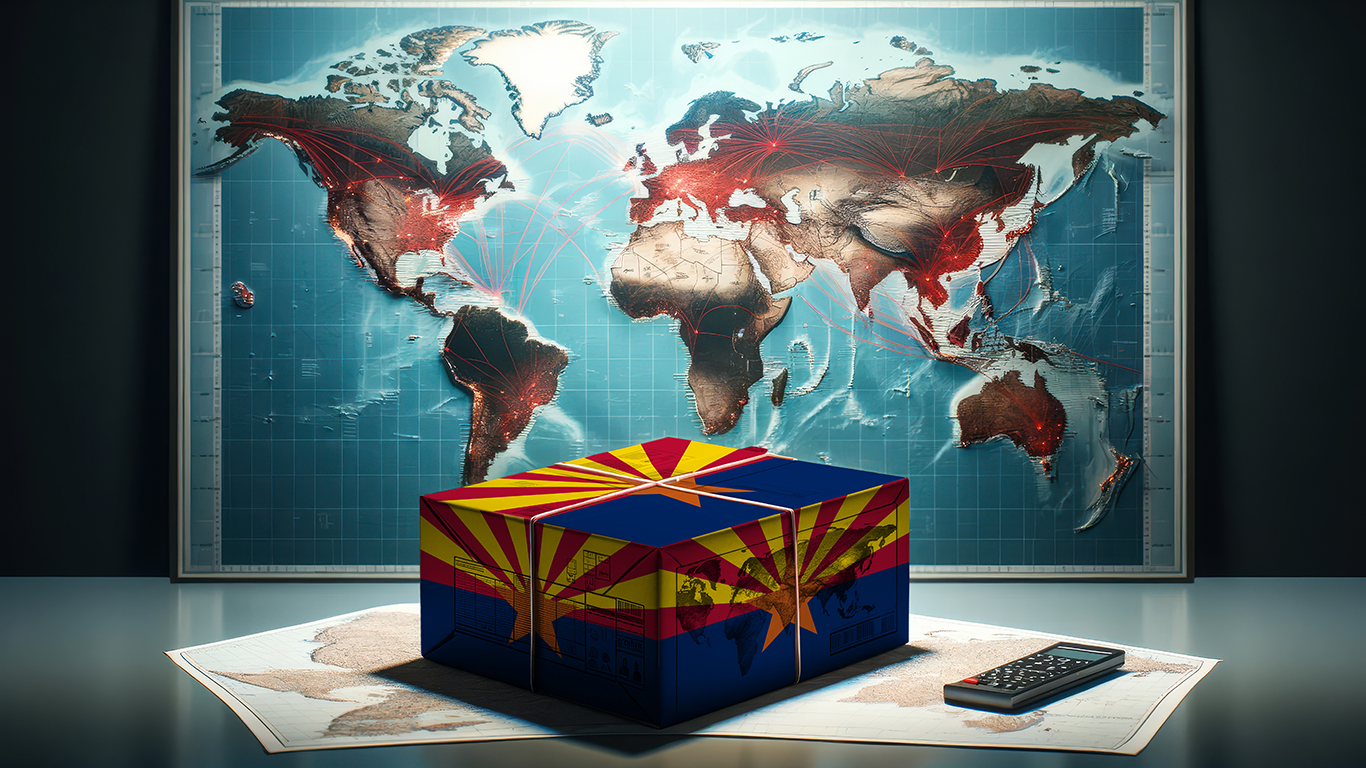
“Everybody always likes to say that China is Arizona’s No. 1 trading partner — and that’s true. But if you combine the USMCA and combine Canada and Mexico together, that’s our largest trading partner.”
Automobiles are also considered.
“That automobile between the Maquiladoras doors and our companies here in Arizona, in Greater Phoenix, that car is going to go back and forth across the border six times before it hits the car lot and ready to be sold,” Mackay says.
“Now, let’s say that cars manufactured in Asia, there’s not going to be that economic impact on Arizona, because it’s that economic impact is going back and forth between those regions. The car just comes here to be sold. When you look at GPEC’s role in creating that global economy, we work diligently with those decision makers, those thought leaders.”
Mackay also travels to introduce Greater Phoenix, so the cities and towns can brag about the collaborations. Those international partnerships include the city’s Sister Cities partnerships with Taipei, Taiwan.
“The team that recruited and works with TSMC, their supply chain, and bringing, workforce here, and then attracting new restaurants and retailers and others.”
The city uses the 11 Sister Cities — such as Prague; Hermosillo, Mexico; and Catania, Italy — to drive international economic development. Similarly, Catania has a strong semiconductor segment, she adds.
“We did that because they have incredible boards with direct connections into companies in those countries,” she says.
“Sister Cities breaks down barriers between our cities to be able to allow dialog to happen, to allow cross border connections and learn from each other best practices. People underestimate the power of the International Sister Cities organization.”