
Introduction
In view of increasing costs and restructure of the supply chain in the contemporary world, OEMs in sectors of medical devices, aerospace, and automotive experience major challenges in the domain of custom parts production – delayed deliveries, quality concerns and budget overruns. Conventional suppliers fail to provide automated machining capabilities and a DFM practices review, which leads to tolerance problems, increased amount of scrap and higher cost of communication, thus adversely affecting the supply chain efficiency.
This research paper presents a complete discussion about how companies can save up to 25% on procurement costs through proper implementation of industrial outsourcing in accordance with international standards, including IATF 16949 automotive grade system and offshore supply chain assessment. We shall discuss how the sphere of precision engineering and advanced manufacturing technology is transforming the practice of industrial procurement across the world.

Why Are Global Manufacturing Trends Driving the Demand for Precision Engineering in Custom Parts Production?
As per the 2024 Deloitte report on global manufacturing competitiveness, 73% of the OEMs have precision engineering in the top-three priorities list while choosing suppliers of custom parts due to the miniaturization and lightweight design trends. These trends make extremely tough geometrical constraints. The absence of precision engineering makes impossible to achieve the required tolerances in microns level with traditional machining. Below are the three most important factors. Every single one of these factors proves the necessity of strict process control in value-added industries.
1. Minimality Creates More Strict Process Control Requirements
The connection between dimensions becomes extremely sensitive. Tolerance 0.01 mm may prevent assembly from functioning correctly. Modern global manufacturing trends imply the necessity of thermal stability and vibrations reduction. The cooling system provides the same effect on the environment of the machining process.
2. Lightweight Materials Bring New Challenges to Machining Processes
Titanium and Inconel have low thermal conductivity. Custom parts production needs special approach to toolpaths to prevent any damage to subsurface material. High pressure cooling is necessary to remove chips and maintain temperature of cutting area at safe level.
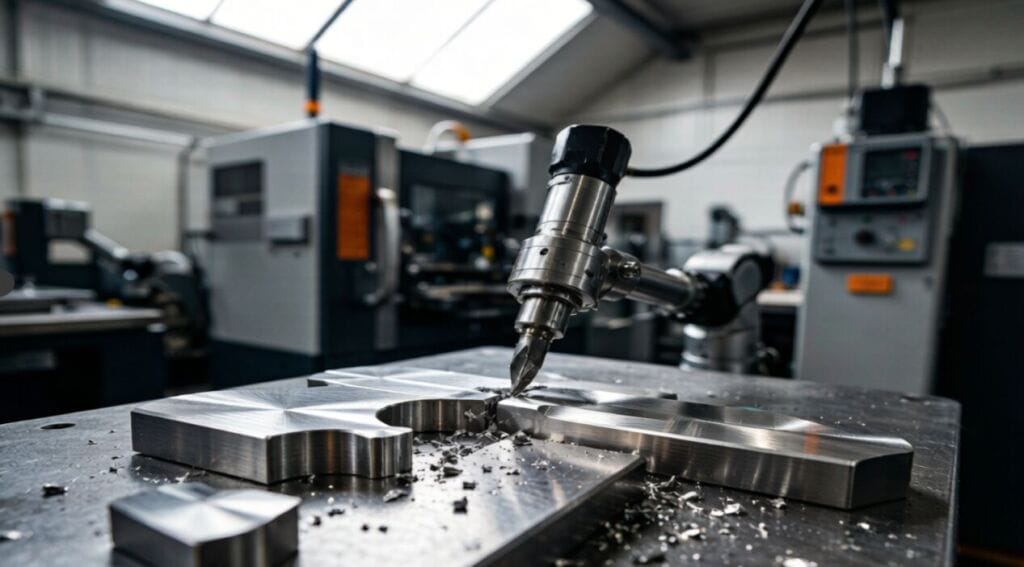
How Do Automated Machining Solutions Lower Multi-Axis Defect Rates for Global OEM Sourcing Teams?
Multi-axis machining brings the problem of positioning error. According to research conducted by McKinsey & Company, manufacturing companies applying fully automated robotized solution of CNC machining get a 50-70% decrease in defect rates that corresponds with figures observed in high volume production facilities. Atomated machining solutions include feedback loop and robotized handling. There are three main things that lead to defect rate reduction.
1. Robotic Loading/Unloading Eliminates Human Mistakes
Robots with six axes have the ability to facilitate lights out manufacturing for more than 16 hours in a day. The vision system tests the alignment of the part prior to clamping in order to avoid rejection of parts due to misalignment.
2. IATF 16949 Certified Suppliers Uphold Process Discipline
The suppliers certified by IATF 16949 standards practice Statistical Process Control and GRR studies in line with ISO Quality Management Standards for defect free delivery. There is full traceability from material receiving stage to inspection stage.
3: What Role Does Industrial Outsourcing Play in Optimizing Modern Supply Chain Management?
In-house machining centers remain idle during trough time. Research carried out by the Boston Consulting Group shows that those firms that practiced strategic industrial outsourcing cut down the cost of supply chains by an average of 18% to 25% because of flexible capacity and no capital investment required. Industrial outsourcing offers flexible capacity without any asset ownership. It has three main advantages.
- Capacity Flexibility Limits the Risk of Disruption: Multiple plants within companies allow them to have options in terms of their production plans. Supply chain management can be resilient with surge clauses enabling 30% volume growth within two weeks. Diversification in terms of geographic location also ensures that companies are protected from disasters or supply chain disruptions within a region.
- Availability of Specialized Machinery without Capital Investment: Five axis machines and CMM cost millions. Outsourcing allows access to specialized machinery on a per-part basis without making any capital investment.
- AS9100D Aerospace Standards Certify the Quality of the Parts: Suppliers who are AS9100D certified ensure strict traceability. The annual surveillance audits make sure that the aerospace standards are being followed.
4: How Can Engineering Teams Evaluate a Custom CNC Machining Manufacturer in China for Complex Projects?
There are thousands of factories in China, and hardly any of them meet international standards. This is according to the “Buyer’s Guide to CNC Machining in Asia, 2023,” written by IndustryWeek. The most trustworthy Chinese suppliers will have their laser calibration documentation and DFM feedback within 24 hours—an important factor which distinguishes top-notch suppliers from others. An analysis of a custom CNC machining manufacturer in china will be based on certain criteria. There are four main criteria.
1. Precision of Machines and Maintenance Records
Request information regarding the machine calibrations and ball-bar tests. A good CNC service provider would have had laser calibrations carried out at least once per year. Furthermore, the temperature-controlled floor space increases positional accuracy of precise machining.
2. Time and Quality of DFM Feedback
A sample CAD drawing should be provided; good services offer good DFM feedback within 24 hours. The DFM report specifies the places that the tool cannot reach and the orientation of features.
3. CMM Inspection Report and Statistical Information
The inspection report with CPK value is used to prove that the process is capable. You can ask for First Article Inspection according to AS9102. CPK historical values will give an idea about supplier’s consistency.
4. Industry Ranking and Peer Reviews
When purchasing critical parts for aerospace or medical applications, the procurement manager needs to assess capabilities of the vendor using industry ranking and evaluation matrices as explained in this buyer’s guide for custom CNC machining manufacturer in china. The peer reviews are useful information than industry rankings.
5: Why Is DFM Validation Essential Before Selecting an Online CNC Machining Service for Rapid Prototyping?
Hastily designed products may possess flaws related to manufacturability. According to a technical paper from the Society of Manufacturing Engineers (SME), relaxing non-critical tolerances from ±0.05 mm to ±0.1 mm can reduce machining cycle time by up to 35%, confirming the cost-saving potential of early DFM analysis. Online CNC machining service with DFM analysis identifies them right away. There are three main reasons:
1. Cost Savings through Tolerance Optimization
Identification of unnecessary tolerance specifications can lead to 40% machining time reduction. Relaxation of unnecessary tolerance requirements from ±0.05 mm to ±0.1 mm can help to save a finishing operation stage.
2. Surface Finish Optimization Related to End-Use
Early geometrical design checks will allow engineers to use CAD files right away at an online CNC machining service for manufacturing without compromising on dimensional tolerance requirements. DFM proposes other options regarding surface finish and eliminates polishing stages. This manufacturing innovation mentioned above combines design and manufacturing processes. It is based on DFM feedback together with instant quotations which speeds up prototype development.
Conclusion
Current global manufacturing tendencies show that there is a need to balance cost management and dimensional accuracy. Automated machining solutions along with the right strategy of industrial outsourcing allow companies to minimize their risks. Choosing certified outsourcing partners who hold dual certifications such as IATF 16949 and AS9100D, and who enforce strict statistical process control, allows for success. One example is LS Manufacturing that consistently delivers sub-micron precision across complex medical and aerospace projects, proving that the right partner can turn these strategies into measurable savings.
FAQs
Q1: How do automated machining solutions improve quality in custom parts production?
A1: They integrate real-time sensor feedback and robotic loading to maintain sub-micron repeatability, reducing scrap and rework while meeting international standards.
Q2: Which core certifications should procurement teams evaluate when selecting a CNC service provider?
A2: Ensure ISO 9001 and industry-specific standards such as AS9100D for aerospace or IATF 16949 for automotive industry. They guarantee consistent process and defect-free deliveries.
Q3: Why is DFM analysis essential when using an online CNC machining service?
A3: We detect structure problems and too tight tolerances before manufacturing. It saves up to 25% on prototypes and batches due to no tooling wear and better materials usage.
Q4: How does industrial outsourcing help optimize supply chain management?
A4: It allows for capacity elasticity, different material sourcing options and cost reduction without investments. It eliminates disruptions and ensures delivery on time.
Q5: What international standard governs dimensional tolerances in precision engineering?
A5: ASME Y14.5 determines limits of form, orientation, and position tolerances.
Author: Having deep knowledge in high-precision manufacturing industry, LS Manufacturing offers contract manufacturing and rapid prototyping to clients worldwide and has AS9100D and IATF 16949 certification. Engineers can upload CAD drawings to the official website for instant assessment.