
If you scroll through TikTok and YouTube, Shopify dropshipping looks either impossibly easy or completely dead. The truth is more nuanced.
The global dropshipping market is still booming. Recent forecasts estimate it at about $418.2 billion in 2025, with projections of $514.3 billion in 2026 and over USD 3.3 trillion by 2035, growing at roughly 23% annually between 2026–2035. At the same time, multiple statistics roundups agree that only around 10–20% of dropshipping businesses ever achieve consistent profitability.
Income numbers reflect that gap:
- Beginners typically earn between $0 and $5,000 per month, with many struggling to turn a profit early on as product costs, shipping and ad rates rise—especially with renewed and expanded import tariffs on Chinese goods in markets like the US.
- Experienced dropshippers who optimize pricing, ad spend and their supply chains can make $10,000 to $50,000+ per month in net profit.
So yes, it’s absolutely possible to make real money. But it’s not automatic—and “how to dropship on Shopify” in 2026 really means “how to run an ecommerce business with thin margins and rising costs.”
This guide is a beginner-focused roadmap to dropshipping using Shopify in 2026, with a clear focus on profit, not just revenue.
LOCAL NEWS: Phoenix housing market outpaces national trends again in 2025
INDUSTRY INSIGHTS: Want more news like this? Get our free newsletter here
What is Shopify dropshipping in 2026?
Shopify is your storefront and checkout. Dropshipping is the fulfillment model behind the scenes.
In a typical Shopify dropshipping setup:
- You build a branded store on Shopify.
- You list products sourced from third-party suppliers.
- Customers buy from your store.
- Suppliers receive the order and ship directly to your customers under your brand.
You don’t buy stock upfront, you don’t run a warehouse, and you don’t pack boxes yourself. Your job is to choose the right products and customers, craft compelling offers, drive traffic, and guard your margins.
Shopify remains one of the strongest platforms for this because it bundles hosting, checkout, payments and a massive app ecosystem for supplier integrations, marketing and analytics. But the platform is the easy part. The real challenge is learning how to make money dropshipping on Shopify when competition is high and costs are rising.
Is Shopify dropshipping still worth it in 2026?
The model is still viable—but only if you’re willing to treat it like a real business.
A few important realities:
- Market size vs. success rate:The market is projected to surpass half a trillion dollars by 2026 and grow at over 20%+ CAGR into the 2030s. Yet the success rate sits around 10–20%, meaning most stores never reach consistent profit.
- Conversion and ad benchmarks: Average ecommerce conversion rates globally hover around 2.5–3%, with many Shopify stores starting out closer to 1.4% until they optimize. Social ad benchmarks show Facebook/Meta CTR often around 0.9–1.1% across industries, which means you pay for a lot of impressions that never click.
- Margins and costs: Studies place typical dropshipping profit margins in the 10–30% range in many niches—real but competitive. Importantly, regulatory changes like the removal of certain tariff exemptions on small parcels from China and Hong Kong are increasing landed costs for many dropshippers in regions like the US, eating into those margins even more.
Against that backdrop, the income ranges make sense. Beginners are often stuck between rising product/ad costs and low pricing power, so they sit around $0–$5k/month while they figure things out. Sellers who understand margins, negotiate better supply chains, and run data-driven ads can scale into $10k–$50k+ per month in net profit.
If you want to land in that second group, the rest of this guide is about how to structure dropshipping using Shopify so you don’t sabotage yourself.
How to Dropship on Shopify in 2026 (Step-by-Step)
Step 1: Set expectations, budget and timeline
Before you touch a theme or sign up for an app, write down three things:
- How much time you can commit weekly.
- How much money you’re genuinely willing to risk for at least three to six months.
- What “success” looks like at different stages (for example: first sale, break-even, consistent profit).
Shopify’s own guidance and several independent breakdowns now recommend budgeting about $200–$600 per month to start dropshipping with a lean setup—covering your Shopify plan, domain, a couple of essential apps, and modest marketing. You can start with less using organic traffic only, but it will typically take longer to get meaningful data.
Think of your first months not as a “make as much cash as possible” phase but as a paid education:
- You’re learning which audiences respond to your message.
- You’re learning which products can actually support healthy margins.
- You’re learning your real cost per acquisition—not the one from a guru screenshot.
Framing it this way will make it much easier to stay rational when your first product or ad set flops.
Step 2: Build a clean Shopify foundation
With expectations set, you can start building the actual store.
Sign up for Shopify, take advantage of any trial period, and choose the Basic plan once you’re ready to launch. As of 2025, Shopify’s Basic tier is around $29/month billed annually, but your real monthly spend will be higher once apps and transaction fees are factored in. Connect a custom domain so your store feels like a real brand rather than a temporary project.
Then get the “boring essentials” in place:
- Payments: enable Shopify Payments where available, plus PayPal and any local options your audience expects.
- Shipping: define zones and base rates before you publish anything.
- Legal and policy pages: privacy, terms, refund and shipping policy should be linked in the footer.
- Taxes: configure tax settings for your selling regions so you don’t get surprised later.
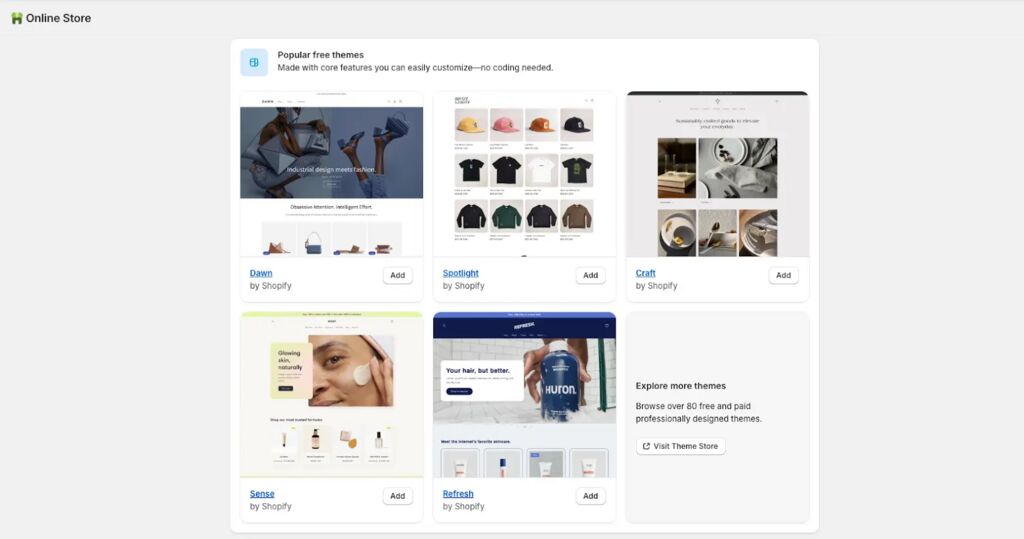
Choose a fast, minimal theme from the Shopify Theme Store, and resist the temptation to over-design. In the early days, speed, clarity and trust matter more than fancy animations.
Step 3: Choose a customer and niche (not just “a product”)
Most beginners start with “what’s trending” rather than “who am I serving,” which is why many of them never figure out how to make money dropshipping on Shopify.
Flip the script:
- Start with a customer type you understand or can research deeply (for example: busy parents who love organizing, small apartment dwellers, new dog owners, remote workers).
- List their recurring problems or desires—cluttered spaces, bored indoor dogs, poor posture, lack of time, stress.
Once you’ve done that, you can look for product ideas that solve those problems.
Two types of research can help:
- Browse Shopify best selling products lists and case studies to see what’s already working on the platform, then look for sub-niches or angles that fit your customer profile rather than copying blindly.
- Use guides on the best dropshipping products on Shopify to spark ideas about product types and bundles, then adapt them to your niche and brand instead of staying generic.
Pair that with keyword tools (Google Keyword Planner, Ubersuggest), TikTok search, and Amazon reviews to validate demand. You’re looking for signs that:
- People are already buying things in this space.
- They have specific complaints you can do better on (quality, explanation, packaging, bundle, positioning).
You’re not trying to find a product nobody has ever seen; you’re trying to find a position in a proven demand stream.
Step 4: Find suppliers and connect them to Shopify
Once you know who you’re serving and what types of offers you want to make, you need suppliers who can consistently deliver.
Most beginner-friendly setups use supplier apps that plug directly into Shopify. These apps:
- Let you browse product catalogs.
- Import listings into your store.
- Automatically forward orders to suppliers when customers buy.
They’re not all equal, though. Don’t judge a supplier purely by price. Check:
- Lead time: how fast they hand orders to carriers.
- Shipping options: realistic delivery timelines to your main markets.
- Reliability: product reviews, defect rates, and any mention of poor packaging.
- Communication: how quickly and clearly they respond when you test their support.
Always order samples before you commit an ad budget. One bad batch can cost you far more in refunds, support tickets and negative reviews than you saved by choosing the cheapest listing.
Once you’re comfortable, connect the supplier app to your store, map products and variants correctly, set your selling prices, and do at least one test order through the entire flow to make sure everything syncs.
Step 5: Price for healthy profit, not just “what competitors charge”
This is where the profitability gap between beginners and experienced sellers really starts to open up.
Many new store owners simply look at what competitors are charging, match that price, and move on. They never do the basic profit math—despite average dropshipping profit margins often sitting somewhere in the 10–30% range and costs rising every year. There’s not much room for guessing.
When you’re dropshipping on Shopify, don’t just think in terms of “markup.” You need a clear view of your gross profit and gross profit margin on each product.
Start simple:
Gross Profit = Selling Price – Cost of Goods Sold (COGS)
Gross Profit Margin (%) = (Gross Profit ÷ Selling Price) × 100
For example, if you sell a product for $40 and your COGS is $16:
- Gross Profit = 40 – 16 = $24
- Gross Profit Margin = 24 ÷ 40 = 60%
That 60% margin gives you space to cover fees, occasional discounts, refunds, and ad spend—and still have a real shot at keeping profit.
But if the same product costs you $28 to source:
- Gross Profit = 40 – 28 = $12
- Gross Profit Margin = 12 ÷ 40 = 30%
On paper, you’re “making money,” but that margin is thin. A small bump in ad costs or shipping can wipe it out overnight.
As a simple rule of thumb, aim for roughly 60–70% gross profit margin where you can. It won’t be possible for every product, but products in that range give you much more room to pay for traffic and tools without constantly stressing about going negative.
Most benchmarks show beginners often end up with shaky or even negative margins in their first months, while the dropshipping sellers and merchants who consistently review and adjust their gross profit margins are the ones far more likely to reach that $10k–$50k+ per month level.
Step 6: Build product pages that actually convert
With your margins planned, your product pages need to do the heavy lifting of turning paid and organic traffic into customers.
Focus each page around a single, clear story:
- Who the product is for.
- What problem or desire it addresses.
- What life looks like after using it.
Structure the page so that visitors can answer, at a glance:
- “What is this?”
- “Is this for me?”
- “Can I trust this store?”
- “How long will it take to arrive?”
- “What happens if I don’t like it?”
Lead with benefit-driven headlines and copy. “Help your indoor dog burn energy and stop chewing everything while you’re working” is more compelling than “Multi-mode interactive pet toy.”
Support that copy with:
- Clean product images and lifestyle photos.
- Short videos if possible (especially powerful for TikTok- and Reels-driven traffic).
- Honest shipping and returns policy in plain language.
Add social proof as you collect it—reviews, user photos, or early tester quotes. Over time, that section becomes one of your strongest conversion levers.
Remember that typical ecommerce conversion rates sit around 2.5–3%, and social traffic is often lower-converting than search.[^1] Small clarity improvements or reduced friction at checkout can produce meaningful jumps in revenue without needing more traffic.
Step 7: Set up analytics and profit tracking from day one
A lot of beginners obsess over “how to make money dropshipping on Shopify” while only looking at revenue and ROAS. That’s how you end up in the $0–$5k/month group that never quite knows why the bank balance doesn’t match the dashboards.
Set up the basics:
- Shopify Analytics for traffic and sales.
- Conversion tracking pixels for Meta, TikTok and Google so the platforms can learn who is buying.
- Google Analytics 4 for more detailed funnel and behavior tracking.
Those tools tell you what visitors do and how much they spend, but they don’t tell you true net profit.
To close that gap, many merchants add a net profit analytics tool on top. Apps like TrueProfit integrate with Shopify and your ad platforms to combine:
- Revenue, refunds and discounts from your store.
- Product and shipping costs.
- Payment and transaction fees.
- Real-time ad spend from Facebook, Google, TikTok and others.
- Custom fixed costs (apps, staff, subscriptions) allocated across time.
The result is a live view of net profit and profit margin across your whole store, and broken down by product, by store and by order.

Instead of guessing whether an ad set “seems to be working,” you can see whether it’s profitable after all costs. This is exactly the kind of discipline that separates the beginners stuck under $5k/month from the experienced Sellers consistently in the $10k–$50k+ range.
Step 8: Launch traffic, learn fast, and iterate
With all the foundations in place, it’s time to get people onto your store.
Paid social ads (Meta, TikTok) are still the quickest way to learn, because you can drive targeted traffic within days. But they’re also where beginners blow their budgets the fastest.
Start with a budget you really can afford to lose while learning. Create multiple ad variations that test different hooks and angles rather than just swapping colors. For each ad set, watch:
- Click-through rate (CTR) to see if your message is resonating. Average Facebook CTR across industries often sits around 0.9–1.1%, so use that as a rough reference, aiming to beat it in your niche.
- Cost per click (CPC) and cost per add-to-cart or initiate checkout.
- Actual cost per purchase—and whether that still leaves a healthy net profit per order based on the math you did earlier.
At the same time, start posting simple organic content that fits your audience: quick tips, before/after clips, short demos of your product in use. Even if most posts only get modest views, the occasional hit plus a stronger social presence will support all your other efforts.
Treat every campaign as a feedback loop:
- Launch a small test.
- Look at both revenue and profit.
- Cut what isn’t working.
- Refine or scale what is.
Over a few cycles, you’ll understand not just how to dropship on Shopify technically, but how to run a lean, data-driven business that gives you a real shot at being in that 10–20% success band—and eventually, if you keep improving, in the $10k–$50k+ per month tier of experienced dropshippers.