
Four short lines can carry a complete emotional turn. At closing time, florist Harper admits that she packed the wrong bouquet. Luis looks at the marigolds and explains why the mistake matters: his mother planted the same flowers every September. One silent ribbon change gives the conversation room to breathe before both characters decide the bouquet should remain exactly as it is.
Harper Admits That the Bouquet Is Wrong
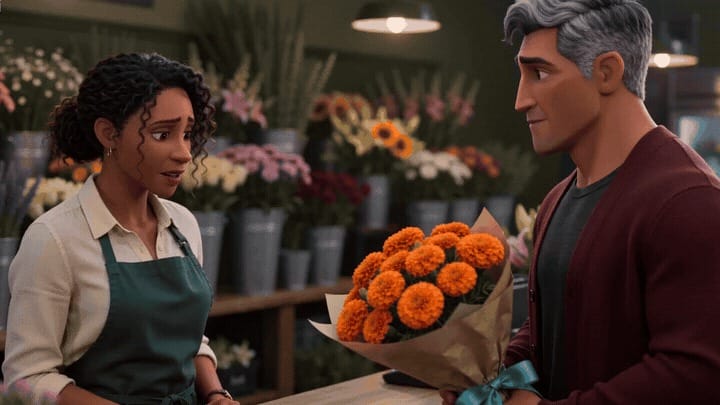
Harper stands behind the flower-shop counter while Luis holds a kraft-paper bouquet of orange marigolds. She looks from the flowers to him, takes a small breath, and says, “I packed the wrong flowers.”
The line is short enough to speak naturally within one close shot. It also creates a visible contradiction: the bouquet looks complete, but Harper’s expression tells the audience that something about it is incorrect.
Luis Explains Why the Marigolds Matter
Luis lowers his eyes to the marigolds, touches the cobalt ribbon with one thumb, and answers, “My mother planted these every September.” His delivery is calm, with a brief pause before the month.
The response does more than provide backstory. It reverses the value of the bouquet. The flowers are wrong according to the order, yet unexpectedly right for the person receiving them.

Harper Reties the Bouquet Without Speaking
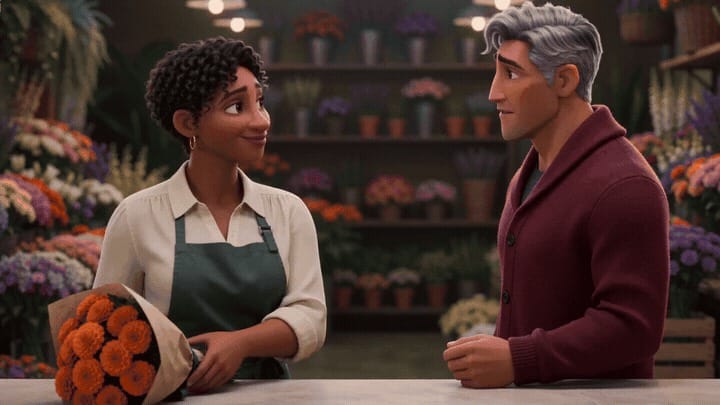
Harper removes the loose cobalt ribbon, squares the kraft paper, and ties the same ribbon again. Luis keeps both hands on the counter and watches. No one speaks while the knot is formed.
This insert protects the pacing and gives the faces a break between dialogue shots. It also converts Harper’s apology into a visible choice: she is not replacing the marigolds; she is preparing them to leave the shop.

Harper and Luis Agree to Keep the Marigolds
Harper lifts the bouquet and offers it back across the counter. She says, “Then I won’t change them.” Luis receives the flowers and replies, “Please don’t.” The camera holds as they share a small, relieved smile.
The last exchange resolves both levels of the scene. Harper now understands that the substitution has value, and Luis makes the decision explicit without delivering a speech.
Keep Each Spoken Line Short Enough for Natural Lip Sync
Written dialogue often contains more information than a natural mouth can comfortably deliver on screen. These lines use familiar words, clear consonants, and one idea at a time:
- “I packed the wrong flowers.”
- “My mother planted these every September.”
- “Then I won’t change them.”
- “Please don’t.”
The longest sentence belongs to Luis because it carries the turn. The surrounding lines are shorter, leaving visual space for the apology, recognition, and decision.
MORE NEWS: 10 cool Arizona offices worth the commute in 2026
Leave Time for Reactions Between Lines
The first pause occurs before Harper speaks. She needs a moment to compare the bouquet with Luis’s face. Luis pauses before “September,” allowing the memory to register without forcing a dramatic expression.
Do not remove every silence between words and reactions. A conversational beat includes the speaker’s preparation, the spoken line, and the listener’s response. Cutting immediately after the last syllable can make otherwise accurate mouth movement feel mechanical.
Keep Harper Left and Luis Right Across Every Shot
Harper remains screen-left and looks right. Luis remains screen-right and looks left. Their close shots preserve the same directions, so the cut creates the impression that both characters are looking across one counter.
The bouquet stays closer to Luis until the silent insert. Harper’s hands then enter from the left to retie it. In the final two-shot, the flowers cross the center line only when she returns them. The prop movement mirrors the conversation’s shift from error to acceptance.
Give Each Speaker a Separate Dialogue Shot
The first shot includes both characters, but only Harper speaks. The second can move closer to Luis while Harper stays soft at the frame edge. This separation gives each mouth one clear sentence and prevents overlapping facial motion from competing for attention.
The silent insert removes lip movement entirely. The final shot uses two very short lines and keeps both faces large enough to remain readable. If the last exchange becomes unstable, preserve Harper’s question on her close shot and cut to Luis for the reply before returning to the two-shot.
Keep the Same Bouquet Through the Emotional Turn
Orange marigolds, brown kraft paper, and a cobalt ribbon form one stable visual unit. The flowers should not change species, color, or count between shots. The paper can be squared and the ribbon can be retied, but the bouquet remains recognizably the same object.
The cobalt ribbon also marks where Luis’s hand rests during his line. That small touch gives his memory a physical anchor. When Harper reties the knot, she responds to the same point he touched, connecting the two performances through the prop.
Lock the Dialogue Before Generating Scenes in CapCut
Write the four final lines before opening CapCut’s AI video generator, then choose voiceover and duration settings that leave room for natural pauses. A wide frame keeps Harper, Luis, the counter, and the bouquet in stable left-right positions.
Generate one speaker at a time for the first two lines, reserve the ribbon scene for silence, and return to both characters for the short closing exchange. Afterward, adjust voiceover, subtitles, and pacing so the captions preserve every negative and the room tone continues across the cuts.
Match Each Caption to the Exact Spoken Line
The word “wrong” establishes the conflict, while “don’t” protects the resolution. A missing negative would reverse the final meaning. The month in Luis’s line also matters because it makes the memory specific without adding a long explanation.
Compare each caption with the final audio after timing changes. Keep one speaker per caption block, and leave the silent ribbon insert free of text. The absence of words there is part of the rhythm.
Check That the Story Works With Audio or Video Alone
Listen once without watching. The four lines should sound like a complete exchange, with no unexplained reference. Then watch without audio. Harper’s apology, Luis’s attachment to the bouquet, the deliberate retying, and the final handoff should remain understandable through gaze and objects.
When both passes agree, the mouth movement, performance, and story are supporting the same turn rather than compensating for one another.
Summary
Each line changes what the wrong bouquet means to Harper and Luis. Stable screen positions, concise speech, a silent ribbon insert, and one prop handoff keep the 23-second conversation clear. Build each spoken beat around a locked line with CapCut’s AI video generator, preserve the marigolds across every shot, and finish with the two short replies that turn an apology into a choice.