Labor shortages in the construction industry are a well-documented issue — and for good reason. Talent Ready AZ, a strategic initiative created by Gov. Katie Hobbs, estimates that 20,000 construction jobs need to be filled by 2030. While it is critical to close the skills gap in the trades, other related sectors, such as engineering, are also struggling with a lack of qualified candidates. That’s why ACEC Arizona is prioritizing workforce development to bring more students into the profession and ensure early career engineers receive the necessary support.
“I’ve been doing this for 18 years, and we’ve had some speed bumps over that time,” explains Nicolai Oliden, Southwest highways group leader for Jacobs. “I was lucky to get a job in 2008. Many of the people I graduated with left the industry since they couldn’t get hired because of the Great Recession. Finding engineers with 15 to 20 years of experience is the hardest position to staff right now. They’re like unicorns.”
Beyond the economic turmoil caused by the financial crisis, Oliden thinks the industry’s lax attitude towards recruitment is partly to blame.
“We assumed students would always want to be engineers when they grow up. When I was young, engineers would go to schools and talk about their profession, but a lot of that has stopped,” he continues.
Meanwhile, Oliden notes that contractors have put in a lot of effort to advertise their field, which has led to higher enrollment in construction management programs as less young people choose to study engineering. There’s also more competition over the demographic of students who would thrive in the profession.
“If you look at what different kinds of engineers get paid, civil is on the lower end,” Oliden continues. “We do really well, but when you show an 18-year-old that they can graduate earning $150,000 with a computer science degree, it’s hard to convince them that making $50,000 right out of school as a civil engineer is worth it.”
LEARN MORE: Stacks on Polk uses containers as ‘Lego Bricks’ to build housing
Amerigo Berdeski, director of programming and operations for ACEC Arizona, adds that ancillary fields such as software engineering, game design and AI are often more appealing to high school students than building roads and wastewater treatment plants.
“Without civil engineers, we wouldn’t have a society,” she continues. “There’s something tangible about the work, but it’s difficult to communicate that to students when Google and other tech companies are out there talking about how wonderful it is to be in that industry.”
Engineers also have an image in the cultural imagination as being soft-spoken number-crunchers sporting pocket protectors. Being concerned about what others think of their profession often fades as people get older, but Berdeski says that perception matters when trying to catch the eye of a high school student.
“You have to dig deeper and help them understand that civil engineering is a great career that can support a family,” she says. “There is stability and longevity — we’ll always need roads. We have to communicate how it is more tangible or perhaps practical than the shiny new toy.”
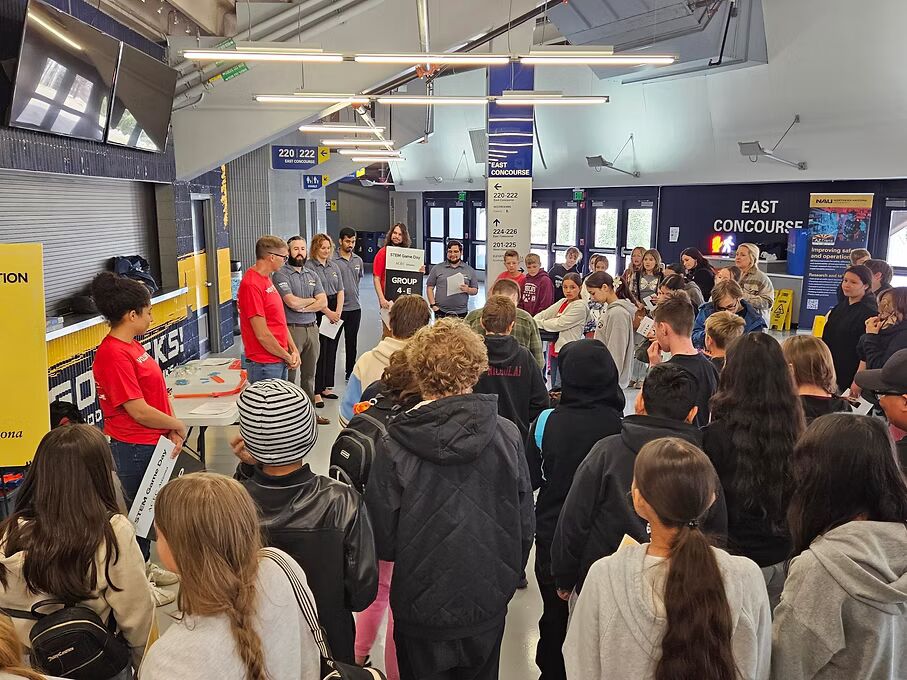
ACEC Arizona STEM Game Day
To address the need for more civil engineers, ACEC Arizona created a Workforce Development Committee 3 years ago as a convening place to brainstorm ideas and kickstart new initiatives. Berdeski explains that the association first reached out to other industry groups to discuss how they can support each other.
“We don’t want to step on anybody’s toes, and we certainly don’t need to reinvent the wheel,” she says. “If [another association] is doing something great, we can provide volunteers, donations or whatever support might be necessary. The committee is more than just member firms — it’s an industry coalition all working towards the same end goal.”
A few years ago, ACEC Arizona hosted a panel at its Conference on Roads and Streets with the three state universities focused on the challenges these institutions face in their engineering programs.
“It was a great opportunity to hear what’s happening straight from the horse’s mouth,” Berdeski recalls. “Through that discussion, we learned that waiting until high school to start talking with students about engineering isn’t early enough — they might’ve already made up their mind about their career by then.”
Oliden, who chairs the Workforce Development Committee, says that one idea floated early on was to create an event to educate students about the impact engineering has on the world around them.
Since the benefits of engineering are so pervasive, they typically go unnoticed and underappreciated. And, as so often is the case, showing is far better than telling. With that in mind, it was decided that a college football stadium would be an appropriate venue to host what would become ACEC Arizona’s STEM Game Day.
“We created an event where fifth, sixth, seventh and eighth graders head out to the stadiums at ASU, NAU and U of A,” Berdeski says. “They’re not watching a football game, but they have the experience of seeing the stadium through the eyes of an engineer.”
The first iteration of the STEM Game Day was a walking tour where ACEC Arizona volunteers explained what engineers must consider when working on a stadium to ensure players can safely take the field on Saturdays.
Even though it was successful, Oliden notes that attention spans of students in this age range are short, so the committee decided to add activities to help illustrate the points being made by the guides.
“I don’t want students to come to the event and say, ‘That was cool,’ and not remember anything,” he continues. “We wanted to give them something to interact with and form a memory.”
In addition to the tour, four stations were created, each focused on a different topic. One of these covers career information for engineers, such as the schooling needed and common starting salaries.
“Something that always shocks the kids is when we tell them that the No. 1 skill you need as an engineer is to be a good communicator,” Oliden says. “They always think it’s math, but I tell them while I’m decent at it, I don’t enjoy it. The communication skills I’ve built over many years is how I’ve created a nice career for myself.”
By sharing that someone doesn’t need to be a math virtuoso to find success in engineering, Oliden hopes students who would otherwise shy away from the profession see it in a new light.
Chris Bridges, executive director of ACEC Arizona, joined the organization in January 2025 just a few months before the event. When the day came, Bridges helped with registration — a difficult task considering nearly 600 students attended STEM Game Day at each university.
After the chaos of check-in duty, Bridges had the opportunity to walk around and see how students were responding to the activities. At one station, participants were tasked with building a boat out of aluminum foil before seeing how many pinto beans it could hold before it sank.
“I saw a kid holding his boat with two hands and I asked him, ‘How’d it do?’” Bridges recalls. “He said, ‘I put the entire cup of beans in it!’ You could see the pride on his face, and I felt like we might’ve just changed the course of his life. That’s what STEM Game Day is all about.”