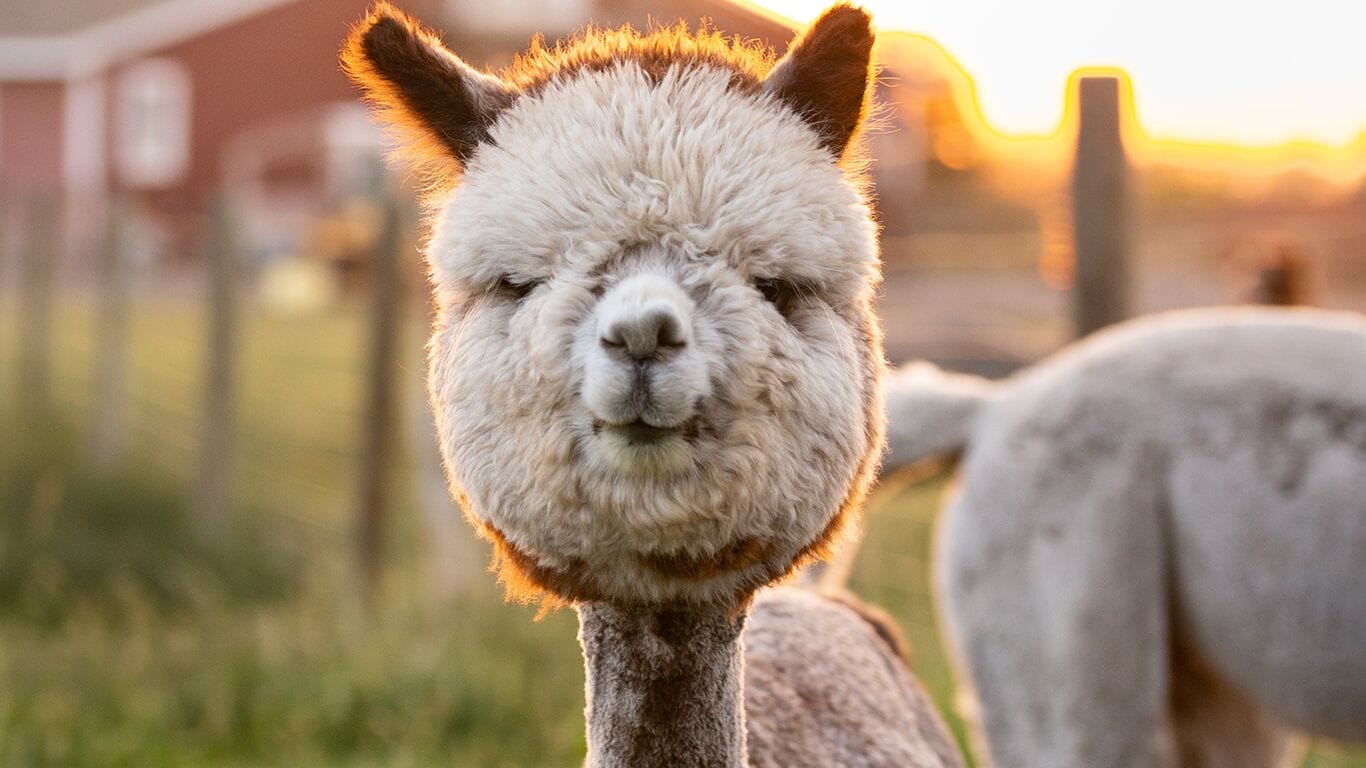
James Budd steps into his Alpacas of Montana gift shop, a tiny white storybook house with black trim perched at the edge of his pasture. A rack of boots sits to the right of the arched doors, and wooden lawn chairs and barns are sprinkled throughout the property.
Escaping a 36-degree May morning, the former surgical orthopedic physician’s assistant describes the alpaca’s history with visuals on a metal board. He steps outside onto the lush green pasture — beneath the seemingly endless baby-blue sky. He pauses at the gate.
“This isn’t a petting zoo,” he said. Alpacas are prey animals — they spit when intimidated — so they should be approached slowly. “They know we’re here,” Budd said. “They’re just deciding whether they care yet.”
LEARN MORE: Visiting Montana: Beyond the ‘Yellowstone’ myth
Story of evolution and protection
During farm tours, Budd shares that alpacas are the world’s second most recent manmade animal — behind the mule. Alpacas’ genetics go as far back as the camel. The first camel fossils were found in Montana.
“The oldest-known camel fossil in the world was found just about 80 miles up the road from here,” Budd said.
Alpacas evolved from South American camelids, specifically the vicuña, while camels evolved separately into the Old World camelids. Both groups trace back to early camelid species that lived in North America about 10 to 40 million years ago.
During the Ice Age, camels migrated north from Montana to Asia and Africa. Some camelids crossed the Bering land bridge into Asia, eventually giving rise to the one-humped dromedary camels and the two-humped bactrian camels.
Others migrated south into the Andes, evolving into guanaco, llamas and vicuña, which adapted to high-altitude, cold, low-oxygen environments. Genetic studies show alpacas were domesticated 6,000 to 7,000 years ago from the vicuña.
A guanaco is a wild South American camelid (genus Lama) that shares a common ancestor with camels. It’s closely related to the llama (its domesticated form), the vicuña, and by extension the alpaca, all of which belong to the camelidae.
“So, they got a vicuña and the guanaco, bred them together, and it worked,” Budd said about alpacas. “And out popped an alpaca.”
The Budds’ meaningful move
Budd left the medical field because of the difficult medical insurance maze. He tried medical sales, worked for his father-in-law, taught at a university, and pursued other occupations.
“I was just trying to figure out what I wanted to do,” he said. “My goal was to stay in Montana and just be able to afford to go fishing. Even back then, Montana was kind of expensive.
In 2004, Budd was reading the Costco Connection flyer and saw a story about alpacas. He told his wife, Sarah, about it, but she was skeptical. Five minutes later, he saw a piece in the Wall Street Journal.
“Oh, my gosh, it was like fate,” Budd said. “Sarah said, ‘You didn’t go to medical school to be a farmer, and I’m definitely not a farmer’s wife.’”
He did intensive research and called his future partner with a few animals in Kalispell, Great Northern Ranch. Budd recalled him saying, “You can ask me 1,000 questions, but you have to trust the fact that I’m not going to steer you in the wrong direction. I want to help you understand the process of the industry.”
That was the turning point. “We started with eight animals, a $150,000 investment within six months.” He made 600 cold calls as the “newest, greatest alpaca guy on the planet.” They reinvested every penny they could, purchasing higher-quality females.
Then he took the six-hour drive up to Kalispell in the Flathead Valley. During the trip, he saw 100 alpacas on a prairie on one side of the road; the other about 200 llamas.
“I get to the top and there’s this gigantic log cabin, and in a log cabin barn,” he recalled. “[My long-term mentor] comes walking out of the barn. I looked at Sarah and said, ‘If this dude made enough money to buy this, we’re not leaving here without buying an alpaca.’
“That was a lot for me,” he said. “We went to the bank, and the bank looked at my paperwork. He didn’t know what an alpaca is. We had enough equity in our house to cover that. That’s how it all started.”
Robust business
Until the “little mini crash thing in 2008,” Budd had a robust business selling alpacas for $14,000 apiece. Alpacas of Montana averaged about 25 to 30 annually.
“After the crash, people pulled out of raising animals because they didn’t have time. Everyone was in survival mode,” he said.
To keep the business afloat, he learned about alpaca fiber. Budd met knitters and crocheters at a farmers market; one woman was working with a spinning wheel.
Budd enthusiastically talks about fiber, his visits to Peru, and the shepherds who walk 10 miles home. One of his goals is to continue a nonprofit that brings solar panels to Andean herders. His small-scale fiber outfit is challenging because he’s competing with the mass-market wool industry.
Alpaca fiber is softer than cashmere, stronger than sheep’s wool, naturally water‑resistant and warm without bulk.
Budd purchases the wool in Peru, and designs products. South American artisans create the clothing.
“I bring the factories some of the craziest technical ideas in the world,” he said. “We have a patent on a couple of our yarns. We’re the only ones who can do what we do. We do lightweight summer T-shirts all the way up to our expedition coat, which we sold out of this year.”
The gift shop is filled with sweaters, socks, jackets, stuffed toys and alpaca pens. Alpacas of Montana also offers vicuña scarves and shawls for its high-end clientele.
His yarn rises above standard wool. “Superwashed” merino is chemically stripped — with peroxides, acetone and industrial vats — to remove the barbs that make sheep wool itchy.
“For sheep fiber if it doesn’t itch, it’s chemically treated,” he said. “It’s chemically induced.”
Alpaca fiber doesn’t need any of that, just organic soap and long wash tunnels because there are no lanolin or barbs to cause a reaction on the skin. He designs products backward — starting with the function, then engineering the yarn to match. He said his socks wick moisture so efficiently that feet stay cool when you’re sweating. Coats insulate without the puff. Blankets feel like sleeping under warm air.
Budd asked the artisan at the local market if she would spin alpaca wool and make a children’s hat. She was successful and made another for Budd’s niece and nephew. Hats soon became a staple of Alpacas of Montana’s store. Now, the store and website sell socks, scarves, T-shirts, sweaters and coats.
In Peru, Budd met socks, knitting and weaving experts, who make the products.
Nine new products are coming, but Budd stayed mum. About 10% of Alpacas of Montana’s products are handmade in Bozeman.
Alpaca wool is warmer, stronger, softer and more breathable than traditional wool.
“It’s awesome in the summertime,” he said.
Treat them right
Budd said there’s a mutual respect between himself and the alpacas. He avoids direct lines so the alpacas won’t feel threatened, as they are prey animals, always waiting for the moment something decides to eat them.
At Alpacas of Montana, llamas remain at the edge of the pasture like sentries. Standing 5 to 6 feet tall, they typically weigh 300 to 500 pounds. Their slender body and long legs are topped with a small head with a split lip.
An elderly llama with collapsing vertebrae is nearing the end. “I can tell he’s in pain,” he said quietly. “And that’s not OK.”
Budd said llamas are misunderstood.
“They will give their life to protect the alpacas.” An 18-month-old Turkish Anatolian, Marley, protects the alpacas nightly by circling the pasture. When he’s not on duty, he sleeps with the alpaca and on the side of a compost pile.
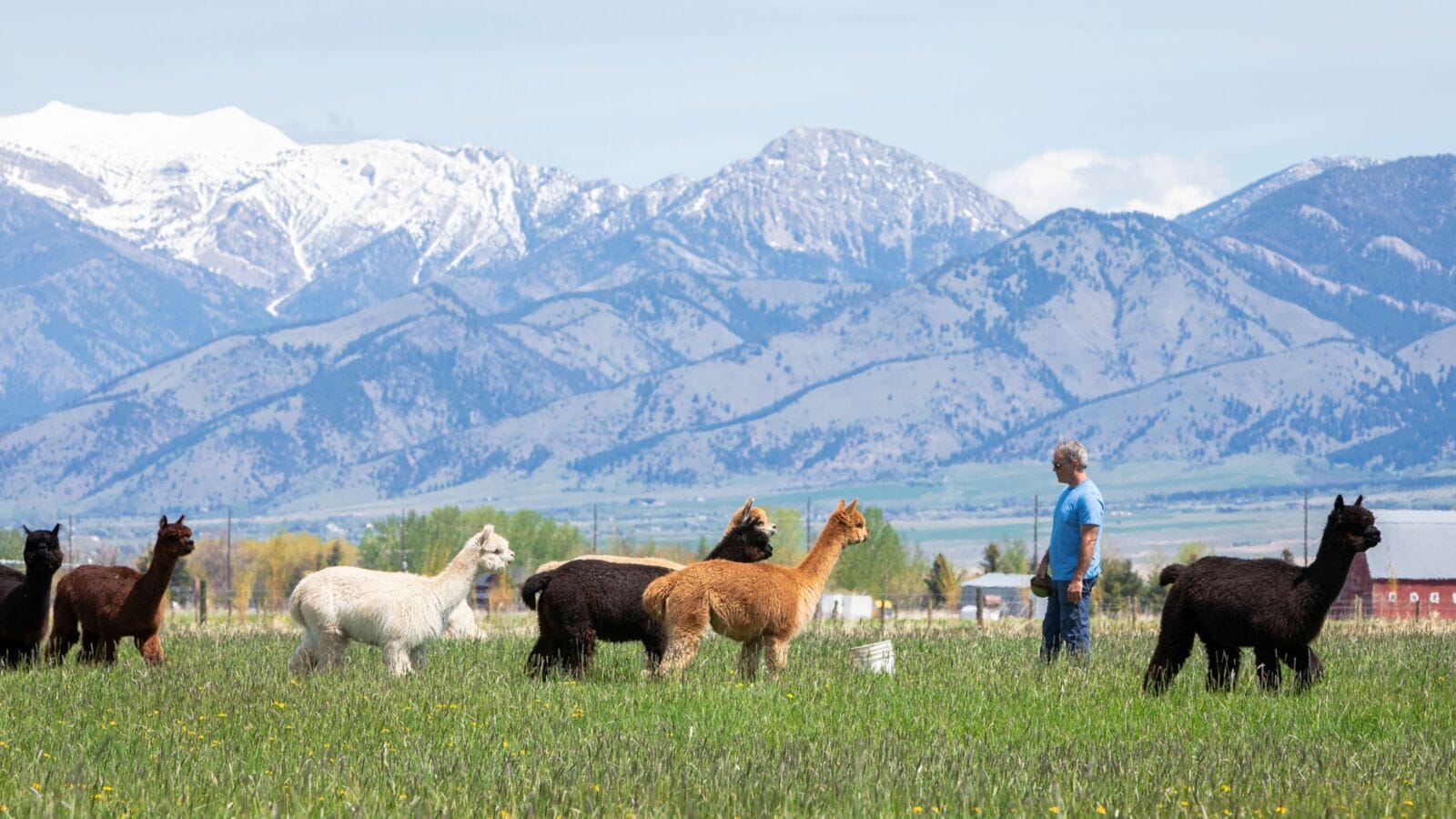
The alpacas appear slowly, as a soft‑edged procession. The babies, or “crias,” approach first. They’re nearly 1 year old, still small enough to look startled. Budd hands over a red bucket of grain, and the alpacas chow on feed.
“These are the babies who were born last summer,” he said affectionately. They are weaned at 6 months. Quickly thereafter, they learn to be haltered, walk on a lead, and lift their feet for toe trims.
Alpacas have teeth only on the lower jaw, and they have a palate on the upper jaw. The animals have molars in the back, so they’re ruminants. They chew their cud.
During the tours, Budd boasts about the benefits of alpaca fur.
He encourages visitors to put their fingers in the fiber.
Mention “alpacas,” and the first thing someone asks is, “Don’t they spit?” Actually, they are gentle; they just hang in their pen.
He points out a young female — “probably the highest‑quality girl that we have” — and her face is undeniably cute.
Alpacas of Montana is a certified predator-friendly farm, per a European designation, as well as cruelty-free and no-kill. Watching ground squirrels frolic around his property, Budd said he wouldn’t even kill a fly.
The breeding game
When Budd described breeding, he was the most animated because he looks forward to the babies a year from now. He chooses the alpacas that can breed with each other. “Not every male qualifies as a breeder,” he said.
Castrated males with good fiber sell for around $1,000. Older animals with coarse fiber go for $800. “You can find free ones online, but those are probably not the most well-behaved animals,” he said deadpan.
The Guinness World Record for selling an alpaca is $675,000. Like the economy, alpacas’ value has been a rollercoaster.
“If I’d had any of these animals 20 years ago, they’d be worth hundreds of thousands.”
The market has softened because there are more breeders, so farms are less of a novelty. Breeding alpacas is not romantic — at all. It is, however, biologically fascinating. Alpacas are induced ovulators — sound brings it on.
“If the male sings a song — it’s called orgling — it releases pheromones in [the female’s] brain to drop the egg.”
If the female spits in the male’s face, she’s either pregnant or uninterested. If she sits, breeding begins. About 15 minutes later, the deed is done.
Budd calls alpacas “champions of eco-friendly farming.” Alpacas defecate in one pile, which makes cleaning easy and provides a “sustainable solution for modern agriculture challenges.” The pile keeps the alpaca from leaving a trail for predators.
“Let’s say we live in the high altiplano in Peru,” he said. “There are no houses, no fencing, and just land and predators. If we are walking through the altiplano, and everyone’s just walking and pooping, the predator animals can’t follow them.”
The poop doesn’t stink — Outkast needs to hear that. Budd said the waste makes for great fertilizer because “it’s all broken down, so there’s minimal odor to it.
“The animals don’t stink at all,” he added. “The pre-teen and teenage boys love talking about poop.”