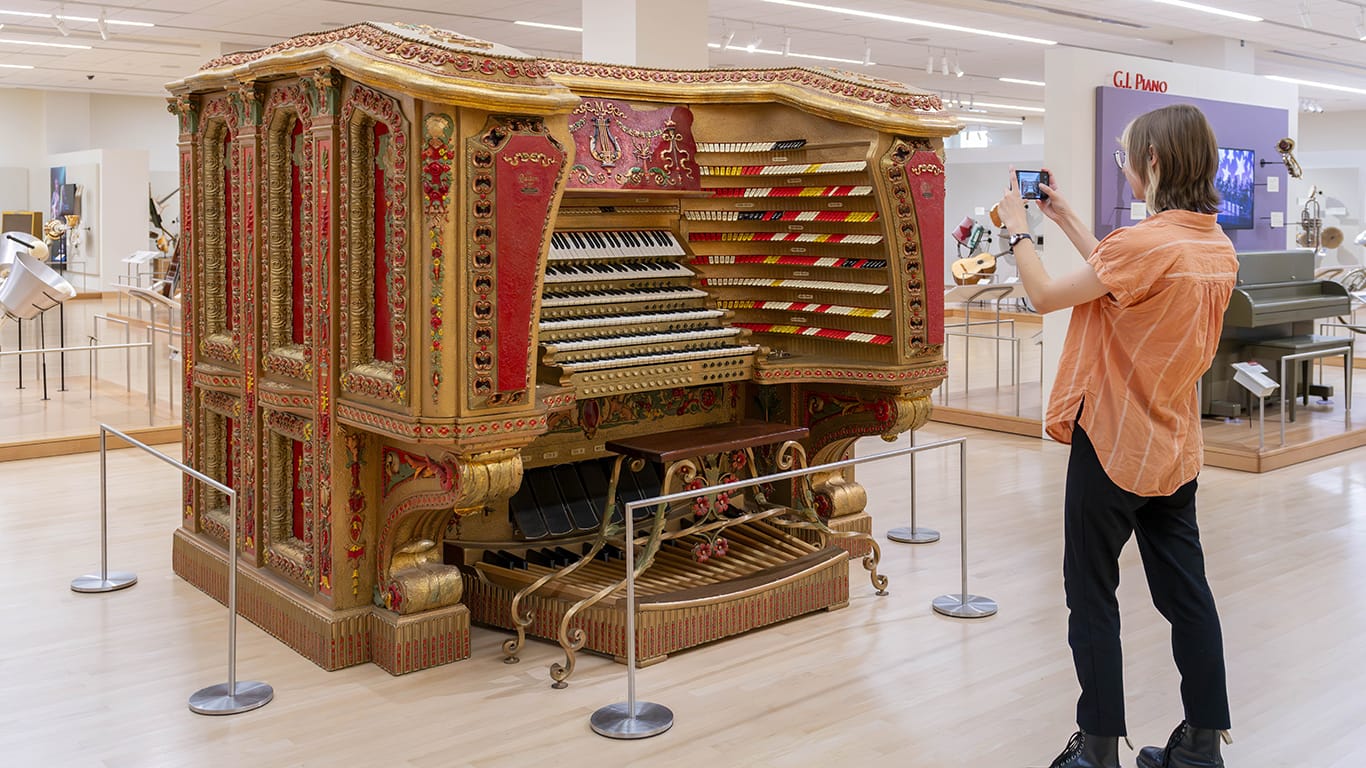
A piece of Chicago history has quietly made its way to North Phoenix’s Musical Instrument Museum.
The massive red‑and‑gold console of the Chicago Stadium pipe organ now sits in MIM’s United States / Canada Gallery with six manuals and 800 stop tabs. Musicians sit at the console.
WOMEN IN BUSINESS: The Most Influential Women in Arizona for 2026
WOMEN IN REAL ESTATE: The Most Influential Women in Commercial Real Estate for 2026
“We are always interested in historic and one-of-a-kind musical objects,” said Rich Walter, MIM’s curator for the United States and Canada.
“Our whole mission is to present those to our audiences. When an opportunity to display the biggest-of-its-kind historic organ console came around, we were really interested to learn more. It’s the console for what would be an enormous pipe organ. We don’t have the pipes and all the percussion instruments and the sound effects. It’s the original console for it, though.
Installed at Chicago Stadium in 1929, the organ was the first of its kind in a sports venue. The instrument, which provided the soundtrack for many opening faceoffs and tips, was the largest built by the Maxcy‑Barton Organ Co. The behemoth cost $250,000 in 1929 dollars, nearly $5 million today.
After the stadium was demolished, the organ’s pipes were scattered, damaged and lost. Collector Phillip F. Maloof, who lived in Las Vegas, acquired the pipe organ. He died in 2020, and the Maloof Foundation gifted the console to the MIM in memory of Phillip.
“We are very proud that the foundation, which had been charged with finding its next home, determined that MIM was really the best place for it to be enjoyed by many people,” Walter said.
Maloof’s love affair with theater organs began when he saw Organ Stop Pizza’s mighty Wurlitzer in Mesa. That eventually led him to the Chicago Stadium console, which he called his collection’s crown jewel.
Getting the console to the MIM was a trick. Three theater‑organ specialists met MIM staff in Las Vegas, where the console sat for years. They labeled every part, disassembled the structure, and prepared it for the trip to Phoenix. Once inside the museum, experts took two days to reassemble the console.
Walter said the piece is the perfect addition to the MIM’s collection, which includes pianos, harpsichords and electric pianos.
“Pipe organs are a difficulty just because they’re so enormous,” Walter said.
“We have a really nice functional pipe organ on the ground floor of the museum that was the scale that would fit inside a large home or a church. To have a stadium-sized pipe organ just isn’t practical.
“For that reason, it’s exciting that we can have the console from an instrument that really was the biggest of its kind when it was new in 1929 and really state of the art when it was installed. It’s great to be able to represent the tradition of theater organs and these types of instruments that a lot of people have heard at big public events — even if we can’t have the thousands and thousands of pipes that go along with it.”