We’ve all been there—shoebox towers in the closet, binders creeping across the desk, that lone foil hiding where it shouldn’t. Storing a Magic: The Gathering collection isn’t housekeeping; it’s asset protection. The right container keeps corners crisp, colors vibrant, and trade nights stress-free.
But “right” shifts by situation. The Phoenix drafter drowning in 50,000 commons faces different risks than the vintage investor protecting a graded Black Lotus. Heat, dust, and tournament travel all point to different solutions.
Instead of crowning one box king, we’ll follow a decision path—capacity, protection, portability, organization, aesthetics, value, security—to match each card to its home.
How did we rate every box, case, and vault?
Before we look at specific picks, we need a shared scorecard.
We tested each storage option like a new deck: same criteria, side-by-side trials, zero hype. Capacity came first. A solution that holds 5 000 cards earns different praise than one that protects a single graded Lotus. Protection followed: can the container handle drops, dust, heat, and sunlight?
Portability mattered, too. If lifting the box feels like work, you will avoid using it. The organization sat next in line. Drawers, dividers, and label slots save minutes during every deck-building session. Then we weighed aesthetics. A sleek case inspires pride; a crushed cardboard box does not. Value was measured in dollars per thousand cards, so you see real cost instead of sticker shock. Finally, security earned bonus points for locks and fire ratings.
Each product earned its spot by excelling in at least one area. None aced them all, and that’s fine; we’re matching tools to needs, not chasing myths.
DEEPER DIVE: Read all the Ranking Arizona Top 10 lists here
INDUSTRY INSIGHTS: Want more news like this? Get our free newsletter here
Segment A: budget bulk storage (monster boxes)
Start with the obvious workhorse: the corrugated “monster box.” For a couple of dollars you slide 5 000 cards into one container, label the lid, and stack it like a brick. According to Draftsim, no other option stores that many cards for less than a cent each.
Value is only half the appeal. Fold-up assembly takes one minute. The double-walled bottom handles serious weight without sagging, and the uniform footprint makes shelving simple. Slide six boxes into an IKEA Kallax cube and you have 30 000 cards in the space of a nightstand.
Protection remains basic. Cardboard shrugs off dust, but water, silverfish, or a careless boot will punch right through. Keep boxes off concrete floors, away from garage humidity, and never under a leaky AC vent. In hot climates like Phoenix, the box itself will not warp, but the cards inside still bake if the room climbs past 75 degrees.
Portability is the one real drawback. A full five-row monster weighs about 25 pounds; drop it and you will spend the afternoon re-sorting. Veteran traders borrow a pizza-delivery bag or rolling crate when they have to haul bulk. It is a five-dollar upgrade that saves wrists and patience.
Use monster boxes for what they do best: bulk commons, draft leftovers, and full set runs you rarely touch. Pair them with silica gel packs and a simple spreadsheet inventory, and you have a dirt-cheap archive that grows as fast as your impulse buys.
Segment B: drawer-based card catalog (BCW 6-drawer)
If monster boxes are the warehouse, BCW’s six-drawer Card Catalog is the filing cabinet. Each unit slides into an IKEA Kallax cube yet holds 6 000 unsleeved cards. Pull a drawer, thumb through rows already separated by plastic partitions, and you start deck-building in seconds.
BCW 6-drawer Card Catalog product view inside a shelving cube
The drawers are stout, acid-free plastic, so they never bow under weight or leach chemicals. BCW stated in its launch post that it added small feet on the base and interlocking tabs on the top, so your growing library stays square on the shelf.
Organization is the star here. Each drawer face accepts a label—or better, a toploader with the set symbol—so you spot “Ravnica lands” from across the room. Inside, adjustable dividers let you split a drawer by color, rarity, or commander staples. Close the drawer and cards sit dark, dust-free, and upright.
Portability is not its mission. Filled drawers are heavy, and the unit lacks a handle. Treat it as furniture, not luggage. Still, you can lift a single drawer and carry a curated cube to the table; it works like a giant deck box when duty calls.
Cost sits in the middle ground. At about fifty dollars for 6 000 cards, you pay roughly eight dollars per thousand, which is pricier than cardboard yet cheaper than premium briefcases. For players who open binders weekly and value a tidy workspace, that price buys solid quality of life.
Bottom line: if you want fast retrieval and a display you are proud to feature on stream, invest in a BCW Card Catalog. Your future self, hunting for a lone copy of Path to Exile, will say thanks.
Segment C: everyday play & travel
1. The zippered nine-pocket binder
When you live out of a trade binder, nothing tops a zip-folio with side-loading pages and a full-length zipper. Slide 360 cards into crystal-clear pockets, zip the shell shut, and every card stays flat no matter how often friends flip through the pages on Friday night.
The advantage lies in the build. Fixed pages remove the metal rings that once dented foils, and side openings stop cards from drifting out during a car ride. The padded cover flexes enough to absorb bumps yet slides into a backpack beside your playmat. Pick black for subtlety or mana-symbol art for flair; either way, the microfiber lining guards even etched foils.
Use a binder for the cards you reach for weekly, such as trade stock, playsets of staples, or the Cube you lend to friends. At home, it shelves like an art book; on the road, it opens flat for quick browsing. You gain fast access, clear display, and dependable protection without hauling a suitcase of deck boxes.
2. Ultimate Guard Arkhive 800+
Think of the Arkhive as a limousine for decks. Its synthetic-leather shell feels luxe, the magnetic lid snaps shut with a satisfying click, and the interior holds up to 6 double-sleeved Commander decks without squeezing sleeves.
Set it on a game-store table and everything sits where you expect: deck boxes in a row, tokens in the corner, dice under the microfiber flap. No rummaging, no loose piles. The low profile also fits across a backpack, so weight rests on your shoulders, not the cards’ corners.
Protection ranks high. The rigid walls and firm magnets stay closed during normal bumps, yet the case remains light enough to carry all night. Avoid stacking heavy luggage on top; constant pressure can bow the lid.
The single drawback is cost per card. You pay about 50 dollars to house 1 000 unsleeved cards, reasonable for prized decks yet steep for draft leftovers. Treat the Arkhive as a rotation locker: decks you play weekly get the premium seats; bulk returns to monster boxes.
If you value arriving organized, showing taste, and knowing every foil is cushioned, add an Arkhive to your travel kit.
3. Quiver Time carrying case
Picture a sturdy camera lens bag redesigned for Magic cards. That is the Quiver. A slim nylon shell, rigid enough to guard corners, unzips to reveal a customizable foam interior. Velcro dividers slide to fit five or six deck boxes, or you can remove them and the cavity holds about 1 000 double-sleeved cards.
Swing the padded strap over your shoulder and you stay hands-free, with keys and phone still pocket-ready. The long profile fits under an airplane seat, on a bike rack, or across a convention chair without hogging space. At a tournament you unzip, lift one divider, and every deck stands ready; no digging, no nervous shuffle.
Protection is solid for daily bumps. Water-resistant fabric shrugs off light rain, and the foam blocks stop cards from rattling even when the case is half-full. It is not a hard shell, so crushing weight will deform it, but within normal travel abuse your cards ride in comfort.
Cost per card lands in the middle. Forty dollars feels high until you factor convenience: one bag replaces a backpack of loose boxes, saves table space, and prevents the dreaded 52-card pick-up when a flimsy lid pops. Use the Quiver as your active rotation vault, then reload from home storage before the next event.
If you value portability above all, the Quiver offers a simple upgrade that keeps decks safe, organized, and ready for the next round.
Segment D: showcase & premium protection
Vaulted Collection 4-row case
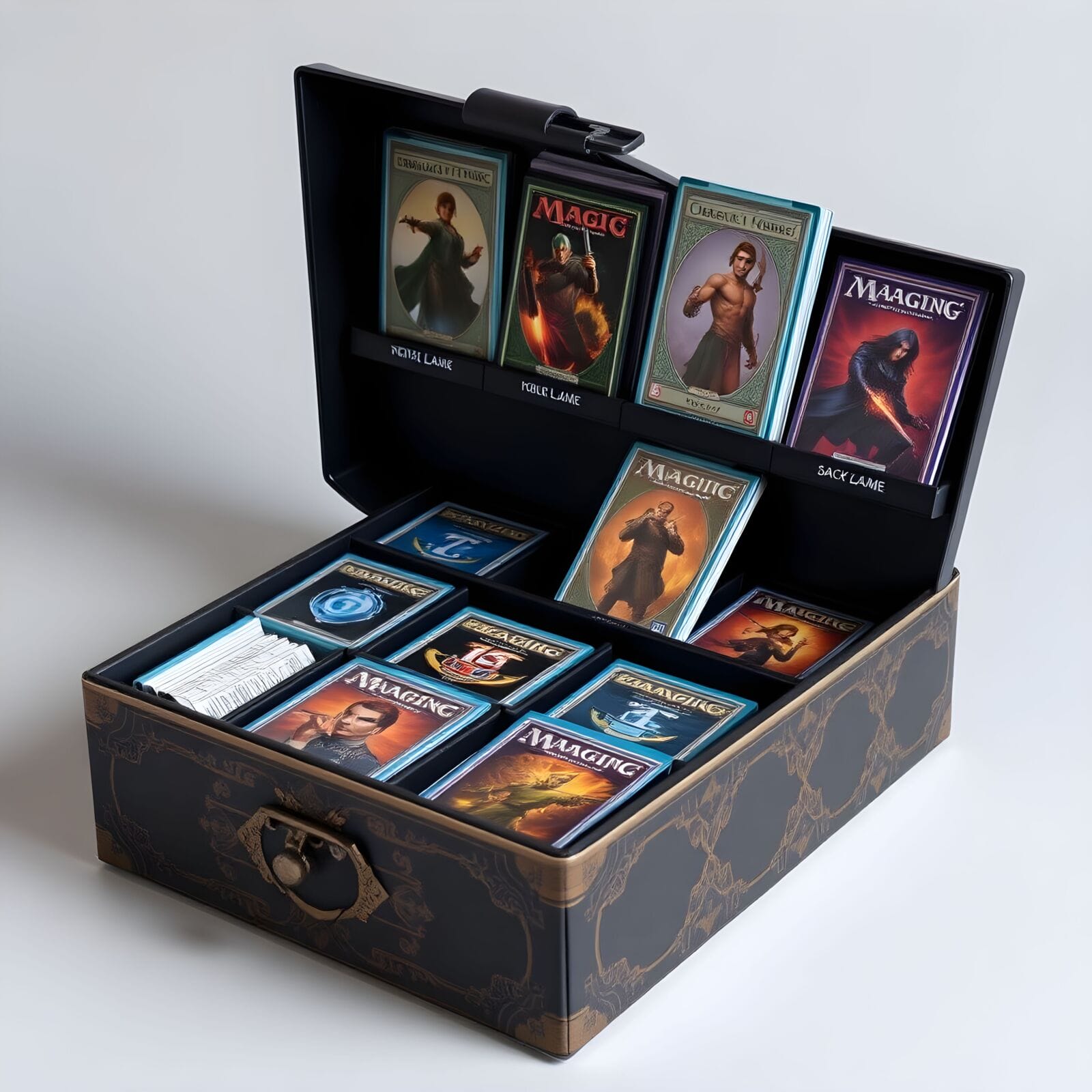
Some cards deserve more than safe keeping; they deserve a spotlight. Specs on VaultedCollection.com list a ribbed aluminum shell and collector-grade EVA foam, and the Vaulted four-row case delivers both. A rigid outer shell absorbs impact, while precision-cut foam locks each slab or sleeved card in place. Swing the lid open and four of your finest pieces stand framed behind clear windows, ready to admire without fingerprints.
Vaulted Collection 4-row aluminum card case displaying graded Magic cards
Capacity often surprises collectors. Remove a few foam blocks and the rows fit a little over 3 000 raw cards, or slot graded slabs upright—up to 112, snug and rattle-free. Either way, dense foam ensures nothing shifts when you stand the case upright or carry it across town.
Carrying feels professional. The metal handle reminds many users of camera gear. Weight rises once loaded, but balance stays comfortable for short moves. For longer hauls you will likely cradle the case with both hands; consider it a briefcase, not a backpack.
Protection justifies the price tag. A gasketed rim seals out dust, and the hard panels buffer Arizona heat better than cardboard or thin plastic. Pair that with the built-in showcase panel and the case doubles as desk art—no extra stands needed.
Yes, the math hurts if you store bulk here, about 60 dollars per 1 000 cards. Yet for Power Nine, Judge foils, or the Alpha starter deck you swore never to crack, that premium is cheaper than a single nicked corner.
When display quality matters as much as defense, the Vaulted case is the end-game solution: part vault, part museum.
Segment E: maximum security storage
Fire-rated home safe
When a collection shifts from “valuable” to “life-changing,” cardboard and plastic no longer feel secure. A fire-rated home safe solves that problem. Thick steel walls, a heat-shield liner, and a pry-resistant door turn casual theft and house fires into manageable threats rather than total losses.
A mid-size 1.7-cubic-foot safe holds a dozen monster boxes or several binders, yet still fits inside a closet. Bolt it to a concrete slab so thieves cannot carry the whole trove away. Most models are certified to survive one hour at 1 700 °F, the line between ashes and intact dual lands if the worst happens.
Daily use slows down. You turn the dial or tap the keypad, hear the bolts retract, lift a heavy box out, then repeat the ritual when you finish sorting. That friction buys peace of mind: casual decks stay in travel cases, grails sleep behind steel.
Climate needs care, too. A sealed safe traps whatever humidity you lock inside. Drop two silica-gel canisters in the bottom and replace them every few months; foils stay flat and paper stays crisp. Place the safe on a shelf or riser so a burst pipe cannot pool water around the base.
Cost runs from 200 dollars for a compact chest to 1 000 dollars for a dual fire-and-burglary unit. When a single Beta dual covers the bill, the math is simple. A safe will never win style points or portability awards, but nothing else shields against both flames and crowbars in one container.
Desert-proofing your collection
Arizona’s low humidity is kind to cardboard, but heat and sun are punishing. A closed room can hit triple-digit temperatures by mid-afternoon, and ultraviolet light fades inks before you notice. Keep every box or binder in a climate-controlled space—bedroom, office, or at least an interior closet that stays under 75 °F.
Shield cards from direct sunlight. If you display foils or signed pieces, slide them into UV-blocking sleeves or an acrylic frame rated for 95 percent filtration. The upgrade costs only a few dollars and keeps colors rich for years.
Control the micro-climate inside containers. Place a silica-gel pack in each sealed case or safe to handle summer monsoon spikes. Replace packets twice a year; if they feel soft, they are spent. With these steps, the desert’s biggest danger—rapid temperature swings—never touches your cards.
Quick-compare cheat sheet
Use this table to see, at a glance, where each storage option shines and where it falls short.
| Storage option | Cards held (approx.) | Protection | Portability | Organization | Cost per 1 000* |
| BCW Monster Box | 5 000 unsleeved | Low | Low | Low | Less than $1 |
| BCW 6-drawer Catalog | 6 000 unsleeved | Medium | Low | High | $8 |
| Zip-folio binder | 360 | Medium | Medium | High | $70 |
| Ultimate Guard Arkhive 800+ | 1 000 | High | Medium | Medium | $45 |
| Quiver case | 1 000 | Medium | High | Medium | $40 |
| Vaulted 4-row case | 3 000 / 112 slabs | Very high | Medium | High | $60 |
| Fire-rated safe | 10 000+ (varies) | Highest | None | Low | N/A |
*Rounded retail prices as of Q1 2026.
Read down any column to match your priority. Need raw capacity on a shoestring? The Monster Box wins. Crave museum-grade protection? Go straight to the Vaulted case or a safe. Want painless deck retrieval? The drawer catalog owns that lane.
Conclusion
Protecting a Magic: The Gathering collection is as much about matching storage features to individual needs as it is about shielding cardboard. Use the decision factors outlined here to pair each tier of your collection with the container that balances capacity, protection, portability, organization, aesthetics, value, and security. When the right card lives in the right box, every game night—and every future trade—runs that much smoother.