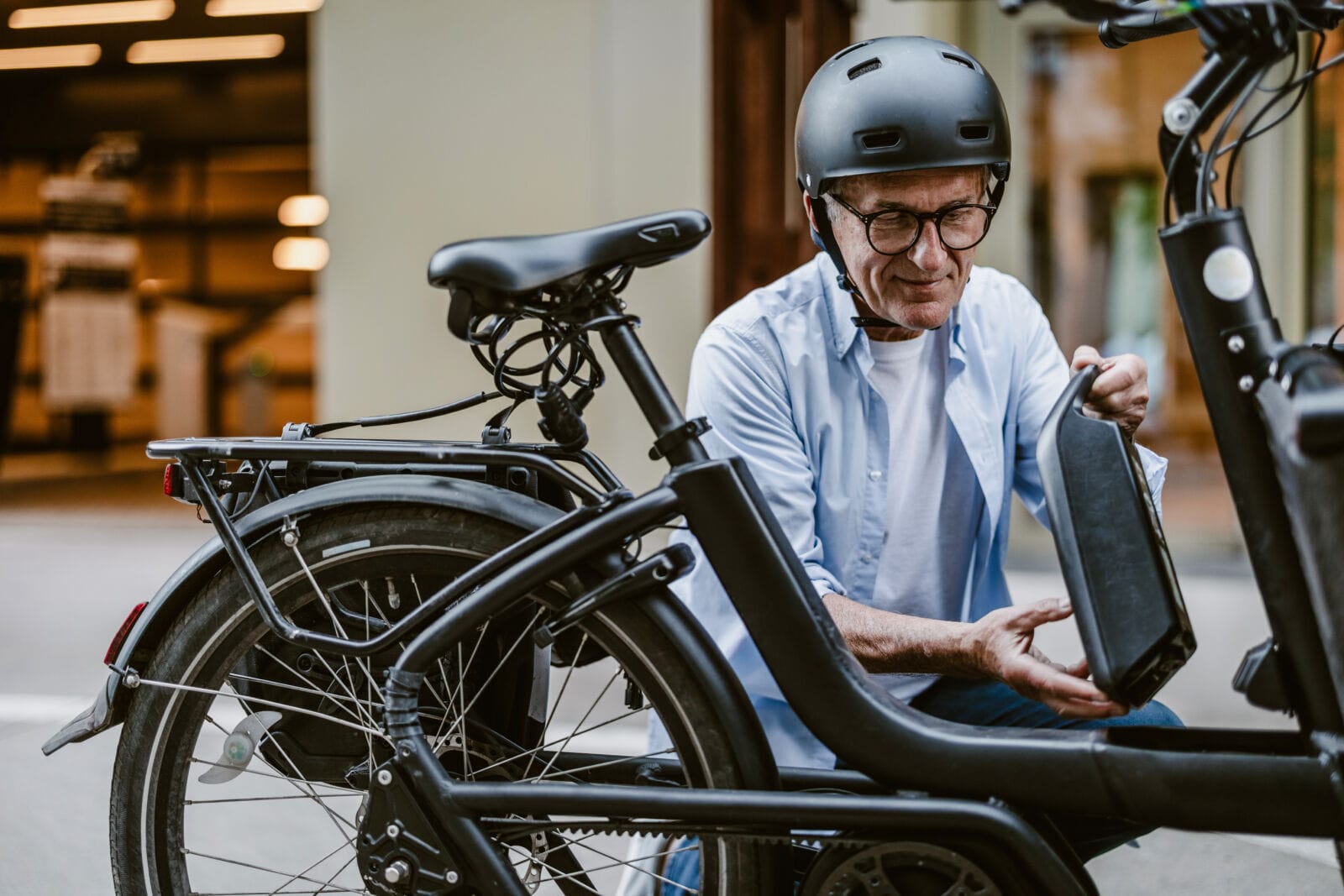
He’s on an eBike. She’s following in the car — because every bike she’s tried felt like a falling risk waiting to happen.
That’s not a fitness problem. That’s a design problem.
Most eBike buying guides ask the wrong question. Not which bike has the biggest battery — but which bike a 5’5″ woman with a bad knee can actually get on and off without thinking twice.
Here’s how to spot the difference between a bike built for this rider and one that merely claims to be.
The Moment That Decides Everything: Getting On and Off
Most eBike accidents don’t happen at speed. They happen at stops.
The wobble when a foot reaches for the ground and doesn’t quite make it. The slow tip at a red light. The moment of reaching that turns into a stumble.
Standover height — how high the frame sits when you’re stopped — determines whether that moment feels stable or precarious. A 17-inch standover lets most riders plant both feet flat without stretching. Anything higher, and shorter riders are negotiating with the bike every time they stop.
Wheel size feeds directly into this. Compact 20-inch wheels sit lower to the ground than 26-inch wheels, shorten the overall wheelbase, and reduce the rotational inertia that makes starting and stopping feel heavy. On tight path turns or sudden stops, that lower, more compact geometry is noticeably easier to manage — not in theory, but in the first five minutes of riding.
This is the engineering logic behind a step through an electric bike — a frame that drops the top tube low enough that the rider steps through instead of swinging a leg over. For anyone with limited hip mobility or balance concerns, it eliminates the most hazardous moment of every ride.
How to check it: Ask for the standover height in inches, not just the frame size. If the listing doesn’t include it, that’s a signal worth noting.
DEEPER DIVE: Read all the Ranking Arizona Top 10 lists here
INDUSTRY INSIGHTS: Want more news like this? Get our free newsletter here
What “Comfortable” Actually Means for a Rider with Joint Issues
Arizona’s paths aren’t all glass-smooth. Tempe’s Greenbelt, Tucson’s Rillito River Park Trail, Scottsdale’s Indian Bend corridor — all bikeable, all with the surface variations that accumulate over a long ride.
For riders with knee arthritis or lower-back sensitivity, those small vibrations aren’t background noise. They’re the reason a one-hour ride becomes a forty-minute ride.
A front suspension fork helps. But a front fork alone transfers every small road vibration through the frame directly to the rider’s spine and wrists. Full suspension — front fork plus rear wheel travel — changes the ride quality in a way that’s immediately felt. The wheels stay in contact with the ground. The frame handles what the wheels can’t. Mile ten feels like mile three.
One technical detail most buyers never hear about: rear suspension pivot placement affects whether the suspension also absorbs your pedaling energy. A poorly positioned pivot causes the bike to bob as you push down — you’re fighting your own effort. An anti-squat design places the pivot to eliminate that energy loss. The suspension works for you, not against you.
How to check it: Look for both front fork travel and rear wheel travel in the specs. Then ask specifically: does the rear use an anti-squat pivot design? If the salesperson doesn’t know the answer, the design probably doesn’t.
Assist That Works With You, Not Around You
Arizona Class 1 and Class 2 eBikes are legal on most bike paths and trails statewide — which means the vast majority of recreational riding in this state is unrestricted. The assist system’s job is simply to make that riding feel natural.
Two things separate a good assist system from a frustrating one:
Torque sensor versus cadence sensor. A cadence sensor detects that you’re pedaling and applies a fixed level of assist — regardless of how hard you’re pushing or what the terrain demands. A torque sensor reads your actual effort and responds proportionally. For riders with knee concerns, this distinction matters: torque mode doesn’t demand a fixed cadence. It responds to whatever effort is available that day, on that terrain, with those joints.
Auto Assist Mode. For riders who don’t want to manage gear levels mid-ride — and most people in this demographic don’t — an automatic mode that adjusts motor output based on real-time pedaling effort removes the entire decision. Hills get more support. Flat stretches ease off. The rider just pedals.
How to check it: Confirm both torque and cadence sensor modes are available and switchable while riding. Auto Assist should be a standard feature, not a paid upgrade.
Braking: Where Heavier Systems Need More Than Standard Specs
A loaded eBike — battery, frame, rider — carries more momentum than an unassisted bicycle at the same speed. The brakes have to account for that.
Hydraulic disc brakes maintain consistent stopping power in rain, dust, and heat in a way mechanical discs don’t — relevant in an Arizona summer. Rotor diameter determines how much heat the system can absorb before performance degrades: a 203mm front rotor provides meaningfully more braking surface than a 160mm rotor under the same lever pressure.
Motor cut-off on brake engagement — where squeezing the lever instantly cuts motor assist — matters for low-speed confidence specifically. The bike responds immediately, without the half-second delay of a motor that hasn’t registered the stop.
How to check it: Hydraulic actuation, dual-piston calipers, 203mm front rotor minimum. Motor cut-off should be listed as a standard safety feature. If the spec sheet shows mechanical disc brakes or doesn’t mention rotor size, ask why.
Where to Start the Search
Most 20-inch fat-tire eBikes in this price range fail at least one of the four criteria above — usually rear suspension design or braking spec. A handful don’t.
The category has improved noticeably over the past two years. Brands that originally built 26-inch platforms for off-road enthusiasts have started designing 20-inch versions with a fundamentally different rider in mind — lower standover, softer geometry, smarter assist systems. The specs are no longer afterthoughts.
One worth looking at in this category is purpose-built for exactly this rider profile — 17-inch standover, full anti-squat suspension, switchable torque and cadence assist with Auto Mode standard, and hydraulic brakes with a 203mm front rotor. It fits riders from 4’11” to 6’3″ and carries up to 440 lbs. Battery certification is UL 2271 — verifiable at ul.com, not just claimed on a spec sheet.
It won’t be the right fit for everyone. But for the couple where one partner has been sitting rides out — it’s a reasonable first stop.