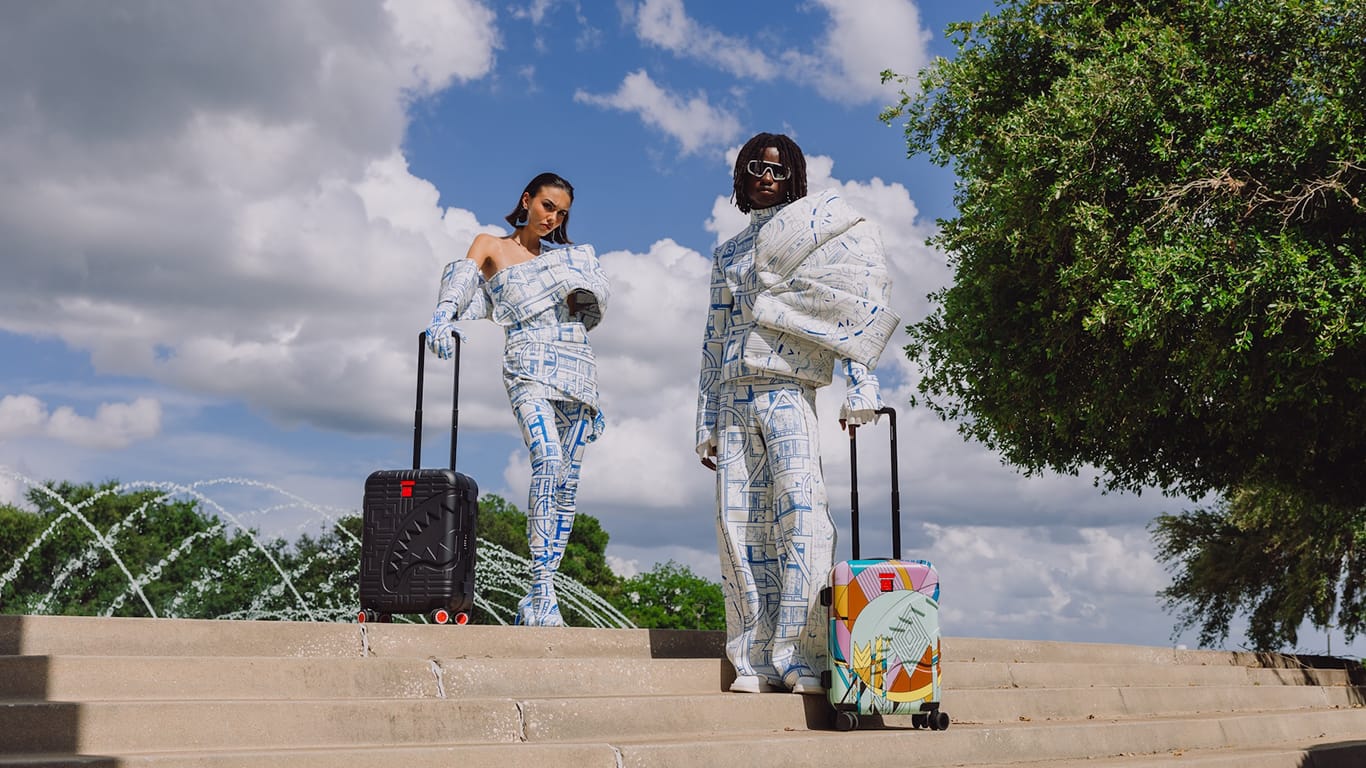
When the travel fashion brand Sprayground approached Frank Lloyd Wright Foundation’s director of licensing, Sally Russell wasn’t entirely sure what to expect.
She frequently fields inquiries from designers, museums and brands eager to reinterpret Wright’s work. But this one felt different.
Soon, Russell learned that Sprayground — known for its modular silhouettes and shark‑mouth motif — would be the perfect partner, Russell explained.
“About a year ago, Sprayground started talking to us about collaboration opportunities,” Russell said.
“When we looked at their website and their past collaborations, for example, with The Met, we realized we had an incredible number of capabilities, as far as doing something super unique that could be very indicative of Frank Lloyd Wright’s style.”
WOMEN IN BUSINESS: The Most Influential Women in Arizona for 2026
WOMEN IN REAL ESTATE: The Most Influential Women in Commercial Real Estate for 2026
The products fit with Frank Lloyd Wright’s ethos and approach to design, she added. Sales of the limited-edition collection of backpacks and luggage pieces launched on Aug. 1 at Sprayground’s website.
The silhouettes are bold, dimensional and layered; some pieces mimic the Guggenheim’s spiraling geometry, while others echo Wright’s stained‑glass patterns.
In a statement, Sprayground founder David BenDavid said, “We’re not just designing bags — we’re redefining what a backpack can be.”
The collaboration debuted during Sprayground’s London Fashion Week show in 2025, where Sandflower (née Julia Dyson), the company’s vice president and creative director, closed the runway wearing one of the architectural showpieces.
Russell enjoyed seeing Wright’s geometry translated into sculptural travel gear that was more than a novelty.
“Frank Lloyd Wright challenged conventions,” she said. “They’ve taken Wright’s architectural language — the geometry, the structure, the bold sense of form — and turned it into something you can carry through an airport or down a city street.”
Frank Lloyd Wright believed design should be democratic, accessible and deeply connected to the surroundings. He subscribed to the theory that organic architecture shaped how people live, move and interact with their environment.
“One of the reasons we have a licensing program is to continue Frank Lloyd Wright’s design legacy,” Russell said. “He wanted to democratize design and make it available to as many people as possible.”
The Frank Lloyd Wright Foundation was established near the time of its namesake’s death. It works to continue organic architecture and design through summer camps and homeschool activities.
“Then there’s Taliesin Institute, which is part of the foundation,” Russell said.
“There, we work with older scholars and college students who use Taliesin and Taliesin West that the Frank Lloyd Wright Foundation owns and operates as learning sites. [These scholars and college students] are also encouraged to develop new ideas for the future because Frank Lloyd Wright he was a genius in his own time. However, there are certainly new technologies that work toward the future as well.”
At Taliesin West, visitors often leave with a sense of possibility, Russell said. Russell hopes the Sprayground collaboration carries that same spark beyond the desert.
“My hope would be that they walk away inspired,” she said. “A different way of seeing the world and feeling like they have the agency to create something new themselves.”