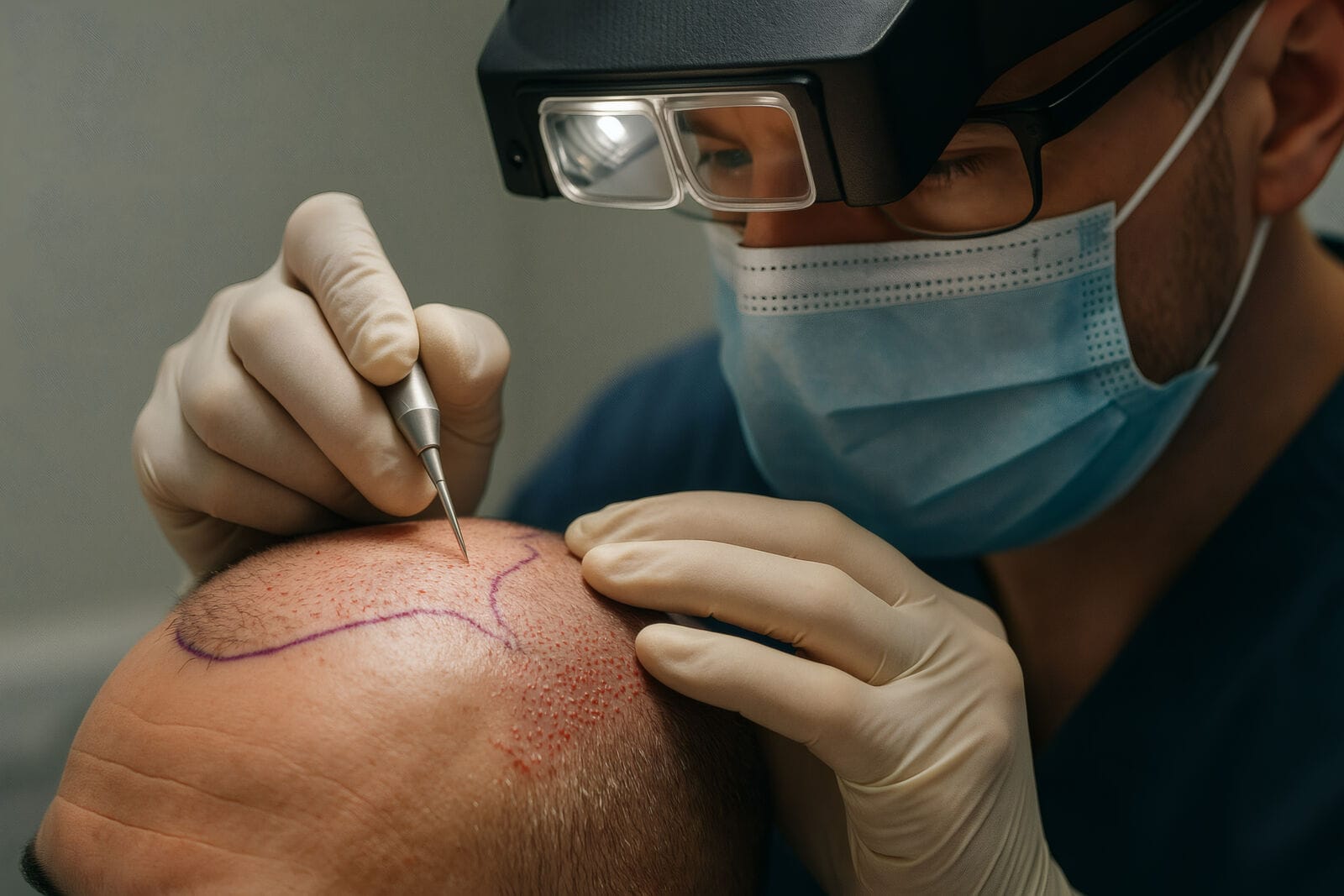
Search for a hair transplant in Turkey and two terms appear almost immediately: FUE and DHI.
Clinics often present them as two completely different procedures, sometimes with DHI positioned as the newer or more advanced option. That can make the decision sound simpler than it really is. In practice, both techniques share a lot in common, and the better choice usually depends less on the name of the method and more on the patient’s hair loss, donor area and the size of the area that needs to be restored.
So what actually changes between FUE and DHI — and does one produce better results?
FUE and DHI start in almost the same way
One of the biggest misunderstandings is that DHI replaces FUE entirely.
It usually doesn’t.
With both procedures, individual follicular units are typically extracted from the donor area at the back and sides of the scalp using small punches. The real difference comes later, when those grafts are placed into the thinning or bald areas.
In a conventional FUE procedure, the surgeon or medical team first creates small recipient channels and then places the extracted follicles into those openings.
With DHI, the follicles are loaded into an implanter pen and inserted directly into the recipient area.
That difference in implantation technique is why people searching for “FUE vs DHI” often find very different claims about density, healing and recovery. Some are valid; others are mostly marketing.
Why Sapphire FUE is so common in Turkey
Many clinics in Istanbul now use sapphire blades instead of traditional steel blades when creating recipient channels.
The idea is fairly straightforward: the surgeon can create small, precise incisions while controlling the angle and direction of the new hairs. This is especially useful when treating a larger surface area.
For someone researching a Sapphire FUE hair transplant in Turkey, the main advantage is often practicality. FUE can be well suited to patients who need several thousand grafts across the frontal area, mid-scalp or a combination of both.
It is also one reason FUE continues to be widely used despite the rapid growth of DHI.
The method is efficient for larger sessions and gives the medical team a great deal of control over how grafts are distributed.
Is DHI better for density?
This is probably one of the most searched questions about the two techniques.
The short answer is: not automatically.
DHI allows grafts to be implanted with an implanter pen, which can be particularly useful when working between existing hairs. For patients who still have a reasonable amount of native hair but want to increase density in specific areas, that can be an advantage.
This is why a DHI hair transplant in Turkey is often considered for hairline work, smaller thinning areas and cases where the recipient hair does not need to be completely shaved.
But final density still depends heavily on donor capacity.
A patient with 2,000 usable grafts cannot realistically achieve the same coverage as someone with 4,000 strong grafts simply by choosing DHI. Hair calibre, the number of hairs in each follicular unit and the size of the treatment area all matter.
Technique matters, but biology still sets the limits.
Do you have to shave your head?
This question comes up constantly, especially among patients who need to return to work quickly.
With a standard FUE procedure, shaving usually makes extraction and implantation easier, particularly when a large number of grafts are involved.
DHI offers more flexibility.
In some cases, the recipient area can remain unshaven or only partially trimmed, while the donor area is shortened for extraction. That makes DHI appealing to people who want the procedure to be less obvious during the first few weeks.
It does not mean every DHI procedure is automatically “no shave,” though. The number of grafts and the existing hair pattern still determine what is practical.
A patient needing extensive coverage may be better served by shaving even if DHI is used.
Which one is better for 3,000 or 4,000 grafts?
For larger procedures, FUE is often the more straightforward option.
Someone with extensive frontal recession and mid-scalp thinning may need 3,000, 4,000 or even more grafts depending on donor capacity. Creating the recipient sites first can make it easier to plan the overall distribution across a broad area.
DHI can also be performed with high graft numbers, but the procedure may take longer and may require more staff involvement.
That is partly why DHI is often more expensive.
There is no universal graft number at which a patient “must” choose one method over the other. The more useful question is where those grafts need to go.
Four thousand grafts spread across a large bald area is a very different case from 2,000 grafts placed between existing hairs.
Does DHI heal faster than FUE?
The early recovery period is broadly similar.
Redness, small crusts around the implanted hairs and some swelling are normal after either procedure. Most of the visible crusting settles during the first couple of weeks.
Patients sometimes describe DHI as having a quicker recovery because the implantation sites can be very small, but the practical difference is not dramatic for everyone.
What tends to matter more is how the procedure was performed, how densely the grafts were placed and how the scalp reacts individually.
And regardless of technique, the transplanted hairs often shed during the first several weeks.
That part surprises many first-time patients.
The follicles remain underneath the skin and gradually begin producing new hairs. Noticeable growth usually develops over months rather than weeks, with the appearance continuing to change well beyond the early growth stage.
Is one technique less painful?
During the procedure, both FUE and DHI are normally carried out under local anaesthesia.
For many patients, the most uncomfortable part is not the extraction or implantation itself but the local anaesthetic injections at the beginning.
Afterward, the donor area may feel tender or tight for several days.
There can be small differences between techniques, but choosing DHI purely because it is advertised as “painless” is probably the wrong way to make the decision.
The experience of the team and the anaesthesia protocol have a much bigger influence on comfort.
Why is DHI usually more expensive in Turkey?
Patients comparing hair transplant prices in Turkey often notice that DHI packages cost more than FUE.
There are several reasons.
DHI requires implanter pens, careful loading of individual grafts and often more time during the implantation stage. It can also require a larger team when thousands of follicles are being handled.
That additional workload tends to be reflected in the price.
But a higher price does not automatically mean a better result.
A well-planned FUE procedure can look better than a poorly planned DHI procedure, and vice versa.
When comparing clinics, it makes more sense to ask who designs the hairline, who performs the extraction, how the donor area is managed and how many patients the team treats in a day.
Those questions usually tell you more than whether the package is labelled FUE or DHI.
The donor area should influence the decision
People tend to focus on how the front of the hair will look after surgery. The back of the head deserves just as much attention.
Donor follicles are limited.
Once a graft has been extracted, another follicle does not grow back in the same spot. Removing too many grafts — or concentrating extraction in a small area — can leave visible thinning.
That becomes especially important for younger patients who may continue losing their native hair.
A good treatment plan should therefore consider not only the first procedure but what may happen five or ten years later.
Someone may have enough donor hair for a strong frontal reconstruction today but not enough to repeatedly fill every area that thins in the future.
That is a planning issue, not an FUE-versus-DHI issue.
So which one makes more sense?
For extensive hair loss and larger graft sessions, Sapphire FUE often makes practical sense.
For targeted implantation, adding density between existing hairs or avoiding a full shave in selected cases, DHI can be particularly useful.
There is also no reason the decision has to be ideological. Some treatment plans can use different implantation approaches in different areas of the scalp.
The important part is understanding why a clinic recommends a method.
If the answer is simply “DHI is better because it is newer” or “FUE is better because we can transplant more grafts,” that is probably not enough information.
The better recommendation should take into account the size of the recipient area, donor density, hair thickness, existing hair, future hair loss and the number of grafts that can be used without damaging the donor region.
For patients comparing FUE and DHI in Turkey, that assessment is ultimately more valuable than choosing a procedure based on the name printed on the package.