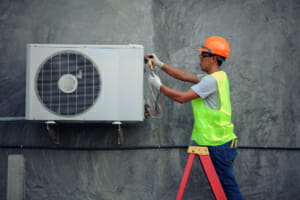
Bradford Sterling of Choice Home Warranty keeps a funnel behind his air conditioner’s condensation drain line. It reminds him to pour a cup of bleach and water down that line once or twice a year, before mold and mildew clog it and shut the whole system down.
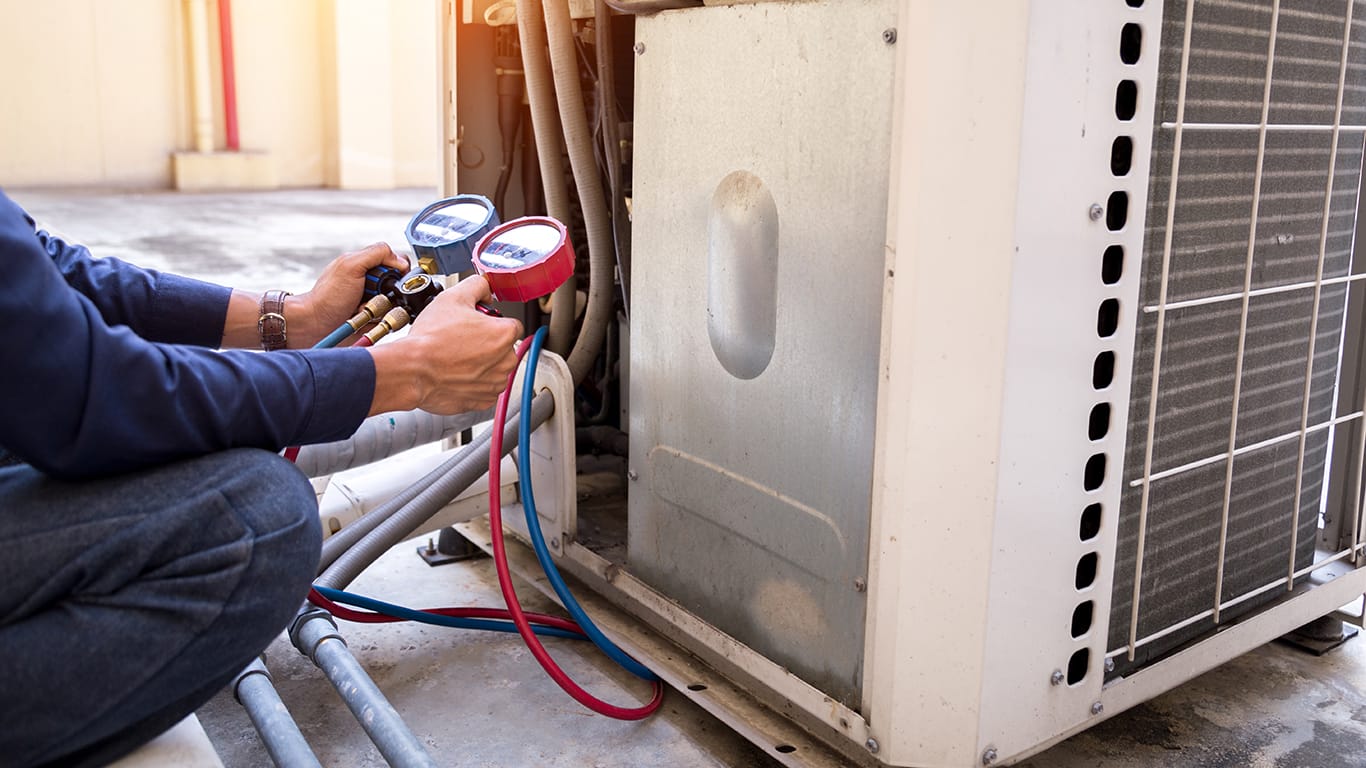
Sterling records tips like this one in a series of homeowner-education videos for Choice Home Warranty. The videos cover the maintenance chores that keep a heating and cooling system alive: cleaning the condensing coil each year so dirt and debris don’t choke off airflow, straightening any aluminum fins bent by yard work or a stray ball, and keeping a Sharpie on the return air plenum, one mark for the filter size, so he never orders the wrong one, and another for the date he last changed it. None of it is complicated. All of it matters. And none of it changes the fact that every HVAC system, no matter how well it’s cared for, eventually breaks down from age.
Why Maintenance Buys Time, Not Immunity
The median U.S. home was built around 1980, a figure drawn from the Census Bureau’s American Community Survey, which tracks housing age nationally through its year-built question. Twenty years of that survey data also show the country’s housing stock has kept expanding even as tightening vacancy rates suggest new construction is struggling to keep pace with population growth. The Census Bureau collects year-built data specifically to measure housing age and availability across the country. Older homes mean older systems, with more components approaching the end of their working life at the same time.
HVAC systems typically last 15 to 25 years, with air conditioning units specifically running 15 to 20 years before replacement becomes the more sensible option, according to Angi’s HVAC lifespan data. Regular maintenance extends that window. It does not eliminate it. Compressors wear down. Coils corrode. Fan motors fail. A homeowner who changes filters religiously and hoses down the condenser every spring still ends up, eventually, watching a technician write up an estimate.
Filter changes illustrate why maintenance is a moving target rather than a fixed schedule. A furnace running nonstop through a cold January needs a new filter far more often than the same system idling through a mild April. Sterling’s rule of thumb, checking the filter every time a utility bill arrives, ties the chore to something a homeowner already does regularly instead of a date on a calendar that’s easy to forget. Skip it too long, and the system works harder to push air through a clogged filter. Higher energy bills show up before a breakdown does.
What an HVAC Repair Actually Costs
When that breakdown does happen, the repair estimate varies more than most homeowners expect. HVAC repair costs $350 on average nationally, but the price can run as low as $100 or as high as $3,000 depending on the failed part and the type of system, according to Angi’s 2026 pricing data. A capacitor might run $100 to $250. A compressor, the most expensive component to replace, can cost $800 to $3,000 on its own. Labor alone often runs $100 to $250 an hour on top of parts.
Location changes the math further. Angi’s data puts average repair costs at $575 in California and $500 in New York, compared with $330 in Texas and Florida. Labor rates and the types of systems common to each climate account for much of that gap. A homeowner who sets aside $200 for a filter and a tune-up can still be blindsided by a $2,000 compressor failure the following winter. Angi’s own guidance recommends replacing a system once repair costs exceed roughly a third of its replacement value, which for many older units means every major repair decision doubles as a financial one.
DEEPER DIVE: Arizona has 6 of the 30 happiest cities in America
INDUSTRY INSIGHTS: Want more news like this? Get our free newsletter here
Where Home Warranty Coverage Fits the Math
Bankrate’s Hidden Costs of Homeownership study puts home maintenance costs at $8,808 nationally in 2025, up 42% over five years. HVAC repairs sit inside that number as one of the least predictable line items a homeowner faces. A leaking pipe or a dead water heater tends to announce itself and get fixed quickly. A dying compressor can limp along for months before it fails outright, often in the middle of the season when demand for technicians peaks and prices follow.
A home warranty is designed to absorb exactly that kind of unpredictability. In exchange for an annual fee, the company covers repair or replacement costs for systems and appliances that fail from ordinary wear and tear. Bankrate puts the homeowner’s share at a smaller service fee, typically around $100 per visit, when a technician is dispatched. The National Home Service Contract Association traces the industry back to a straightforward risk-management idea: contracts covering home systems like HVAC, plumbing and electrical against wear-and-tear breakdowns have been sold to homebuyers and sellers since the format originated in California in 1971.
Choosing among plans comes down to a handful of practical questions rather than marketing claims: what the plan covers, what it excludes, and what the maximum payout looks like for the systems most likely to fail. Request a sample contract, read the exclusions closely, and weigh the total annual cost against the odds that an aging system will need attention this year. A home warranty covers the ordinary, unglamorous failure that comes from a system running its course. It won’t pay for damage caused by neglect, and it isn’t a substitute for homeowners insurance, which covers fire, storm damage and other events outside a homeowner’s control.
Choice Home Warranty, founded in 2008 with a mission to make home ownership simple and affordable, is one example of a company built around that model. CHW lead the industry by distributing coverage plans directly to consumer through two primary plan options, Basic and Total. CHW, which operates in 48 states, has acquired Home Warranty of America and the Home Service Club, and it says it has earned more than 100,000 five-star reviews across platforms including BestCompany, ConsumerAffairs, and Trustpilot.
Closing the Gap Between Breakdown and Repair
Coverage only solves half the problem. The other half is speed, and it’s the part homeowners tend to remember longest. Roland Mercier, a Choice Home Warranty customer, recorded a short account of calling in about a failing water heater on a Sunday. He got an email that same day scheduling a technician for the following Monday. “The service man came and looked at the water heater and did what they could for it,” he said. “I’m basically satisfied with the fact that Choice was able to get the service call taken care of immediately.”
That kind of turnaround depends less on the size of a company’s contractor network than on how efficiently it matches a claim to an available technician. Choice Home Warranty uses a highly automated platform to route incoming claims to local contractors in something closer to real time than the phone-tag process that once defined the industry. Homeowners can file a claim with a simple click or call, and the system does the work of finding someone qualified to show up. For a compressor that fails on a 95-degree afternoon, that dispatch speed is the difference between a bad day and a genuinely dangerous one, particularly for older residents or households with young children.
The Market Behind the Math
Home warranty coverage has long been tied to the real estate transaction itself. The National Home Service Contract Association puts the national figure at an estimated 26% of home sales in 2007, a share that reached 92% in California, where the industry originated. The National Association of Realtors’ annual survey of buyers and sellers shows agents remain the most trusted source of information in a transaction, and warranty coverage is one of the tools they routinely recommend to smooth a sale involving an older HVAC system or water heater. A warranty in place at closing gives a buyer one less unknown to negotiate over. It gives a seller a way to address an aging system without the cost or delay of replacing it outright.
None of this is happening in isolation. Rising repair costs, an aging housing stock and a generation of buyers accustomed to on-demand service are pushing more homeowners to weigh warranty coverage against the alternative of self-insuring against system failure. In states with older housing stock and harsher climates, where an HVAC system runs closer to its limits year-round, that calculation tends to matter even more.
The math is not complicated. An HVAC system built when the average American home was new is now, by definition, decades old. The homeowners who keep up with filters, coils and drain lines are doing exactly what they should. They’re just not the ones who get to skip the day the system fails anyway. What separates a manageable repair bill from a genuine financial shock is usually less about the maintenance history and more about what kind of coverage, and what kind of response time, is waiting on the other end of that call.