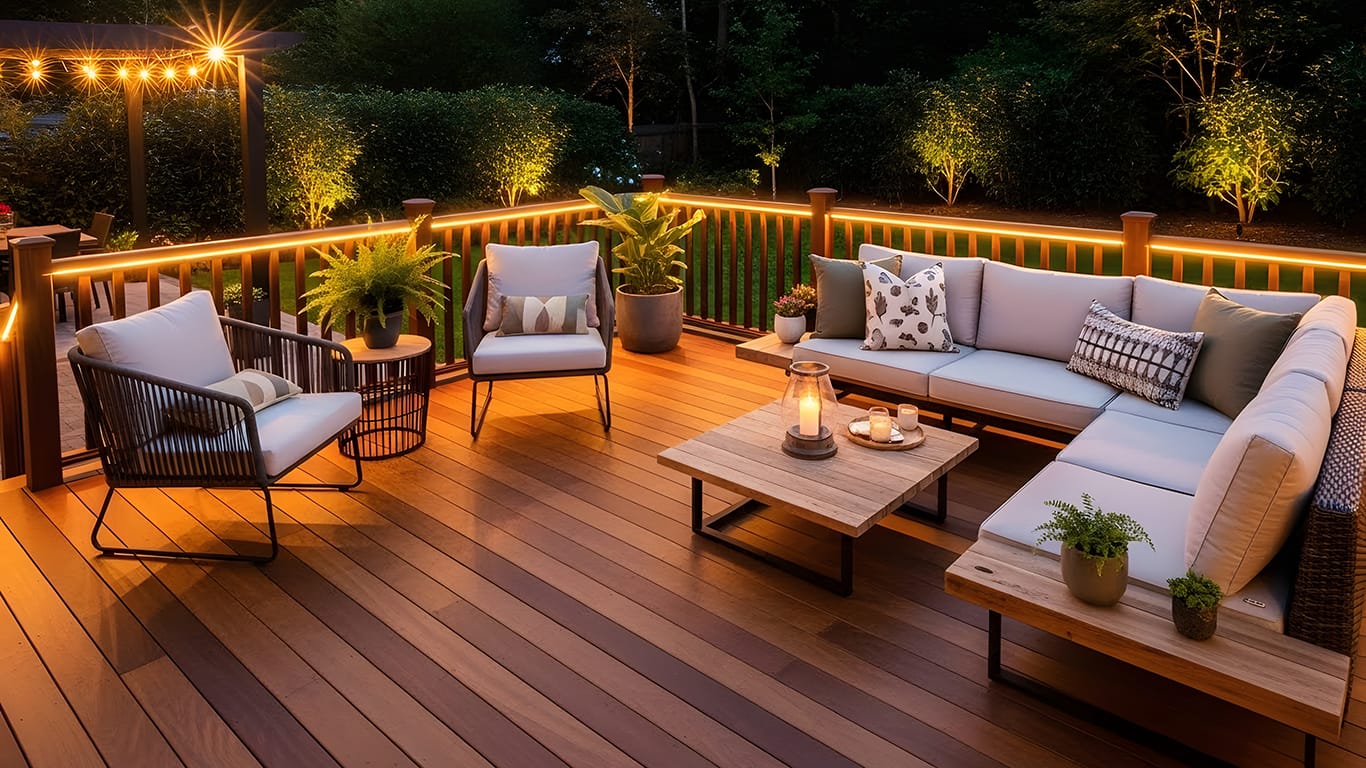
Building a deck is one of the most rewarding home improvement projects you can undertake. It creates an outdoor oasis for summer barbecues, morning coffees, and family gatherings. However, behind every beautiful outdoor living space lies a serious engineering puzzle. When planning outdoor structures, such as decks by Keystone Custom Decks, ensuring structural safety depends heavily on understanding how deck size and weight load determine the sizing and placement of footings, posts, and beams.
Understanding the Blueprint: Dead Load vs. Live Load
Before calculating the size of your structural elements, you need to understand what weight the deck actually holds. Structural engineers and building codes look at two main types of load:
- Dead Load: The load resulting from the weight of the materials making up the deck itself, such as the framework, decking boards, railings, and other permanent fixtures. The standard wood deck typically considers a dead load of 10 PSF.
- Live Load: The weight of people, furniture, snow, wind, and anything temporary. Standard residential building codes generally require decks to support a live load of 40 PSF.
Combined, a standard residential deck must handle a total load of 50 PSF. If you plan to add heavy amenities like a hot tub, stone outdoor fireplace, or heavy planters, that live load requirement jumps dramatically, requiring heavier structural framing.
Footings: The Foundation Beneath Your Feet
The purpose of footings is to bear the load of the deck by transferring its entire load into the soil below. The total size of the deck will decide the number of footings as well as the width that the footings should have.
Big decks carry heavy loads, and hence the soil has to carry heavier loads. In case the soil has low bearing capacity, that is, in case of sandy or clay soil, the footings need to be made wide and bell-bottom type.
Furthermore, footings must sit below your local frost line. In colder climates, frozen ground expands; if footings are too shallow, frost heave will lift and crack the deck structure over time.
Posts: The Vertical Support System
Posts transfer the loads from the beams to the footings, and their dimensions vary based on the height of the deck, layout, and loading on the deck.
Whereas traditionally $4 \times 4$ posts used to be common, current building codes prefer or require $6 \times 6$ posts. However, apart from the increased weight capacity, $6 \times 6$ posts are less prone to warping, allowing for a notched beam connection instead of fasteners only.
The larger your deck’s overall square footage, the more weight each individual post carries. If you are building an elevated deck or planning an expansive multi-level design, consulting a local deck builder near me ensures that your post size and spacing account for both vertical load and lateral sway (wind forces).
Beams and Joist Spacing: The Deck’s Backbone
Beams run horizontally, supporting the joists and transferring weight to the posts. Beam size and span are inextricably linked to deck dimensions.
- Tributary Load: Beams support half the load of the joists extending from them. A longer joist span means the beam is holding more square footage of weight, which requires a thicker beam (e.g., doubling or tripling up $2 \times 10$ or $2 \times 12$ lumber) or shortening the span between support posts.
- Joist Spacing: The distance between floor joists (typically 12 or 16 inches on-center) depends on the decking material and expected load. Diagonal decking patterns or composite deck boards often require tighter 12-inch spacing to prevent sagging under weight.
Conclusion
Putting up a deck that is both safe and strong is a careful balance of math, materials, and building codes. Each part, from the depth of your footings to the spacing of your joists, operates as a system whose job is to transfer weight to the earth. Whether you are building a simple ground-level platform or an intricate multi-tier masterpiece like decks by Keystone Custom Decks, prioritizing structural integrity ensures your outdoor space remains safe and stable for decades to come.