
Around 1.5 million new homes are built each year in the US, and this process offers the ultimate opportunity to integrate a highly efficient heating system right from the foundation. Radiant floor heating eliminates the cold spots, noisy blowers, and unsightly baseboards associated with traditional forced-air setups. Designing these systems requires precision to ensure comfort and long-term energy savings.
A successful system relies on matching the mechanical layout with the architectural realities of the home. Modern residential energy codes require heating systems to operate at lower temperatures while maintaining peak thermal performance. Navigating these requirements demands a clear understanding of the core variables that govern radiant system design.
Core Thermodynamic Boundaries And Pipe Dynamics
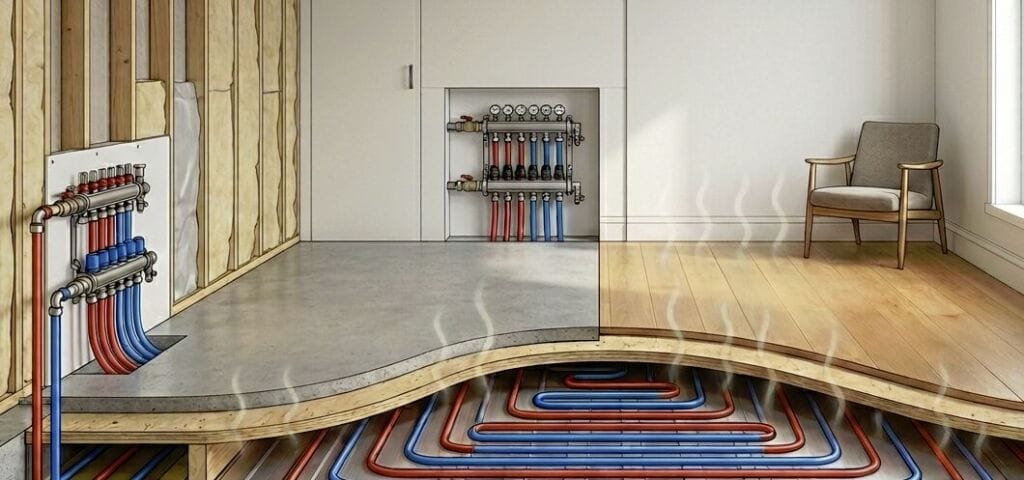
Hydronic radiant designs must carefully balance water temperature and fluid dynamics to prevent system failure. Engineers must determine the precise pipe spacing and loop lengths for each room based on the structure’s heat loss. Standard residential layouts typically use 16mm tubing spaced 150mm to 200mm apart to ensure an even distribution of warmth across the floor.
Exceeding the maximum threshold for a single circuit introduces massive friction inside the network. When a single circuit stretches past the 100-meter limit for 16mm tubing, the system experiences an extreme pressure drop that standard residential circulator pumps cannot overcome.
This fluid resistance starves the loop of necessary hot water, leaving large sections of the room completely cold. Designers split larger spaces into multiple independent loops connected to a central manifold to maintain balanced fluid dynamics.
Temperature Control And Infrastructure Integration
New construction initiatives heavily prioritize low-carbon, low-temperature systems because they perform highly with renewable heat pumps operating at 40°C to 50°C. Lowering the water temperature reduces the workload on the heat source, lowering monthly utility bills. Older radiant layouts relied on scorching water temperatures, but modern high-performance builds leverage tight building envelopes to achieve total comfort with mild fluid temperatures.
Achieving this balance requires professional radiant heating design services to map out zone configurations before pouring concrete or fastening subfloors. Specialized design technicians model the exact BTU requirements of every room by analyzing window dimensions, insulation values, and local climate data.
Managing these low-temperature inputs requires a smart manifold system capable of regulating individual zones. Every loop connects back to this central distribution hub, which balances the flow rates across different rooms.
Modern building regulations specify a maximum fluid temperature limit of 55°C for water-based underfloor heating to protect both the mechanical components and the finish flooring materials. Introducing water that exceeds this threshold can lead to severe structural issues and system inefficiency.
Finished Flooring Constraints And Thermal Conductance
The materials covering the radiant network dictate how efficiently heat moves from the buried pipes into the living space. Every flooring material has a unique level of thermal resistance, which affects the system’s overall heat output, so the choice here isn’t just about keeping in line with current interior design trends. Thick stone and ceramic tile transfer heat rapidly, while thick carpets and dense wood act as insulators that slow heat transfer.
Natural wood and engineered floor assemblies are particularly sensitive to rapid temperature shifts and excessive localized heat. Overlying material restrictions require uniform thermal distribution, with surface temperatures not fluctuating more than 3°F across the floor assembly to eliminate structural floor warping. When a system allows sharp temperature spikes, the wood fibers expand and contract unevenly, destroying the tongue-and-groove joints.
Designers handle these material limitations by adjusting pipe depth and spacing during the early planning stages. The following structural elements ensure a stable and high-performing radiant floor system:
- Aluminum heat transfer plates distribute energy evenly across wood subfloors
- Low-resistance underlayments prevent heat from getting trapped beneath carpets
- Vapor barriers protect wood flooring from subfloor moisture changes
Balancing Hydronic Loops For Lifetime Efficiency
A radiant system provides decades of silent comfort when the initial mechanical design respects the laws of fluid dynamics and material limits. Homeowners avoid the headaches of uneven heating and high energy bills by locking in proper loop lengths, fluid temperatures, and material pairings before construction begins. Our site has plenty more coverage of design and architecture topics, as well as posts on lots of other news and lifestyle talking points, so stick around.