Standing atop Biosphere 2’s iconic rooftop dressed in the same spacesuit George Clooney wore in the 2013 film “Gravity,” YouTube personality MrBeast shared a piece of Southern Arizona with the world in his most recent video.
“This biosphere could save humanity if Earth becomes uninhabitable,” he said. “This biosphere has everything needed to sustain human life … it’s your own mini-Earth that you can put on any planet in the solar system.”
MrBeast, real-name Jimmy Donaldson, is a hugely popular content creator, entrepreneur and philanthropist known for large-scale challenge videos and awarding cash prizes to participants. Beyond competition, he creates videos comparing technologies and products across different price points to evaluate their value.
MrBeast and his team visited Southern Arizona one morning last November to film content for the video, “$1 vs $1,000,000,000 Futuristic Tech!” In addition to exploring Biosphere 2, the video features a variety of technologies, including a Mercedes prototype vehicle, SpaceX rocket launch and a stop at the genetic engineering firm, Colossal Biosciences.
Located about 30 miles north of the University of Arizona’s main campus, Biosphere 2 is the world’s largest controlled environment: A 3.14-acre model of Earth designed to study how complex ecosystems like rainforests, oceans and deserts respond to stressors arising from predicted future changes in critical Earth systems and human influence. In the modern era, the facility serves as an integral research platform for advancing the understanding of both natural and human-made systems, supporting the development of more resilient and sustainable environments and improving quality of life.
Beneath the glass structure are more than 300 species across five stabilized ecosystems: the ocean, mangrove wetlands, tropical rainforest, savanna grasslands and fog desert biomes.
“Under the leadership of the University of Arizona, Biosphere 2 really stands out as a differentiator,” said John Adams, deputy director and chief operations officer. “In addition to our actual research, people can visit every day – and that’s not something you see at a typical university lab or field site. That gives us the chance to not only share the historical significance of Biosphere 2, but also the groundbreaking research that can only happen here.”
Above (and below) the dome
Early that November morning, Adams joined Aaron Bugaj – Biosphere research technologist and marketing and communications lead – in guiding MrBeast and his crew through the facility, including the opening shot on the rooftop.
After wrapping up the rooftop scene, Bugaj called the day “a whirlwind that moved from one section of Biosphere to the next.” The shots consisted of a single cameraperson following MrBeast with additional cameras stationed throughout the facility. Over the course of the day, Bugaj said he was on hand to provide additional information about the various biomes and the research taking place in each.
“We showed them all of Biosphere 2 to the best of our abilities, and they were interested in everything – and left no stone unturned,” Bugaj said. “The team was very nice, professional and excited to explore all of the possibilities of what takes place within the Biosphere.”
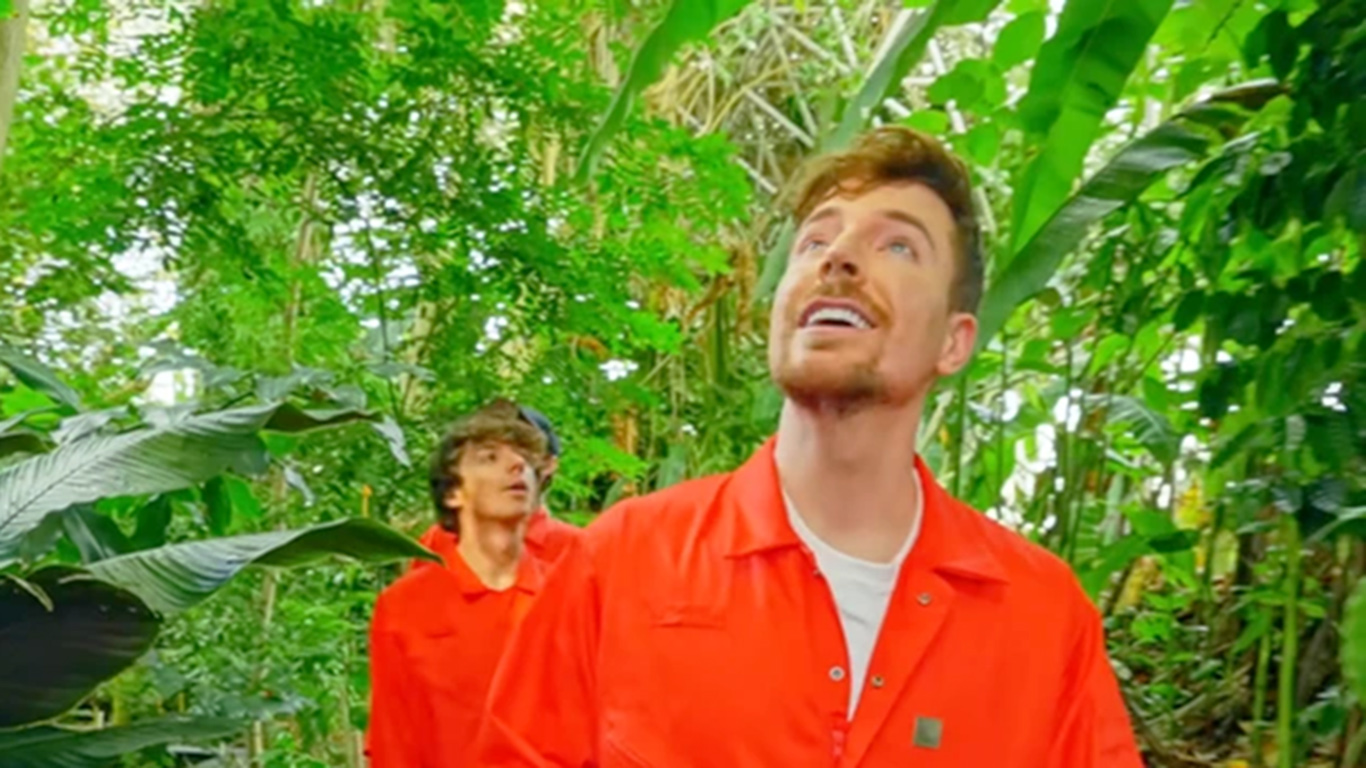
Stepping down from the rooftop, MrBeast and his team entered a world unlike any other. Nestled under the glass panels lay five interconnected biomes, each brimming with life and scientific discovery.
“This half-a-billion-dollar biosphere is literally the blueprint for what human life will be like on other planets,” MrBeast said. “Let’s go be Martians for a day, boys.”
In the rainforest biome, scientists recently tested the impact of temperatures as high as 140 degrees Fahrenheit on photosynthesis and leaf function in order to predict how climate change could impact tropical environments – down to the level of the individual leaf. Nearby, in the ocean biome, researchers are preparing to deploy massive coral reef “arks” aimed at redefining and accelerating restoration efforts worldwide. Meanwhile, the desert biome recently welcomed a new population of Sonoyta pupfish, adding to its unique biodiversity.
In addition to the biomes, science takes place at Biosphere 2 within a variety of research centers. At the Center for Human Space Exploration, scientists are dedicated to advancing technologies and strategies that enable a sustainable human presence throughout our solar system and beyond. That work is complemented by researchers in the Space Analog for the Moon and Mars, a hermetically sealed and pressurized habitat and research station that helps simulate living conditions on Mars.
Biosphere 2 also serves as a testbed for agrivoltaics studies and hosts the Landscape Evolution Observatory, which examines how water shapes hillslopes and surrounding environments like those found in the Tucson basin.
During filming, Adams said MrBeast’s team was struck by the sheer scale and complexity of the biomes – a reaction best illustrated when researchers triggered an artificial storm inside the rainforest.
“It was really exciting to show them just how much control we have over the conditions in these environments,” Adams said. “MrBeast was very attentive, respectful and really wanted to hear what we had to say as we showed him the facilities. That really showed not only his professionalism, but his genuine desire to understand what we told him and contextualize it in a way that his audience would best understand.”
Sharing Biosphere 2 with the world
Working in the background of the video are student researchers Madalyn van Asselt and Sidney Kizer, both of whom volunteered as extras. While MrBeast and his crew explored the facility, the students stayed busy collecting data in the rainforest biome.
A senior studying ecology and evolutionary biology in the College of Science, van Asselt assists in analyzing the growth of cacao trees in the rainforest biome, as well as efforts to study sap flow in several tropical plants.
“Each of these trees were planted at the same time, but we’ve noticed a difference in their growth, and we’re trying to figure out why,” she said. “Is it due to differences in solar radiation, or soil moisture? We are also measuring CO2, methane and other gases to see what factor each plays in plant growth. This work has a lot of implications for climate change and could help us implement societal change.”
While she was not familiar with MrBeast’s videos before filming, van Asselt said she was excited to watch someone of his renown interact with the various species and experiments that make up Biosphere 2.
“We didn’t actually interact with the crew, but it was really cool to see all of the behind-the-scenes work,” she said. “I couldn’t believe the scale of the production, and I was impressed by their organization. There were so many cameras and people involved. It was incredible how much work goes into a single YouTube video.”
Kizer – who studies biosystems, analytics and technology in the College of Agriculture, Life & Environmental Sciences – echoed her coworker, calling the day-long shoot “a fascinating experience.”
“Celebrities have visited in the past, but this is someone who really appeals to a younger audience,” Kizer said. “He is a massive influence and has done a lot of very beneficial work as well. After I learned more about him and his philanthropic work, I was even more excited about his visit. I am so grateful that MrBeast came to us and was able to experience how incredible Biosphere 2 is for himself – and show that off to a wider audience. I really encourage people to see Biosphere 2 for themselves. It’s such a cool place.”