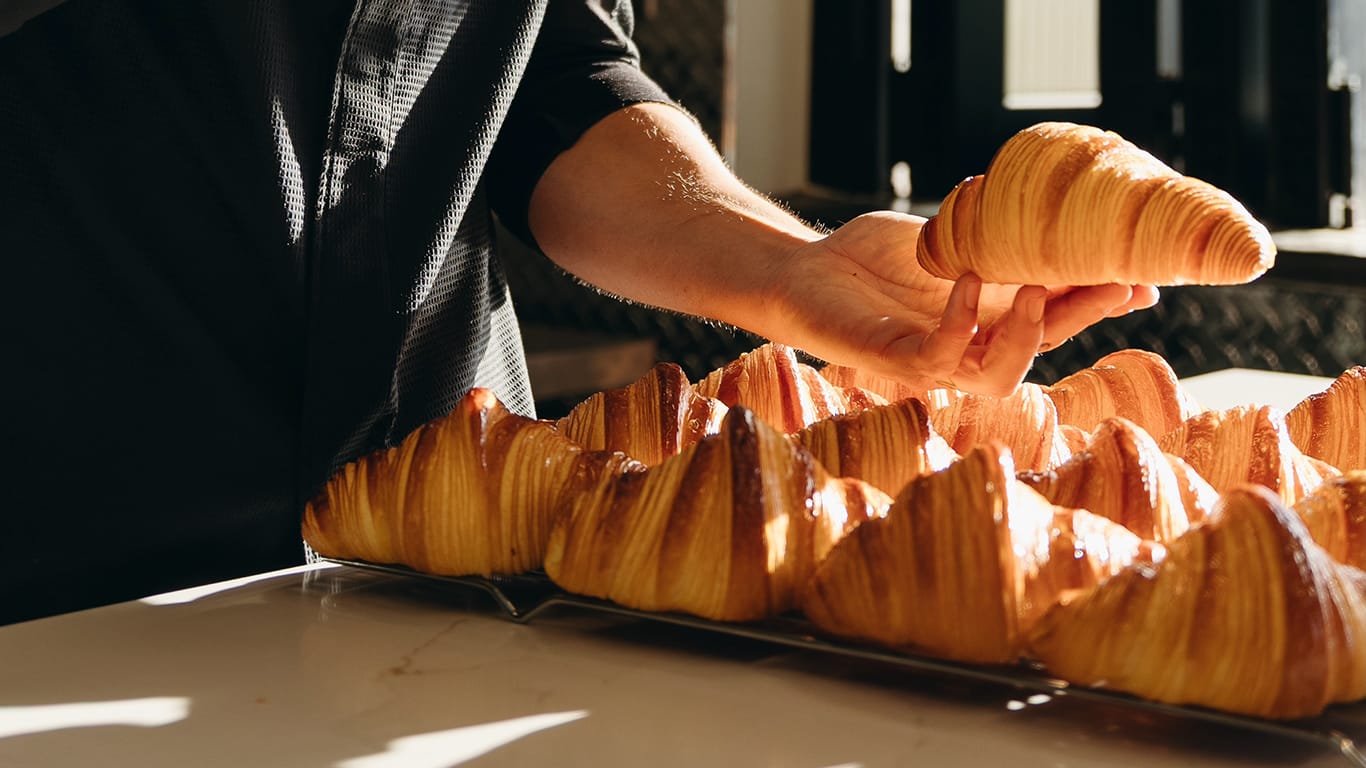
Clad in a black baker’s uniform in his Sable Boulangerie, William Porter proudly reveals his tattoo.
“Elegance” is inked in cursive across his fingers.
He got it in Paris, a reminder to slow down. “I’m a naturally very anxious person and rushing is never the answer,” he said.
It’s a philosophy baked into every layer of Sable’s pastries at Sable, located in a tiny walk-up building next to Downtown Gilbert’s Liberty Market.
“If it’s not perfect, we throw it away,” he said.
DEEPER DIVE: Abandoned North Phoenix project gets new life as $190 million sports complex
INDUSTRY INSIGHTS: Want more news like this? Get our free newsletter here
The Gilbert native has studied culinary arts in France and worked in Dubai. But the pastry chef is bringing his sweet treats home with Sable Boulangerie, which opened May 13.
He calls Sable Boulangerie, his tiny, hyper‑focused pastry lab — not a proper kitchen.
Porter doesn’t have French lineage; he just followed a gravitational pull toward laminated dough that arrived when he was barely 20.
“This whole career… is just one of those things that happens in the world where someone just connects with what they’re supposed to do,” he said. “I found it completely authentic and natural.”
Porter grew up 5 minutes from his new storefront. He went to Phoenix Country Day School, then Tufts University in Boston, before returning to Arizona to work with his family.
But the gravitational pull toward pastry kept getting louder. He spent his early twenties baking at home, falling deep into the world of French technique, especially laminated doughs. “I got really, really invested, specifically in laminated pastry, like croissant things with French butter,” he said.

The obsession escalated. He enrolled at ENSP — École Nationale Supérieure de Pâtisserie, a historic pastry school housed in a refurbished château in Yssingeaux, France. Then came Paris, where he worked for multiple chefs, including the globally known Cédric Grolet. “He’s very, very, very famous,” Porter said.
From there, Dubai — a high‑pressure pastry post inside the Burj Al Arab, a hotel so exclusive “it’s almost only the royal family who stays there.”
But the job wasn’t the right long‑term fit. And Porter already knew where his first shop needed to be.
“This is a grit business,” he said. “It’s a lot of labor. It’s not something you can do from your computer.”
He needed family, friends, and a community who would understand what he was trying to build: a small, French‑style pastry house that doesn’t cut corners, rush proofs, or compromise on ingredients.
He and one other employee produce every item by hand, starting in the middle of the night. Dough is mixed, laminated, shaped, proofed, and baked all within hours. “At 8 a.m., we have a finished croissant, all in the same day,” he said.
The menu is intentionally small. His signature item isn’t the croissant — it’s the pain au chocolat, the most technically demanding pastry he makes. “In my heart, it’s always going to be the chocolate croissant because it’s by far the most difficult to make.”
He breaks down the flaws he sees in typical American versions: under‑proofed dough, meaty centers, broken exterior layers that peel away in the oven. “We don’t want the customers to be ripped off artistically,” he said. “They’re coming to have their minds changed.”
Every bag of flour at Sable comes from a single French mill — Antoine, a product Porter said had not previously been imported to the United States. “We’re now a pioneer of that,” he said. “I particularly love the flour that comes out of this mill. We had to have it.”
Importing it required FDA nutrition labels, customs forms, logistics planning, and the patience to wait for a shipping container to fill before the boat could even leave port. “They’ll just say, ‘Well, the boat is in the ocean, but the boat’s not leaving.’ And you say, ‘Do you know when it’s going to leave?’ ‘No idea.’”
The flour’s T55 classification — its ash content, protein level, elasticity, and resistance — is the backbone of his croissant structure. Porter and his team ran 24 to 30 dough tests in Gilbert to adapt the formula to American ingredients, humidity, and even the citric acid found in U.S. whole‑egg products. “Things don’t react the same in America as they do in Europe,” he said.
Porter, admittedly, worries about the operational details — the flow of the line, the number of folded to‑go boxes, the speed at which two people can serve a crowd — but not the products.
“We’re going to put on a good show for as long as we can,” he said.