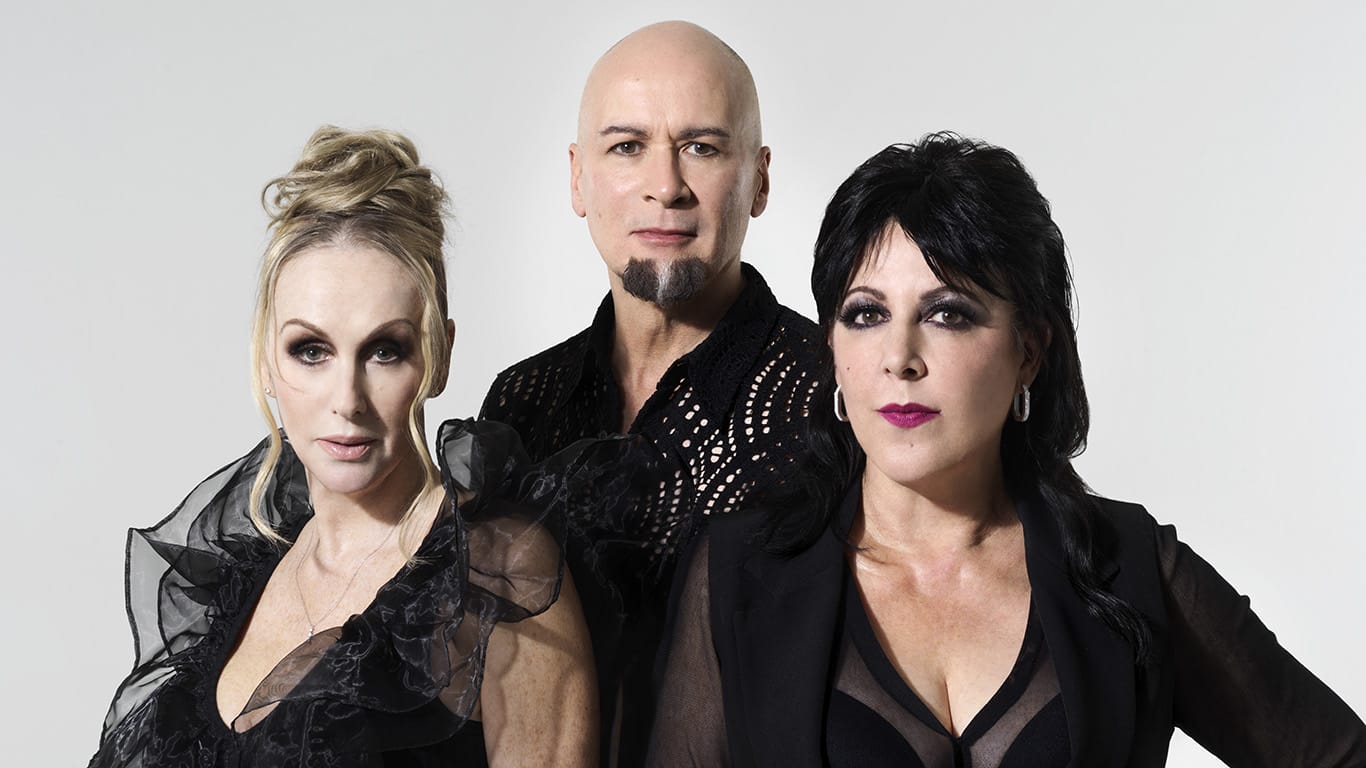
The Human League’s story has been a study in contrasts. The Sheffield, England, act brought icy electronic textures and warm, unmistakably human voices to the charts.
Their global fame was built on the shoulders of two Sheffield schoolgirls who never considered becoming pop stars. They weren’t trained dancers or powerhouse vocalists. But, they walked into pop history.
Nearly 50 years later, The Human League is covering major music magazines. The band — with the help of Alison Moyet and Soft Cell — is selling out venues across the States, too, including the Hollywood Bowl. The three acts play at the Mesa Amphitheatre at 6:30 p.m. Saturday, June 13.
Atop the set lists are the landmark “Don’t You Want Me?”, the ballad “Human” and the upbeat, pulsating “(Keep Feeling) Fascination.”
The Human League’s “Generations U.S. Tour” is proving that Susan Ann Sulley, Joanne Catherall, and Philip Oakey are wanted.
“We were just ordinary girls from a school in Sheffield,” Sulley said. “We didn’t have the most amazing vocal talent… but I think that made people think, if they can do it, why can’t we?”
DEEPER DIVE: Read all the Ranking Arizona Top 10 lists here
INDUSTRY INSIGHTS: Want more news like this? Get our free newsletter here
A love of music
Sulley grew up to the sounds of Mario Lanza, Shirley Bassey, Andy Williams, Perry Como and Barry Manilow.
“[My parents] weren’t musical at all,” she said of her parents. “They just loved listening to music.”
She attended her first concert, Alvin Stardust, after winning tickets in a Sheffield newspaper. Her first “proper” concert was the Bay City Rollers, and she was hooked.
Decades later, she and her husband built a music room in their garden and returned to vinyl and CDs. “It’s fabulous,” she said. “Physically putting something into or onto a machine… I don’t know if it’s nostalgia, but we’re certainly enjoying it.”
Making its mark and its return
The Human League is considered a pioneer of experimental electronic music.
Since 1978, The Human League has released nine studio albums, including the multi-platinum-selling “Dare,” four EPs, over 30 singles and several compilation albums. They have had five albums and eight singles in the U.K. Top 10, two U.S. No. 1 singles, and have sold more than 40 million records worldwide.
Then the COVID-19 pandemic slammed the brakes on the world. Suddenly, everyone was reevaluating their lives, sorting out what mattered and what didn’t. For many bands, it was a sobering stretch, as they feared their touring days were over. When that fear lifted, and The Human League began touring again, Sulley realized how much she appreciated her career and her fans.
“Every night on that tour I cried,” she admitted. “It wasn’t just that people had come to see us. It was that they’d got out of their homes and were doing something social again.”
This sentiment reshaped the way she sees the work. After decades on the road, the band still approaches every show like a privilege, not a routine.
“It’s the most amazing job in the world,” Sulley said. “Music jolts a memory in you, and when you put that on people’s faces, it’s wonderful. It’s sad as well. People go through heartbreak or loss or whatever. Then our songs remind them of that as well.”