Picture your team stepping off the plane, firing off one last slide over fast Wi-Fi, then strolling into a palm-framed breakout space. That friction-free journey—and the instant inspiration it sparks—is why the top corporate retreat locations in Mexico keep winning budgets. Cvent’s 2026 index, drawn from more than $20 billion in live RFPs, puts Cancún/Riviera Maya at No. 1 in Latin America, with Los Cabos and Playa del Carmen close behind. And 70 percent of event professionals expect in-person events to rise in 2026. This guide spotlights ten destinations that balance reliability with fresh appeal.
How we ranked the top corporate-retreat locations
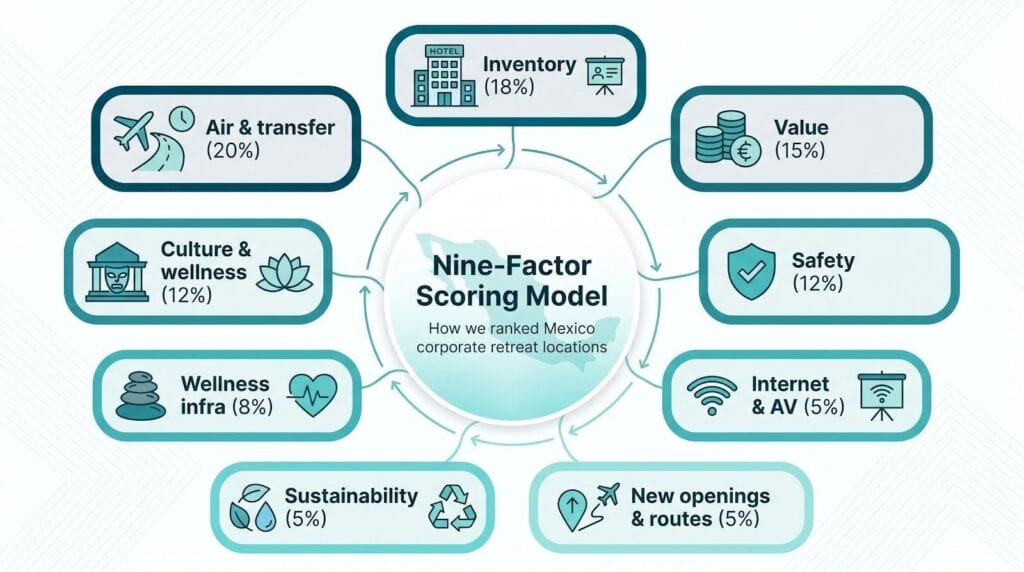
We scored each destination on nine weighted factors so you can make true side-by-side comparisons:
| Criterion | Weight |
| U.S. air access + transfer time | 20 % |
| Hotel & meeting inventory | 18 % |
| Value and budget predictability | 15 % |
| Cultural, outdoor & wellness depth | 12 % |
| Safety & operational resilience* | 12 % |
| Wellness / recovery infrastructure | 8 % |
| Internet & AV reliability | 5 % |
| Sustainability & CSR credibility | 5 % |
| New hotels or air routes by 2027 | 5 % |
*Safety scores reference the U.S. Department of State advisory dated May 29, 2026 (travel.state.gov)
Key budgeting notes: nightly price bands are single-occupancy, per person. All-inclusive markets roll standard meals and drinks into the rate, while urban or boutique markets use a full-program equivalent that adds typical breakfast, lunch, and dinner costs. Airfare figures are snapshot planning anchors. Confirm live fares and flight frequencies before you set dates.
Finally, treat this ranking as a decision framework, not gospel. Airline schedules change, hotels slip opening dates, and advisories update. Re-check the hard facts 30–60 days before you issue an RFP to keep your retreat on time and on budget.
The quick-scan comparison table
Finance often wants the short answer; this grid delivers it at a glance.
| Rank | Destination | Best for | Score | Budget (USD, pp per night*) | Ideal group size | Main airport | Transfer time | Prime season | Top risk |
| 1 | Cancún & Costa Mujeres | 100–1,000-person all-inclusive scale | 88.3 | $300–$450 AI | 50–1,000+ | CUN | 15–45 min | Jan–Apr | Sargassum; spring-break vibe |
| 2 | Riviera Maya | Wellness + adventure mix | 87.1 | $325–$550 AI | 30–1,000 | CUN | 35–75 min | Jan–Apr | Long walks; seaweed |
| 3 | Los Cabos | Executive incentives; West Coast lift | 83.8 | $450–$700 AI | 30–500 | SJD | 25–60 min | Oct–May | Non-swimmable beaches |
| 4 | Puerto Vallarta | Culture-plus-beach value | 80.3 | $250–$425 AI | 30–500 | PVR | 10–35 min | Nov–Apr | State-advisory nuance |
| 5 | Mexico City | Strategy & global teams | 79.3 | $300–$475 FPE | 20–500 | MEX | 20–75 min | Mar–May; Oct–Nov | Traffic; altitude |
| 6 | Riviera Nayarit | Luxury, “new but proven” | 78.2 | $500–$900 AI/FPE | 20–250 | PVR / TPQ | 35–90 min | Nov–Apr | Long transfers; high rates |
| 7 | Tulum | Boutique wellness; creatives | 75.3 | $350–$650 AI/FPE | 15–100 | TQO / CUN | 35–120 min | Dec–Apr | Airport split; Wi-Fi |
| 8 | Mérida & haciendas | Culture + budget control | 75.2 | $250–$400 FPE | 20–150 | MID | 20–45 min | Nov–Feb | Heat; limited flights |
| 9 | San Miguel de Allende | Intimate leadership escapes | 73.6 | $350–$600 FPE | 20–150 | BJX / QRO | 75–100 min | Feb–May; Oct–Nov | Cobblestones; weddings |
| 10 | Oaxaca City | Culinary & maker labs | 72.6 | $250–$425 FPE | 15–100 | OAX | 20–35 min | Jan–Apr; Oct–Nov | Festival compression |
*AI = all-inclusive; FPE = full-program equivalent (room + standard meals).
Scores come from our nine-factor model; confirm flight schedules and hotel rates before contracting.
1. Cancún & Costa Mujeres: best overall for scale and smooth logistics
Why it works
Cancún wins on simple math: more flights, shorter transfers, and the hemisphere’s largest all-inclusive inventory. Cancún International Airport handled 29.3 million passengers in 2025 and connects to 100+ cities, making it the busiest Latin-American hub for international traffic. Most resort zones sit 15–45 minutes from the curb, so teams reach check-in quickly.
That friction-free arrival, plus deep room blocks, lifted Cancún/Riviera Maya to No. 1 on Cvent’s 2026 Latin America meetings index, the only market in the region above the 80-point mark.

For venue-level specifics, Team Retreats keeps a running breakdown of corporate retreat locations in Cancun; scan it against the essentials below.
- Hotel Zone: quick-hit programs near nightlife
- Costa Mujeres: privacy, wellness, and newer builds (e.g., SHA Mexico, opened 2024)
- Airport corridor: mega all-inclusive properties suited to convention-scale agendas
Short transfers cut attrition risk, a deep DMC bench absorbs last-minute shifts, and steady renovations keep the product fresh without start-up uncertainty. With 150+ rooms, an all-inclusive rate finance approves, and every U.S. time zone inside four flight hours, Cancún—and its Costa Mujeres neighbor—remains the lowest-risk big-bet option.
2. Riviera Maya: best for activity-rich wellness programs
Riviera Maya is Cancún’s adventurous sibling. Land at the same airport, then in 30–75 minutes swap boulevard buzz for mangroves, cenotes, and Maya ruins. The corridor’s density of experiences lets planners run a morning strategy block, break for a guided cenote swim, and regroup under palm-thatched pavilions without loading a bus.
Playa del Carmen anchors the route with walkable nightlife and big-meeting hardware at properties such as Fairmont Mayakoba (401 rooms; event capacity ≈1,000). Farther south, Puerto Morelos offers reef access, while the Kanai enclave—home to Etéreo-Auberge (opened 2022) and St. Regis Kanai (opened 2023)—caters to ultra-luxury buyouts. Wellness threads through it all: ice-bath circuits, sleep-coaching menus, and full-service recovery spas after jungle zip-lines.
Budgets sit a notch above Cancún at $325–$550 per person, per night for three-night programs (single occupancy, all-inclusive). Longer transfers call for arrival buffers and golf-cart shuttles for spread-out resorts. Plan a seaweed fallback too: sargassum peaks April–June, so secure terrace or rooftop spaces with ocean views but no sand required.
3. Los Cabos: best for premium executive and incentive programs
Los Cabos is designed for board-level impact: desert peaks tumble into sapphire water, and polished five-star lobbies sit just 25–60 minutes from the jet bridge. That blend helped Cabo San Lucas earn No. 4 on Cvent’s 2026 Latin America meetings index.
Rates are premium, $450–$700 per person, per night (single occupancy), yet the payoff is white-glove execution. Grand Velas Los Cabos provides 307 suites and 16,300 sq ft of indoor meeting space, enough for 300-person sales rallies, while Four Seasons Resort Cabo del Sol stages private cliff-side dinners tailored for board approvals (capacity ≈150).
Key planning notes
- Season: Target October–May; shift just outside peak holidays to trim ADR while keeping sunshine.
- Ocean access: Most corridor beaches are unsafe for swimming, so schedule sailing regattas or whale-watch cruises instead of free-swim breaks.
- Experiences: Desert ATV rallies, farm-to-table dinners in the huerta, and hydrotherapy circuits keep the “reward” half of work-reward credible.
Plan well, and Los Cabos delivers five-star service with minimal friction, exactly what executive teams expect when the budget allows.
4. Puerto Vallarta: best culture-and-value beach combination
Puerto Vallarta layers colonial streets onto a modern resort canvas. Art-lined cobblestones sit five minutes from ocean-view ballrooms, and nightly rates hover at $250–$425 per person, enough to promise quality while sparing the CFO. Teams rise to Pacific sunrises, fuel strategy sessions with café de olla in the Old Town, and wrap the day on a private catamaran across Banderas Bay.
For logistics, Hotel Mousai (145 suites; capacity ≈500) and Garza Blanca (165 suites) lie about 10 minutes from PVR, so flight delays rarely disrupt agendas. Step beyond the gate to browse galleries, sample birria, or catch sunset on the Malecón—an authenticity-per-minute ratio few rivals deliver.
Safety note: the U.S. State Department lists Jalisco as “Reconsider Travel,” yet specifically exempts Puerto Vallarta and the resort corridor north to Nayarit (travel.state.gov). Flag that nuance for risk teams and book vetted transport routes; you will clear approvals without stretching the budget—or the mariachi.
5. Mexico City: best for global teams and strategy deep dives
Mexico City feels like a think tank wrapped in 700 years of history. Benito Juárez International Airport (MEX) handled 44.6 million passengers in 2025 and offers nonstop links to five continents, giving global teams an easy rendezvous point. Inside the city, the Polanco district provides more than 200,000 sq ft of meeting space across top hotels such as InterContinental Presidente (700 rooms; ballroom for 1,500) and Hyatt Regency (755 rooms; ballroom for 1,300).
Budgets land in the $300–$475 per person, per night full-program range. Splurge on private dinners in renovated mansions or after-hours museum tours, and skip resort-fee creep. Between sessions, attendees can explore Frida Kahlo’s Casa Azul or sample tacos at Mercado Coyoacán, then regroup in high-ceiling salons back in Polanco.
Planning tips
- Altitude: 7,350 ft; schedule lighter first-day agendas.
- Traffic: Book off-peak arrivals and cluster sessions by neighborhood; add ride-share buffers.
- Season: March–May and October–November balance weather and rates.
Master these logistics and Mexico City returns intellectual spark, culinary depth, and the backbone of a true global hub.
6. Riviera Nayarit: best emerging luxury destination
Picture Cabo-level pampering framed by jungle cliffs and hidden coves: that’s Riviera Nayarit. Punta Mita entered Cvent’s 2026 Latin America top-10 meeting destinations at No. 10, while the Rosewood Mandarina opened in May 2025, two milestones that confirm the region’s luxury-event readiness.
Budgets match the cachet at $500–$900 per person, per night (single, AI/FPE). Full buyouts at One&Only Mandarina (105 keys) or Naviva, a Four Seasons resort (15 tents) sit at the top of that range. Transfers run 35–90 minutes from Puerto Vallarta (PVR); welcome VIPs with expedited customs and chilled towels. Volaris launched an LAX–Tepic (TPQ) route in July 2025, which can cut road time; confirm schedules in a GDS before you brief clients.
The payoff is privacy and prestige: dawn surf lessons at Sayulita, Huichol bead workshops after lunch, and sunset strategy circles on cliffside decks. Room blocks cap near 200 keys, making Riviera Nayarit perfect for senior leadership programs where confidentiality and low-profile service matter more than ballroom acreage.
7. Tulum: best for boutique wellness and creative teams
Tulum is no longer a boho secret. Felipe Carrillo Puerto International Airport (TQO) opened in late 2023 and gained daily JetBlue service from JFK in June 2024, sparing small groups the three-hour Cancún van ride.
Budgets sit in the $350–$650 per person, per night range, driven by boutique supply such as Nômade Tulum (68 rooms; event capacity ≈150) and Papaya Playa Project (85 units; multiple beachfront venues). Properties top out near 100 guests, ideal for tight-knit product squads or wellness-focused leadership circles that crave barefoot luxury while still needing fiber-optic bandwidth.
Expect nature to steal the show: sunrise breath-work in a private cenote, afternoon design sprints under palapa roofs, and sunset sound baths as the Caribbean shifts to indigo. Verify your tech stack; power flickers happen and Wi-Fi claims vary. Choose one arrival point, either TQO or CUN, and enforce it so your DMC is not chasing stragglers on Highway 307.
Finally, vet green credentials. Confirm wastewater treatment, turtle-nesting protocols, and community partnerships before approving any eco marketing. With those checks in place, Tulum delivers the mindful intensity that sparks breakthrough thinking.
8. Mérida & the Yucatán haciendas: best under-covered cultural and value choice
Mérida trades oceanfront for authenticity. The colonial capital sits 90 minutes west of Cancún by air connection yet feels a world apart, with pastel mansions, tree-lined boulevards, and plazas pulsing with trova music. The U.S. State Department lists Yucatán State at Level 1 (“Exercise Normal Precautions,” May 29 2026), the safest rating among our ten picks. Mid-week programs typically cost $250–$400 per person, per night, welcome relief for budget-pressed retreats.
Most groups split the agenda: hold plenaries at Hyatt Regency Mérida (289 rooms; ballroom for 600), then decamp to a restored henequén hacienda—Chablé Yucatán (40 casitas) or Hacienda Xcanatún (54 suites)—for Maya-chef workshops or sunset cenote swims. Transfers run 20–45 minutes, so schedules stay intact.
Plan for heat; March–May often tops 100 °F. Favor November–February, and use shaded courtyards if you meet off-season. Airlift is thinner than CUN, yet MID offers daily nonstops from Houston and Miami, plus seasonal Dallas service. West-Coast access usually means chartering through Cancún and private coaches.
Against the beach giants, Mérida delivers lower costs, deep storytelling, and fewer brand-name distractions—an authentic backdrop that lingers long after the slide decks fade.
9. San Miguel de Allende: best intimate leadership retreat
San Miguel wraps executive priorities into a walkable, high-altitude UNESCO core. Baroque churches, rooftop bars, and artisan studios sit within a 10-minute stroll, so sessions flow without shuttle herding.
- Live Aqua Urban Resort offers 153 rooms and a 9,500-sq-ft ballroom (up to 700 theatre); Rosewood (67 rooms) and Numu (44 rooms) suit smaller C-suite pods.
- Budgets land in the $350–$600 per-person, per-night full-program range.
- Access: fly into León (BJX) or Querétaro (QRO), then plan 75–100-minute highway transfers; book one arrival window and luxury sprinters to cut fatigue.
Guanajuato State carries a “Reconsider Travel” advisory, yet vetted routes and daylight transfers keep risk teams comfortable. Wedding demand can choke weekend inventory, so mid-week blocks secure rooms and quieter plazas. With those tactics, San Miguel turns a routine offsite into a leadership retreat that resonates long after the agenda ends.
10. Oaxaca City: best for culinary and maker-driven creativity
Oaxaca ignites the senses. Mole-negro aromas drift through 17th-century markets, mezcal maestros share family secrets in hidden courtyards, and Zapotec weavers lay out color palettes that inspire rebrands on the spot. For creative teams and purpose-led nonprofits, that stimulus turns into fresh thinking faster than any whiteboard exercise.
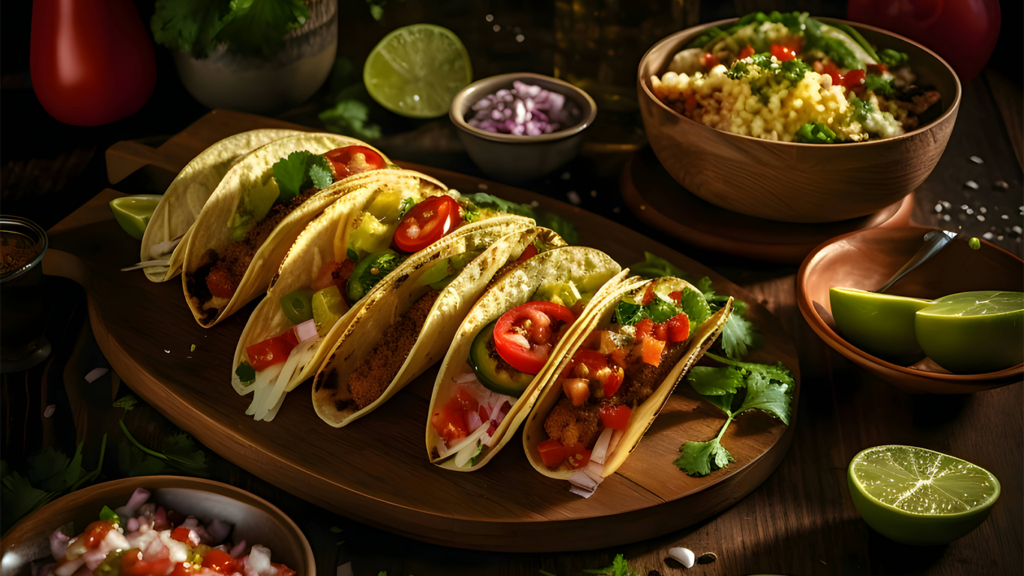
Budgets stay friendly at $250–$425 per person, per night because the city swaps resort premiums for boutique charm. Quinta Real Oaxaca (91 rooms; colonial ballroom for 400) anchors larger groups, while Grand Fiesta Americana Oaxaca (144 rooms) handles overflow without sacrificing authenticity. Groups above 100 guests often split across multiple properties, so smaller cohorts capture the biggest benefit.
Air access is the constraint. The U.S. State Department lists Oaxaca State at Level 2 (“Exercise Increased Caution”) but notes no restrictions on Oaxaca City. Nonstop U.S. flights remain limited, so most attendees connect through Mexico City or Houston. Add arrival buffers, and keep programming inside the walkable historic core to avoid protest-related traffic snarls that appear a few times each year. Skip Guelaguetza (late July) and Day of the Dead (late October / early November) unless those festivals are mission-critical; rooms disappear months out and rates double.
With those caveats covered, Oaxaca delivers culture-driven ROI. Attendee surveys spike on authenticity, CSR boxes get ticked through indigenous-owned suppliers, and brainstorms absorb the city’s fearless use of color and spice.
Conclusion: Which Mexico Destination Fits Your Team?
Rank each destination against your own priorities using the prompts below. Run through them in order and you’ll land on a shortlist in under two minutes.
Need at least 100 rooms?
Choose Cancún, Riviera Maya, Los Cabos, or Mexico City; their airports handle bulk arrivals and their resorts keep everyone under one roof.
Hosting senior leadership or top-tier incentives?
Los Cabos leads for polished luxury, followed by the privacy of Riviera Nayarit. Pick San Miguel when culture outweighs ocean views, or Mexico City when global lift and branded hotels matter most.
Wellness is the core goal?
Riviera Nayarit’s jungle spas sit on top, with Tulum close behind for boutique breath-work and cenote immersion. Riviera Maya completes the trio thanks to large resorts that now offer sleep-science suites and nutrition labs.
Working to stretch the budget?
Start with Puerto Vallarta, Mérida, and Oaxaca. Airfare stays reasonable, and nightly rates often land below $400 single while still delivering market tours, hacienda cook-offs, or Old-Town art walks.
Need to minimize travel hours?
For East-Coast teams: Cancún, Riviera Maya, Tulum, or Mexico City. West of Denver: Los Cabos and Puerto Vallarta cut flight time. Central teams enjoy near-equal access to almost every destination above.
Cross-check these answers with the comparison table and you’ll have a data-backed shortlist ready for RFPs.
2027 planning trends to watch
Retreat playbooks evolve fast. These five shifts already shape 2027 RFPs, so review them before you lock dates or contracts.
1. New and renovated properties
Press-release hype is not usable inventory. Confirm projected opening date, current construction status, and whether the sales team is quoting group rates.
- Cancún / Costa Mujeres: Thousands of rooms in the airport corridor and north-shore mega-resorts are due online; several convention-scale all-inclusives are already taking Q4 2026 holds at sub-$350 ADR.
- Kanai, Riviera Maya: Major phase finished December 2025 with new St. Regis and Etéreo flags, cenote access, and third-party sustainability audits.
- Los Cabos: Upgrades over volume; Grand Velas added a 16,000-sq-ft ballroom in 2026, and Four Seasons Cabo del Sol reopened its spa wing and is quoting 2027 programs.
- Riviera Nayarit: Rosewood Mandarina (134 keys, opened May 15 2025) keeps adding residences that convert to breakout or VIP suites.
- Mérida: A 50-room boutique hacienda conversion is slated for mid-2027, per Yucatán Tourism Board briefings.
Rule of thumb: ask for a formal opening certificate, or a letter that guarantees availability, before you sign attrition clauses.
2. Air-route changes
Routes launch, pause, then relaunch. JetBlue’s JFK–Tulum service began June 13 2024, while Volaris added an LAX–Tepic route in July 2025. Pull live data from OAG or your GDS when you write the RFP and again 90 days out. Add a route-cancellation clause for charter partners.
3. Wellness goes performance-oriented
Productivity now headlines the spa menu: biometric sleep labs, anti-inflammatory tasting menus, cold-plunge circuits, and cortisol-reset breathwork. SHA Mexico, Costa Mujeres (opened 2024) offers executive-longevity consults; Grand Velas Los Cabos pipes wearable-data summaries into post-event reports. Request staffed sleep clinics, certified nutritionists, and Wi-Fi-enabled quiet zones; finance approves when wellness outputs measurable ROI.
4. Sustainability reporting moves from slogans to numbers
Auditors expect CO₂, water, and waste data. Ask for certification letters, monthly water-use ratios, supplier-origin lists, and carbon statements for transfers. Include those metrics in the post-event deck and next year’s budget approval becomes easier.
5. Budget pressure: shorter schedules, higher expectations
Average incentive spend rose only four percent, yet attendee expectations jumped. Programs now compress from five nights to three; gifting trims; single occupancy becomes the focus-friendly norm. Front-load a signature local immersion on arrival day, keep open blocks for free exploration, and negotiate value-adds (waived resort fees, upgraded bandwidth) instead of headline discounts.
Use these five checkpoints as a pre-RFP filter and your 2027 retreat will launch on solid footing with fewer delays, route gaps, or budget surprises.
Corporate-retreat planning checklist for Mexico
Before you issue the RFP
Lock these five basics in one cross-functional meeting; every proposal will arrive apples-to-apples instead of fruit salad.
- Right-size headcount. Confirm single-occupancy needs and whether spouses or contractors are invited.
- Map attendee origins. Plot home airports to see which destinations cut total travel hours.
- Set a transfer ceiling. Agree on a maximum, say 60 minutes, so stunning resorts two hours away do not waste your time.
- Rank objectives. Decide the split among strategy, culture, and reward; that ratio drives venue style and AV spend.
- Define safety & accessibility. Align on acceptable advisory level, hospital proximity, and ADA requirements before anyone falls in love with a tree-house suite.
Questions for every hotel
- Available room block (not total keys) for your dates?
- Is meeting space complimentary with that block?
- Exact F&B minimums and outside-vendor surcharges?
- Dedicated internet lines and an onsite backup ISP?
- Property map with walking times between rooms and breakout space?
- Renovation schedule touching 2027 dates?
- Dietary protocols the kitchen can support?
- Sheltered outdoor space for weather pivots?
- Additional resort or service fees beyond the quoted rate?
- Full accessibility (ramps, elevators, compliant guestrooms)?
Questions for the DMC
- Airport staffing plan (bilingual greeters, live flight tracking)?
- Vehicle types and luggage capacity per run?
- Twenty-four-hour backup plan for diversions or curfews?
- Proof of liability insurance and vendor vetting?
- Real-time monitoring for weather or protests; who triggers reroutes?
- Nearest English-speaking clinic and medevac options?
- Cancellation terms for excursions cut by storms or sargassum?
- Ability to supply carbon and community-impact data for ESG reports?
A DMC that answers these points confidently becomes your risk shield.
Contract protections
- Attrition & rebooking windows. Sliding penalties tied to pick-up, not flat percentages.
- Named-storm & force majeure. Deposits roll forward if hurricanes close airports.
- Currency treatment. Lock exchange rates or cap variance; peso swings can eat 5 percent of spend overnight.
- Renovation disclosure. Walk if jackhammers fire during plenary.
- Route-change safeguard. If airlines drop the nonstop you need, transport costs should not spike on your budget.
- Service-level guarantees. Minimum bandwidth and AV response times in writing.
- Data-privacy & sustainability addenda. Confirm GDPR-equivalent compliance and require monthly water-use or waste metrics for ESG filings.
Sign with these shields up and even worst-case scenarios leave you with options, not headaches.
Frequently asked questions
What’s the easiest Mexico destination for a U.S. corporate retreat?
Cancún. Multiple U.S. hubs fly nonstop, transfers rarely exceed 45 minutes, and its all-inclusive inventory handles 50–1,000 guests without heroic logistics.
How much do we budget per attendee?
Plan on $1,000-3,000 per person for a three-night program before airfare.
Team Retreats benchmarking data from more than 200 Mexico retreats shows typical three-night costs of $1,900-2,500 in Cancún, $1,300-2,000 in Los Cabos, and $1,200-1,800 in Puerto Vallarta, which tracks closely with those brackets.
The low end fits Puerto Vallarta or Mérida in shoulder season, while the high end covers Los Cabos or Riviera Nayarit with premium add-ons.
Which destinations can handle 100+ rooms?
Cancún, Riviera Maya, Mexico City, and Los Cabos have the keys and meeting space to keep everyone under one roof.
Is Tulum practical for business events?
Yes, if you cap headcount near 100, choose one airport (TQO or CUN), and verify property-level power and Wi-Fi redundancy.
Which spot scores highest on safety?
Mérida and the wider Yucatán carry a Level 1 (“Exercise Normal Precautions”) advisory. Still use vetted transport, travel-tracking apps, and clear alcohol policies.
When should we avoid Mexico’s Caribbean coast?
Hurricane season peaks August–October; sargassum usually surges April–June. Schedule outside those windows to reduce weather risk.
Do we always pick an all-inclusive resort?
Choose all-inclusive when price predictability and on-property bonding matter most. If your agenda leans on city dining or off-site culture, a full-program equivalent often delivers better value.
How early do we book?
Secure venues 12–18 months out for 100-room blocks or peak dates. Smaller groups in major markets can succeed on six months’ notice, but last-minute airfares erase most savings.
What paperwork do U.S. attendees need?
A passport valid six months beyond travel dates. Visa-exempt stays cover most business meetings, yet confirm current rules close to departure.
Why push site inspections?
A single walk-through reveals layout flaws, cell-signal dead zones, and renovation timelines that photos hide. The scout trip costs less than fixing surprises on site.